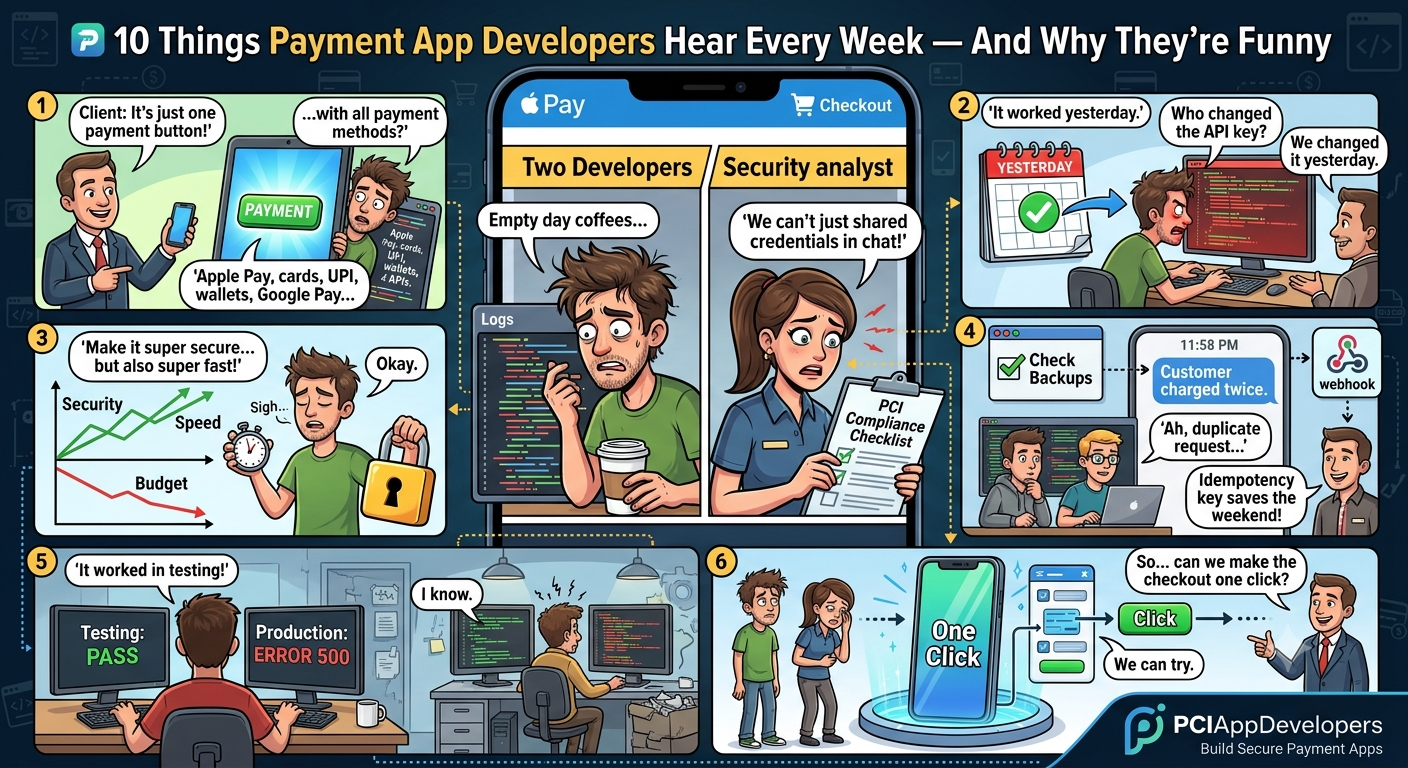
Building a payment application sounds simple.
A customer taps Pay.
The payment goes through.
Everyone goes home happy.
Right?
If only.
Behind that little “Payment Successful” message are developers, APIs, security controls, databases, encryption, testing, compliance requirements, and at least one person asking:
“Why did the payment fail only for this one customer?”
Welcome to the funny side of payment app development.
1. “It’s Just a Payment Button”
Client:
“We only need one payment button.”
Developer:
“Sure. Which payment methods?”
Client:
“Everything.”
Developer:
“Meaning?”
Client:
“Cards, Apple Pay, Google Pay, UPI, wallets, bank transfers, international cards…”
Developer:
“So… one button?”
The button may be tiny.
The architecture behind it definitely isn’t.
2. “The Payment Worked Yesterday”
Few sentences create more excitement for a payment developer than:
“It was working yesterday.”
Developer checks the code.
Everything looks fine.
Checks the database.
Fine.
Checks the payment gateway.
Fine.
Checks the logs.
Nothing.
Checks everything again.
Still nothing.
Then someone discovers that an API key was changed.
Developer:
“And when exactly did you change it?”
Client:
“Yesterday.”
Developer:
Deep breath.
3. The Famous Test Payment
Every payment developer has made hundreds of test transactions.
Test card.
Test payment.
Test refund.
Test failure.
Test timeout.
Test webhook.
Test everything.
At some point, the developer becomes so familiar with test payments that they almost feel emotionally attached to imaginary money.
₹10,000 paid successfully.
Developer:
“Excellent!”
Bank account:
₹0.
Developer:
“Oh right.”
4. “Can We Skip PCI Compliance?”
This is one question payment developers definitely don’t want to hear.
“Can we skip PCI compliance? It’s just an app.”
Unfortunately, payment security doesn’t work that way.
If a system handles payment card data, security and compliance requirements need to be considered from the beginning of the architecture.
That means developers may need to think about:
- Secure payment processing
- Data protection
- Encryption
- Authentication
- Access controls
- Secure APIs
- Logging and monitoring
- Vulnerability management
- Secure development practices
- PCI DSS requirements
So yes…
That little payment button has homework.
5. “The Customer Says They Were Charged Twice”
This message arrives at 11:58 PM.
“Customer says payment was deducted twice.”
Everyone suddenly becomes very interested in logs.
The development team starts checking:
- Transaction IDs
- Webhooks
- Payment gateway responses
- Retry logic
- Database records
- Network timeouts
- Duplicate requests
Eventually:
“Ah. The customer clicked Pay twice.”
Everyone looks at the screen silently.
6. The Webhook Has Entered the Chat
Webhooks are incredibly useful.
They can also create interesting conversations.
Developer:
“We received the payment webhook.”
Backend:
“Great.”
Webhook:
“Here comes another one.”
Backend:
“Why?”
Webhook:
“Because I’m feeling generous.”
Suddenly the system has to handle duplicate notifications without accidentally creating duplicate orders, invoices, or transactions.
That’s why idempotency isn’t just a fancy technical word.
It can save your weekend.
7. “Make It Super Secure… But Also Super Fast”
Client requirements:
Maximum security.
Maximum speed.
Minimum development time.
Minimum budget.
Developer:
“Anything else?”
Client:
“Make it beautiful.”
Of course.
Modern payment applications have to balance security, performance, usability, scalability, and business requirements.
That’s why good payment app architecture matters.
8. When Production Says Hello
Everything works in development.
Everything works in staging.
The team celebrates.
Then production says:
“Hello.”
Suddenly:
- One API behaves differently.
- One payment method fails.
- One customer gets an error.
- One webhook arrives late.
- One database query takes 12 seconds.
Developer:
“But it worked in testing!”
Production:
“I know.”
9. The Password Conversation
Security team:
“You cannot share credentials through chat.”
Developer:
“Absolutely.”
Five minutes later:
Someone sends:
**“API key: ******”
Developer:
“Please delete that message.”
Security:
“I saw it.”
Developer:
“I know.”
This is why secure credential management and proper access controls matter in payment software development.
10. The Ultimate Payment App Question
After weeks of development, testing, security reviews, integrations, and debugging, someone finally asks:
“So… can we make the checkout one click?”
Developer:
“We can try.”
And that’s how another payment technology project begins.
Final Thoughts
Payment app development isn’t only about making transactions work.
It involves security, reliability, payment gateway integration, APIs, authentication, data protection, testing, monitoring, and compliance.
And when card payments are involved, PCI DSS requirements need to be considered as part of the overall payment environment and security strategy.
At PCIAppDevelopers, the goal is to help businesses build payment applications with security and compliance considerations from the beginning—not after the first production incident.
Because a payment application should make customers think:
“That was easy.”
Not:
“Where did my money go?”
And developers should ideally finish the project saying:
“It works.”
Instead of:
“It worked yesterday.”
Comments