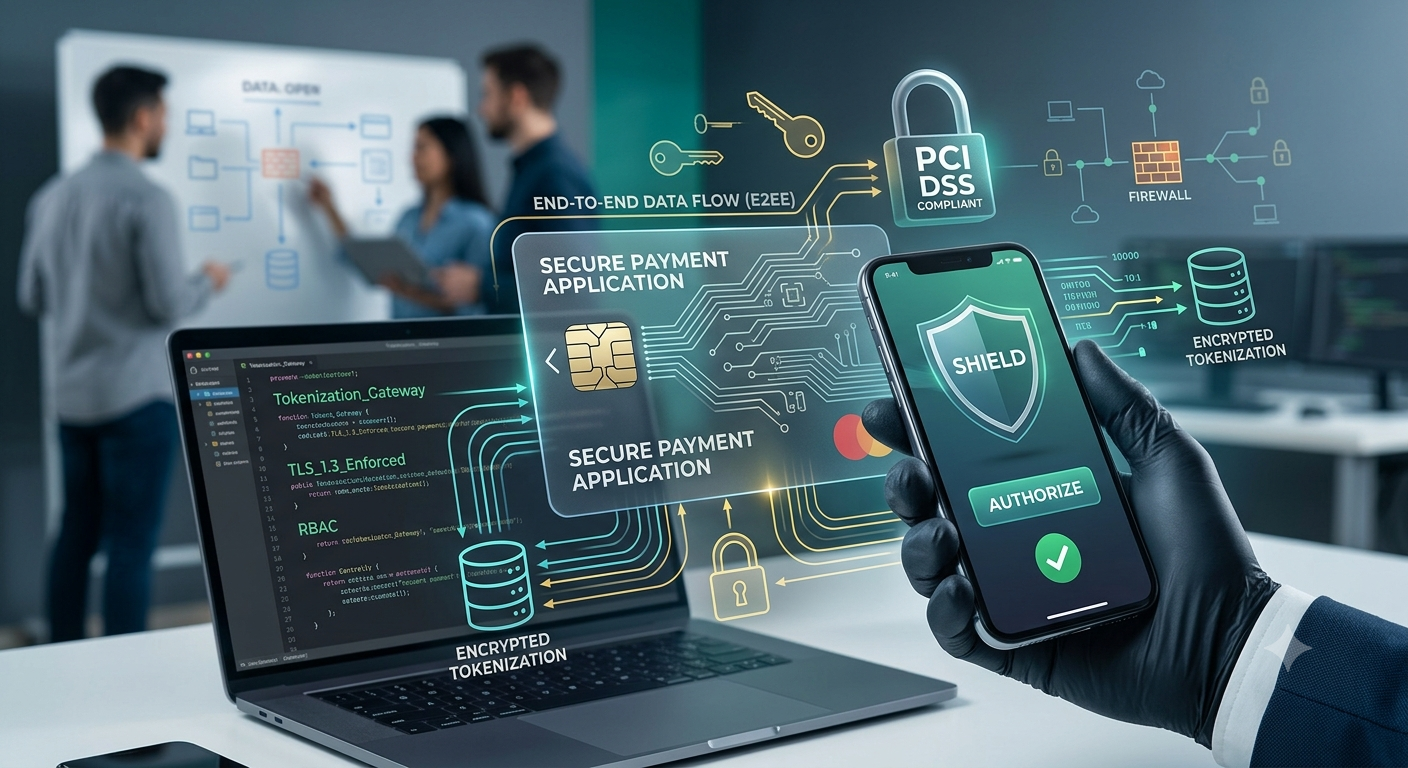
Developing an application that handles cardholder data requires balancing seamless user experience with strict security controls. Non-compliance with the Payment Card Industry Data Security Standard (PCI DSS) can lead to severe financial penalties, data breaches, and loss of merchant processing privileges.
Here is a practical breakdown of how to architect and build a secure, compliant payment application.
1. Minimize Scope with Tokenization and Hosted Fields
The most effective way to simplify PCI compliance is to ensure your servers never touch raw Credit Card Numbers (PANs).
- Use Tokenization: Rely on payment gateways (e.g., Stripe, Braintree) to intercept card details on the client side. The gateway converts sensitive data into a unique token that your backend can safely store and process.
- Implement Hosted iFrames/Fields: Use gateway-provided UI elements to collect card numbers. This isolates sensitive input fields from your DOM, drastically reducing your PCI DSS assessment scope (often down to SAQ A or SAQ A-EP).
2. Enforce End-to-End Encryption (E2EE)
Protect sensitive data both in transit and at rest using modern cryptographic standards.
- In Transit: Force TLS 1.3 (or minimum TLS 1.2) for all network communication. Disable outdated protocols (SSL v3, TLS 1.0, TLS 1.1) and weak cipher suites.
- At Rest: If your system must store cardholder data or sensitive tokens, encrypt it using strong algorithms such as AES-256. Never store Sensitive Authentication Data (SAD)—such as CVV/CVC codes or PINs—after transaction authorization, even if encrypted.
3. Implement Robust Authentication and Access Controls
Unauthorized access to administrative tools or APIs is a primary vector for payment data breaches.
- Multi-Factor Authentication (MFA): Require MFA for all administrative access into the cardholder data environment (CDE).
- Role-Based Access Control (RBAC): Apply the Principle of Least Privilege. Restrict API keys, database access, and system permissions strictly to the components and roles that require them.
- Secure API Keys: Store environment variables and API credentials in encrypted key vaults (e.g., AWS Secrets Manager, HashiCorp Vault) rather than hardcoding them into application repos.
4. Secure the API Layer and Application Code
Payment endpoints are constant targets for automated attacks, scraping, and injection vulnerabilities.
- Input Validation & Sanitization: Enforce strict server-side validation to prevent SQL Injection (SQLi), Cross-Site Scripting (XSS), and Command Injection.
- Rate Limiting & Bot Protection: Apply rate limiting on payment endpoints to block enumeration scripts and brute-force card testing attacks.
- Dependency Auditing: Regularly scan third-party libraries and package dependencies (npm, pip, Maven) for known vulnerabilities using automated tools like Snyk or Dependabot.
5. Comprehensive Logging and Real-Time Auditing
PCI DSS mandates tracking and monitoring all access to network resources and cardholder data.
- Log Critical Events: Capture authentication attempts, privilege escalation, and API calls targeting financial endpoints.
- Mask Sensitive Data: Ensure card numbers, CVVs, and passwords are strictly sanitized and never written to raw server logs or debug traces.
- Centralize and Protect Logs: Route logs to a write-once, read-many central logging system to prevent tampering by unauthorized users.
Comments