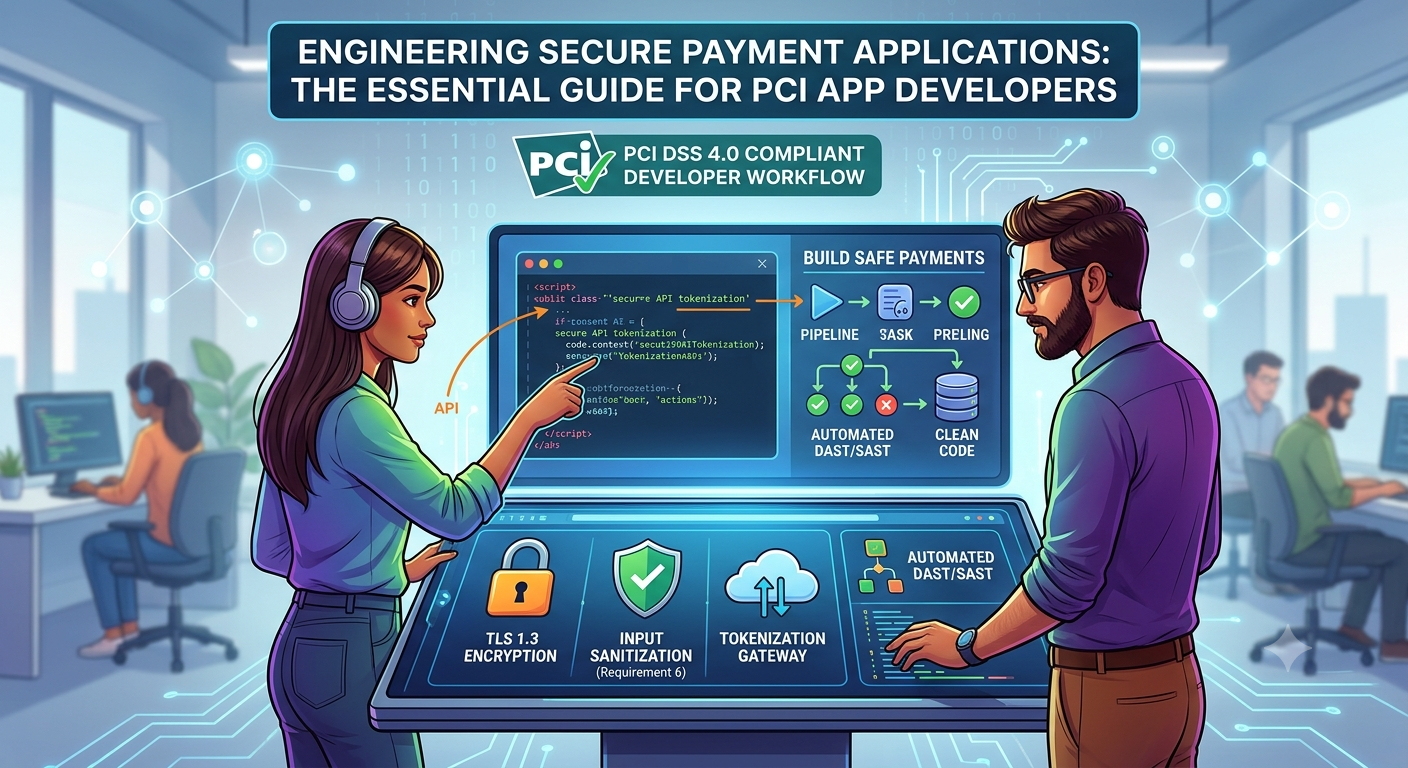
In modern fintech, application security is not an afterthought—it is the foundation of digital payment infrastructure. Whether you are building an enterprise checkout gateway, a custom point-of-sale (POS) platform, or a mobile payment wallet, adhering to the Payment Card Industry Data Security Standard (PCI DSS) is mandatory.
For payment application developers (PCI app developers), compliance is not just about passing annual audits; it is about writing resilient software that protects cardholder data against evolving cybersecurity threats.
Core Principles of PCI-Compliant Application Engineering
| Engineering Principle | Implementation Approach | Compliance Benefit |
| Scope Reduction | Hosted payment fields, iframe injection, and direct tokenization APIs. | Minimizes audit footprint down to SAQ A or SAQ A-EP levels. |
| Cryptographic Standards | Enforce TLS 1.3 for transit; AES-256 for data at rest with key rotation. | Protects sensitive authentication data (SAD) against exposure. |
| Secure SDLC | Automated SAST/DAST pipeline checks, dependency scanning, and input validation. | Satisfies PCI DSS Requirement 6 for application security. |
| Zero Trust Access | Role-Based Access Control (RBAC), API key rotation, and mandatory MFA. | Limits internal system exposure and prevents lateral movement. |
Key Technical Mandates for PCI App Developers
1. Scope Reduction via Tokenization
The safest way to secure cardholder data is to ensure your application server never processes, transmits, or stores raw Primary Account Numbers (PAN) or Card Verification Values (CVV). By utilizing client-side tokenization SDKs or hosted fields:
- Sensitive card numbers are exchanged directly with a secure vault before reaching your backend.
- Your server receives a non-sensitive token used for processing transactions and recurring billing.
- You drastically reduce the complexity and cost of compliance audits.
2. Adhering to PCI DSS Requirement 6 (Secure Coding)
Requirement 6 explicitly dictates how developers must handle code production and deployment. Key development requirements include:
- PAN Masking: Displaying only the first 6 and last 4 digits of a card number on user interfaces or digital receipts.
- Input Sanitization: Enforcing strict schema validation to eliminate SQL Injection (SQLi), Cross-Site Scripting (XSS), and Remote Code Execution risks.
- Credential Hygiene: Eliminating hardcoded secret keys, default administrative passwords, and exposed API tokens from source code repositories.
3. Continuous Vulnerability Management
Security is an ongoing operational workflow rather than a one-time checklist. Development pipelines should integrate:
- Automated Static & Dynamic Scanning: Identifying security flaws in application code before merging into production.
- Dependency Auditing: Regularly patching third-party libraries and open-source frameworks to remediate known vulnerabilities.
- Penetration Testing: Performing regular third-party security assessments on all public-facing API endpoints.
Building for Security and Scale
Integrating PCI DSS compliance directly into your development lifecycle reduces security risks, prevents costly data breaches, and protects user trust. By architecting applications around tokenized workflows, robust encryption, and continuous automated testing, developers can build scalable payment platforms that stand up to modern security threats.
Comments