Digital payments have become an essential part of modern commerce.
Businesses now expect customers to pay through mobile applications, websites, digital wallets, contactless interfaces, and integrated payment platforms. As payment experiences become more convenient, the security requirements behind them also become increasingly important.
For companies developing payment applications, security cannot be treated as a final-stage feature.
It needs to be considered throughout the software development lifecycle.
The PCI Data Security Standard (PCI DSS) provides a baseline of technical and operational requirements designed to protect payment account data. The current PCI DSS documentation is based on PCI DSS v4.0.1.
For developers building payment applications, this means architecture, authentication, data protection, logging, vulnerability management, testing, and secure development practices all need to be considered from the beginning.
What Is a PCI-Compliant Payment Application?
A PCI-compliant payment application is software designed and operated in a way that supports applicable payment security requirements.
Depending on the application’s architecture and role in the payment process, the security scope can vary significantly.
A payment application might:
- Connect customers with a payment gateway
- Process payment transactions
- Integrate with payment terminals
- Support card-not-present transactions
- Connect with digital wallets
- Provide merchant payment management
- Integrate with POS systems
- Process payment-related information
- Communicate with third-party payment providers
The exact PCI responsibilities depend on how payment data flows through the environment.
This is why payment application development should begin with scope and data-flow analysis, rather than simply adding security controls after development is complete.
Why PCI Compliance Matters for Payment App Development
Payment applications operate in an environment where security failures can have serious consequences.
A vulnerable application can potentially expose sensitive payment information, create unauthorized access opportunities, or become a target for attackers.
PCI DSS establishes requirements intended to protect payment account data across the payment environment.
For software developers, PCI considerations can affect:
- Application architecture
- Database design
- API development
- Authentication
- Authorization
- Encryption
- Logging
- Vulnerability management
- Software development practices
- Security testing
- Deployment processes
Security therefore needs to be incorporated into the development lifecycle rather than treated as a final audit checklist.
PCI DSS v4.0.1 and Modern Payment Software
PCI DSS v4.0.1 is the current revision listed by the PCI Security Standards Council.
The revision was created to address stakeholder feedback, correct errors, and clarify requirements and guidance. PCI SSC states that it did not add or remove requirements in the revision.
PCI DSS v4.x also places greater emphasis on security as an ongoing process and provides organizations with greater flexibility in how security objectives can be achieved.
For developers, this reinforces an important principle:
Payment security should be continuous—not something performed only before an application launch.
Start With Payment Data Flow
One of the first steps in developing a secure payment application is understanding exactly where payment information travels.
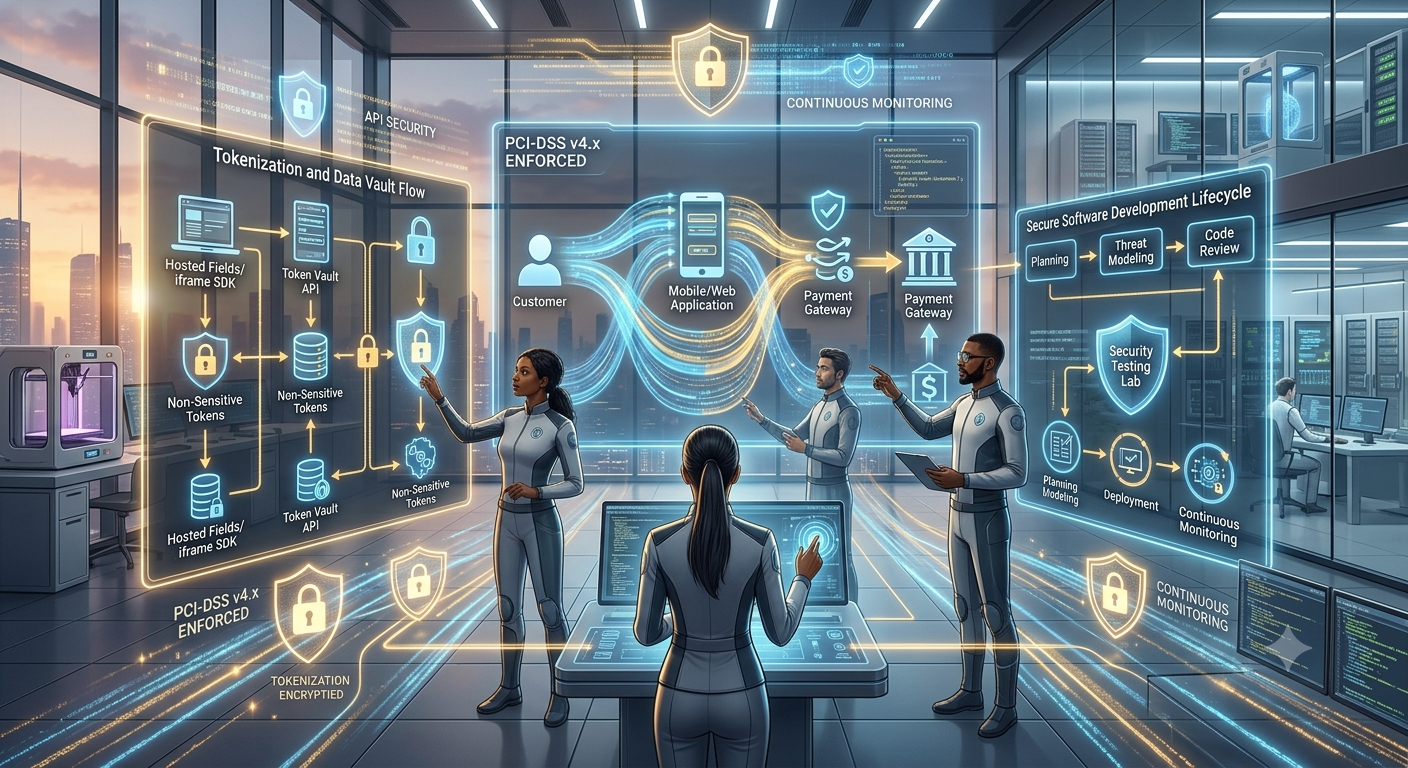
Consider a simplified payment flow:
Customer → Mobile/Web Application → Payment Gateway → Payment Processor → Bank
The application may also communicate with:
Database → Analytics → CRM → Notifications → Merchant Dashboard
Each connection needs to be evaluated carefully.
Developers should determine:
- What payment data enters the application?
- Is payment data stored?
- Where is it transmitted?
- Which systems receive it?
- Which third-party providers are involved?
- Which components can access it?
- What data is logged?
- Which systems are inside the relevant security scope?
A clear data-flow diagram can help identify unnecessary exposure and security boundaries.
Minimize Payment Data Storage
One of the most important architectural decisions is determining whether the application actually needs to store payment card data.
If payment data does not need to be stored, processing architecture can often be designed to reduce the application’s exposure.
Depending on the payment architecture, developers may use payment gateways, tokenization, hosted payment components, or other approaches that reduce direct handling of sensitive payment information.
The appropriate approach depends on the specific payment flow and compliance requirements.
The objective is simple:
Only handle the payment information that the application genuinely needs.
Tokenization in Payment Applications
Tokenization is commonly used in payment environments to replace sensitive payment information with a token.
Instead of repeatedly using sensitive card information throughout an application, the system can work with a token representing that payment credential.
A simplified architecture might look like:
Card Information
↓
Secure Payment Provider
↓
Token
↓
Merchant Application
↓
Future Payment Request
Tokenization architecture can help reduce the amount of sensitive payment information handled directly by an application.
However, developers should not assume that tokenization automatically makes an environment PCI-compliant.
The complete payment architecture, third-party relationships, implementation, and applicable requirements still need to be evaluated.
Secure API Development for Payment Applications
Modern payment applications depend heavily on APIs.
Mobile apps, websites, merchant dashboards, payment gateways, fraud detection systems, and backend services may all communicate through APIs.
Payment APIs should be designed with strong security controls.
Important areas include:
Authentication
Only authorized users and services should be able to access protected resources.
Authorization
Authentication confirms who a user or service is.
Authorization determines what that identity is allowed to do.
These should be implemented separately and carefully.
Input Validation
Applications should validate incoming data before processing it.
This helps reduce the risk of common application vulnerabilities.
Rate Limiting
APIs should consider appropriate rate limits to reduce abuse and automated attacks.
Secure Error Handling
API responses should not expose sensitive information, credentials, internal infrastructure details, or unnecessary technical information.
Logging
Security-relevant events should be logged appropriately while avoiding unnecessary exposure of sensitive payment information.
Protect Payment Data in Transit
Payment-related information should be protected while moving between systems.
Secure communication protocols such as HTTPS using current TLS configurations are fundamental components of modern web and mobile payment architectures.
Developers should carefully evaluate:
- TLS configuration
- Certificate management
- API endpoints
- Mobile-to-server communication
- Server-to-server communication
- Third-party integrations
Security should cover the entire communication path rather than only the main payment API.
Protect Payment Data at Rest
If payment-related data must be stored, developers should carefully determine:
- What information is being stored
- Why it is required
- How long it needs to be retained
- Where it is stored
- Who can access it
- How it is protected
- How it is securely deleted
Data minimization should be considered before implementing database storage.
A secure payment application should avoid collecting or retaining sensitive information simply because the database technically allows it.
Secure Authentication and Access Control
Payment applications require strong controls around user access.
A merchant administrator should not necessarily have the same permissions as:
- A cashier
- Customer-support staff
- Finance staff
- Developers
- System administrators
- API services
Role-based access control can help limit users and services to the functions they actually require.
Additional security controls may include:
- Multi-factor authentication
- Strong password policies
- Session management
- Account lockout or protection mechanisms
- Privilege management
- Access monitoring
The principle of least privilege is particularly important in payment environments.
Secure Software Development
PCI SSC’s requirements include secure development considerations for bespoke and custom software.
PCI DSS Requirement 6 addresses developing and maintaining secure systems and software, including secure development practices for bespoke and custom software.
A secure software development lifecycle can include:
Planning
↓
Threat Modeling
↓
Secure Design
↓
Secure Coding
↓
Code Review
↓
Security Testing
↓
Deployment
↓
Monitoring
↓
Continuous Improvement
Security should be incorporated into each stage.
Threat Modeling for Payment Apps
Threat modeling can help development teams identify potential security problems before they become expensive to fix.
For example, developers can ask:
- What happens if a user’s account is compromised?
- What happens if an API credential is stolen?
- Can users access another customer’s payment information?
- What happens if a payment request is modified?
- Can an attacker replay a transaction?
- Can a malicious user manipulate transaction amounts?
- What happens if a third-party API becomes unavailable?
Thinking about these scenarios during design can strengthen the overall application architecture.
Security Testing Before Launch
Payment applications should undergo appropriate security testing before production deployment.
Testing can include:
- Vulnerability scanning
- Code review
- Dependency analysis
- API security testing
- Authentication testing
- Authorization testing
- Penetration testing
- Configuration reviews
- Infrastructure security testing
The appropriate testing methodology depends on the application and its environment.
External vulnerability scanning requirements can also apply in specific PCI DSS scenarios, with PCI SSC providing guidance around Approved Scanning Vendors and related requirements.
Third-Party Payment Integrations
Most modern payment applications rely on third-party services.
These may include:
- Payment gateways
- Payment processors
- Fraud detection platforms
- Banking APIs
- Digital wallets
- Tax systems
- Accounting platforms
- POS platforms
Third-party integrations introduce additional dependencies.
Before integrating a payment service, developers should understand:
- What information is sent
- What information is returned
- Where information is stored
- How authentication works
- How credentials are protected
- What security responsibilities belong to each party
A third-party provider can reduce development complexity, but it does not eliminate the need for secure application design.
Mobile Payment App Security
Mobile payment applications have additional security considerations.
Developers should consider:
Secure Local Storage
Sensitive information should not be unnecessarily stored on the device.
Secure API Communication
The mobile application should communicate with backend services through secure channels.
Authentication
Mobile sessions should be protected against unauthorized access.
Application Integrity
Developers should consider threats involving tampering, reverse engineering, and compromised devices.
Secure Updates
Applications should have a controlled and secure update process.
PCI SSC specifically notes that software developed to facilitate merchant payment acceptance remains relevant to secure development considerations even when it runs on a consumer’s device.
Payment Application Logging and Monitoring
Security does not end when the application goes live.
Payment environments should have appropriate monitoring and logging.
Security teams may need visibility into:
- Failed authentication attempts
- Privilege changes
- Suspicious API activity
- Administrative actions
- Configuration changes
- Security events
- Unusual transaction behavior
However, developers must ensure that logs themselves do not unnecessarily expose sensitive payment information.
Build Security Into CI/CD
Modern development teams frequently use continuous integration and continuous deployment pipelines.
Security checks can be integrated directly into these workflows.
For example:
Developer Commit
↓
Automated Build
↓
Static Analysis
↓
Dependency Scan
↓
Automated Tests
↓
Security Testing
↓
Deployment
↓
Monitoring
This approach helps identify vulnerabilities earlier in the development lifecycle.
Why Secure Software Standards Matter
PCI SSC also maintains a Secure Software Standard specifically for software vendors and developers creating payment software.
The standard provides security requirements for the design and management of payment software and aims to protect the integrity of payment transactions and the confidentiality of payment data.
For payment software companies, this provides an additional framework to consider alongside applicable PCI DSS requirements.
Common Mistakes in Payment App Development
Treating Security as a Final Audit
Security should not begin immediately before an assessment.
It should begin during architecture and design.
Storing Too Much Data
If sensitive information is not required, avoid collecting or retaining it.
Hardcoding Credentials
API keys, passwords, tokens, and other secrets should not be embedded directly into application source code.
Ignoring Third-Party Dependencies
Libraries and APIs can introduce security risks if they are outdated or improperly configured.
Weak Access Controls
Users should receive only the permissions required for their roles.
Inadequate Testing
A payment application should not rely solely on functional testing.
Security testing needs to be part of the development process.
How PCIAppDeveloper Helps Build Secure Payment Applications
At PCIAppDeveloper, we focus on developing payment software with security considerations built into the architecture and development lifecycle.
Our payment application development services can include:
- PCI-focused payment application development
- Payment gateway integration
- Secure API development
- Mobile payment applications
- Web payment applications
- Digital wallet integration
- POS payment integration
- Tokenization-based architectures
- Payment dashboard development
- Secure backend development
- Payment system modernization
- Security-focused application testing
Every payment application is different.
The appropriate architecture depends on the payment flow, business model, integrations, data handling requirements, and compliance scope.
PCI Compliance Is More Than a Checklist
Building a secure payment application requires more than adding encryption or completing a compliance questionnaire.
It requires an architecture that considers:
Data → Applications → APIs → Infrastructure → Users → Integrations → Monitoring
Security needs to be maintained throughout the software lifecycle.
PCI DSS provides a baseline for protecting payment account data, while secure software practices help development teams build applications with security integrated into their design and development processes.
Final Thoughts
Payment applications are becoming more sophisticated, but the fundamental requirement remains the same:
Protect payment information and build security into the technology from the beginning.
For businesses developing a new payment application in 2026, the development strategy should consider data minimization, secure architecture, API protection, authentication, encryption, access control, testing, monitoring, third-party integrations, and applicable PCI requirements.
A secure payment application is not simply a product that passes a test at launch.
It is a system designed to maintain security throughout its lifecycle.
Planning a secure payment application?
PCIAppDeveloper can help businesses design and develop payment applications around their business requirements, integrations, security objectives, and applicable payment technology standards.
Comments