Digital payments are becoming increasingly connected across mobile apps, eCommerce platforms, POS systems, subscription services, digital wallets, and embedded payment experiences.
As payment applications handle more transactions, businesses need stronger ways to reduce exposure to sensitive payment information. One technology playing an important role in modern payment security is tokenization.
For businesses investing in PCI-compliant payment app development, tokenization can help reduce the amount of sensitive payment data handled directly by an application while supporting secure and convenient payment experiences.
What Is Payment Tokenization?
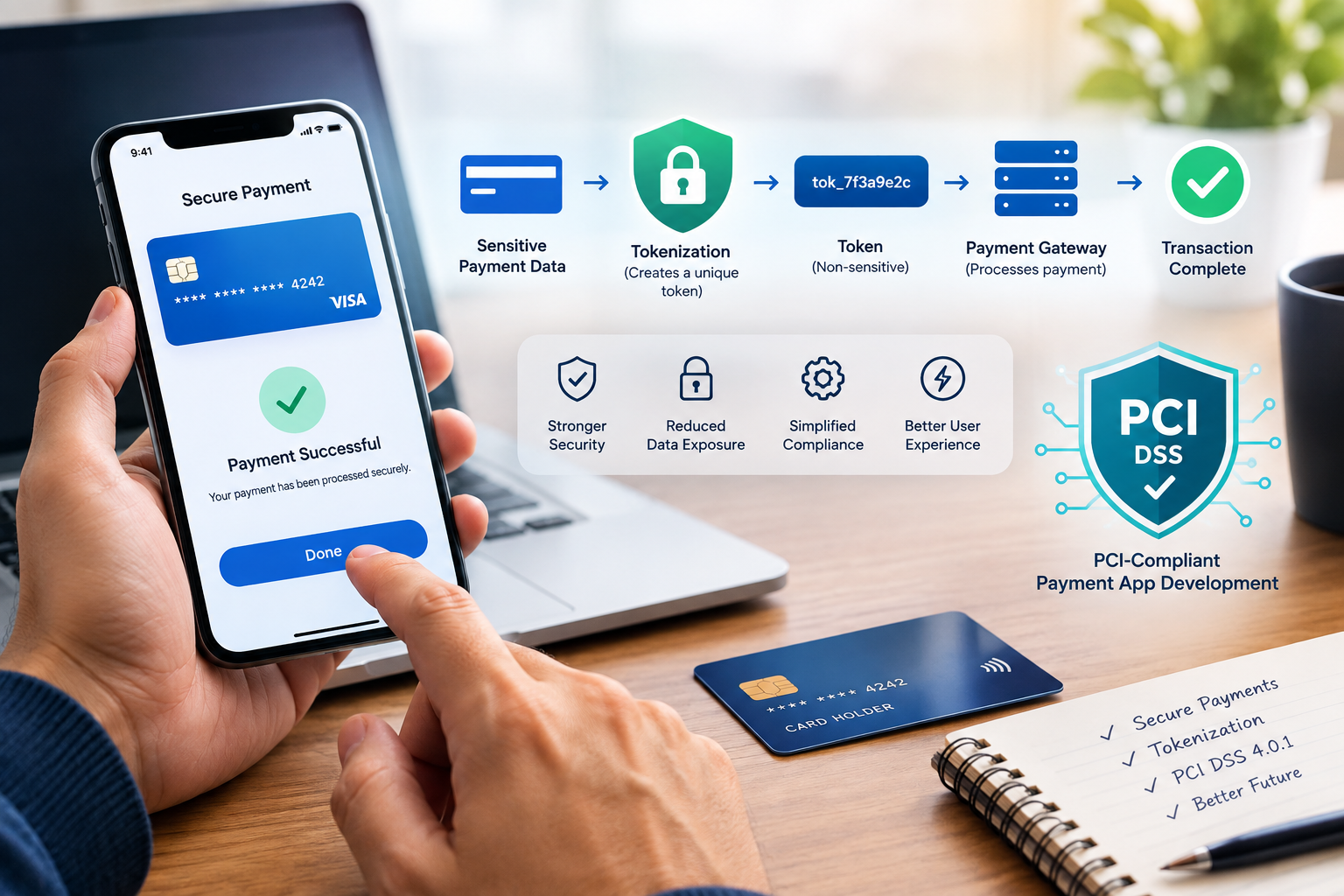
Payment tokenization replaces sensitive payment information with a unique, non-sensitive value known as a token.
Instead of repeatedly handling actual card information, an application can use a token to represent the payment credential.
For example, a payment workflow can look like:
Customer → Payment App → Secure Payment Provider → Token → Transaction
The actual payment information can remain within an appropriate secure environment while the application works with the token.
The exact implementation depends on the payment provider, architecture, transaction flow, and compliance requirements.
Why Tokenization Matters for Payment Apps
Payment applications may interact with card information, payment gateways, APIs, databases, mobile devices, and third-party services.
Reducing unnecessary exposure to sensitive payment information can simplify security architecture and help limit the potential impact of a security incident.
Key advantages of tokenization can include:
- Reduced exposure to payment card data
- Lower data-storage requirements
- More secure recurring payments
- Safer payment gateway integrations
- Better separation between applications and sensitive payment credentials
- Support for modern mobile and digital payment experiences
Tokenization does not automatically make an application PCI compliant. Businesses still need to understand their specific payment environment and applicable PCI requirements.
How Tokenization Works in a Payment Application
A typical tokenized payment workflow may follow these steps:
1. Customer Starts a Payment
The customer enters payment information through a secure payment interface.
2. Payment Information Is Sent Securely
The payment information is transmitted to the appropriate payment service or secure processing environment.
3. A Token Is Created
The payment provider generates a token representing the payment credential.
4. The Application Uses the Token
The application can store or reference the token instead of unnecessarily storing sensitive payment information.
5. Payment Is Processed
When a future transaction is required, the token can be submitted through the appropriate payment integration.
6. Transaction Status Is Returned
The payment platform returns the transaction result to the application.
This architecture can be particularly useful for applications supporting recurring payments, subscriptions, saved payment methods, and merchant payment platforms.
Tokenization vs. Encryption
Tokenization and encryption are both important security technologies, but they solve different problems.
Encryption transforms data into ciphertext using cryptographic techniques. The original data can generally be recovered using the appropriate key.
Tokenization replaces sensitive information with a token that has no equivalent value outside the relevant tokenization system.
A modern payment architecture may use both.
For example:
Payment Data → Secure Transmission → Tokenization → Encrypted Systems → Payment Processing
The appropriate combination depends on the application’s architecture and security requirements.
Tokenization and PCI DSS
PCI DSS is designed to protect payment account data and applies to organizations and environments within its scope.
Tokenization can potentially reduce the amount of sensitive payment data an application directly handles, but it does not automatically remove PCI responsibilities.
Businesses should consider:
- Where payment data enters the environment
- Where payment information is transmitted
- Whether any payment data is stored
- How tokens are generated and managed
- Which systems can access payment information
- Third-party payment providers
- API security
- Authentication and authorization
- Logging and monitoring
- Vulnerability management
- Applicable PCI requirements
Understanding the complete data flow is therefore essential when developing a secure payment application.
Where Tokenization Can Be Used
Tokenization can support several payment application use cases.
Mobile Payment Apps
Mobile applications can use tokenized payment credentials to support convenient transactions without unnecessarily storing sensitive card information.
Subscription Platforms
Recurring billing applications can reference stored payment tokens for future transactions through the appropriate payment provider.
eCommerce Applications
Online stores can use tokenization for saved payment methods and repeat purchases.
POS Applications
POS software can integrate with payment processors and use tokenized payment information within supported workflows.
Marketplace Platforms
Marketplaces handling payments between customers, merchants, and service providers can use secure payment integrations with tokenized credentials.
Digital Wallets
Tokenization can support secure payment credentials across mobile and digital wallet ecosystems, depending on the payment technology involved.
Key Security Features for a Tokenized Payment App
Tokenization should be part of a broader security architecture.
A secure payment application may include:
Strong Authentication
Use appropriate authentication and authorization mechanisms to protect accounts, administrative functions, and payment operations.
Secure APIs
Payment APIs should use strong authentication, authorization, input validation, secure communication, and appropriate rate limiting.
Data Encryption
Sensitive information should be protected during transmission and, where applicable, while stored.
Access Control
Users and administrators should only receive the permissions required for their responsibilities.
Secure Logging
Logs should provide useful security and operational information without unnecessarily exposing sensitive payment information.
Vulnerability Management
Applications should be regularly tested and dependencies should be monitored and updated.
Monitoring and Alerts
Security and transaction monitoring can help identify unusual activity and potential attacks.
Common Mistakes in Payment App Development
Businesses developing payment applications should avoid treating tokenization as a complete security solution.
Storing Sensitive Card Data Unnecessarily
Applications should avoid collecting or retaining sensitive payment information when it is not required.
Weak API Security
Even if payment data is tokenized, poorly secured APIs can create significant vulnerabilities.
Ignoring Third-Party Integrations
Payment applications often depend on gateways, SDKs, cloud services, analytics tools, and other external components.
Each integration should be reviewed as part of the overall security architecture.
Treating Compliance as a Final Step
Security and compliance considerations should begin during architecture and continue throughout development, testing, deployment, and maintenance.
Poor Access Management
Administrative dashboards and payment-management systems require strong authentication and carefully controlled permissions.
How to Build a Tokenized Payment Application
A practical development process can include:
Step 1: Define the Payment Flow
Map every stage from customer payment initiation to authorization, processing, settlement, refunds, and reporting.
Step 2: Identify Sensitive Data
Determine what payment information enters the system and where it travels.
Step 3: Minimize Data Exposure
Use appropriate payment-provider capabilities and tokenization strategies to reduce unnecessary handling of sensitive information.
Step 4: Design Secure APIs
Build secure communication between mobile apps, web applications, backend systems, and payment providers.
Step 5: Implement Authentication and Access Controls
Protect customer, merchant, administrator, and internal application access.
Step 6: Test the Application
Perform appropriate security testing, vulnerability assessments, and application testing before production deployment.
Step 7: Monitor and Maintain
Security does not end after launch. Applications need ongoing updates, monitoring, access reviews, and security maintenance.
Why Choose a PCI App Development Company?
Payment software requires a combination of application development, payment integration, security engineering, and compliance awareness.
A specialized PCI app developer can help businesses address areas such as:
- Custom payment application development
- Payment gateway integration
- Payment API development
- Mobile payment applications
- Web payment applications
- POS payment systems
- Digital wallet integration
- Tokenization architecture
- Secure backend development
- Payment application modernization
- Security-focused testing
- Ongoing application maintenance
The right architecture depends on the business model, payment flow, integrations, technology stack, and applicable security requirements.
The Future of Tokenized Payment Applications
Payment experiences are moving toward mobile commerce, embedded payments, contactless transactions, digital wallets, connected devices, and automated billing.
As these technologies develop, businesses will need payment applications that balance:
Security + Compliance + User Experience + Scalability
Tokenization can be an important component of that architecture by helping applications reduce unnecessary exposure to sensitive payment credentials.
However, secure payment development requires more than one technology. Strong authentication, secure APIs, encryption, access controls, testing, monitoring, and appropriate compliance practices must work together.
Conclusion
Tokenization is becoming an important technology in modern payment application architecture.
By replacing sensitive payment credentials with tokens, businesses can design payment workflows that reduce unnecessary exposure to payment data while supporting convenient experiences such as recurring billing, saved payment methods, mobile payments, eCommerce transactions, and POS integrations.
For businesses planning PCI-compliant payment app development in 2026, security should be considered from the architecture stage—not added after the application is built.
A well-designed payment application combines secure architecture, tokenization, payment integrations, strong access controls, secure APIs, testing, monitoring, and an understanding of applicable PCI requirements.
Build a Secure Payment Application
Looking to develop a secure payment app, payment gateway, POS solution, or tokenized payment platform?
PCI App Developer can help design and develop payment applications around your business requirements, payment workflows, integrations, and security objectives.
Comments