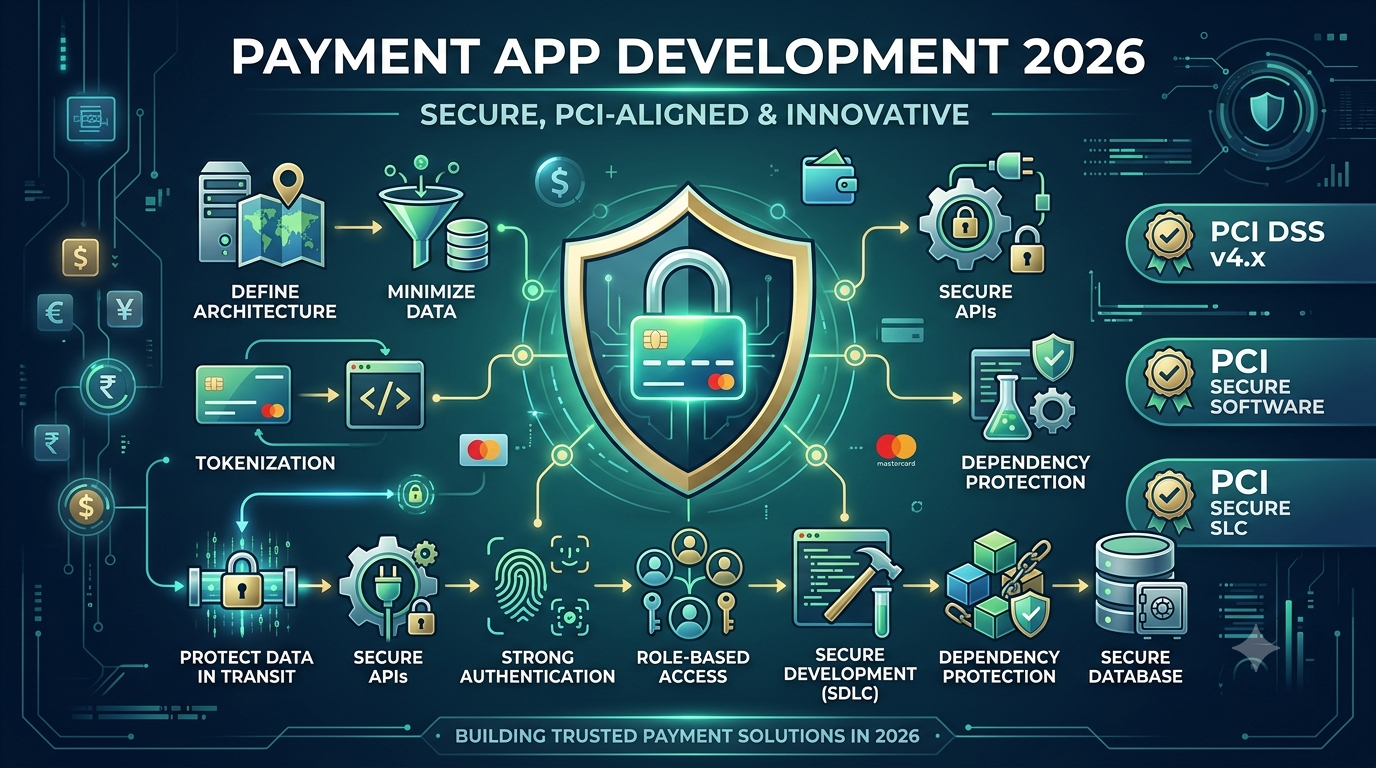
Digital payments have become a core part of modern commerce. Businesses now expect payment applications to support cards, digital wallets, mobile payments, recurring transactions, online checkout, refunds, subscriptions, and multiple payment providers.
But building a payment application requires more than creating a checkout screen and connecting a payment gateway.
A modern payment app development project needs to consider application architecture, data protection, authentication, encryption, secure APIs, payment processing, third-party integrations, logging, vulnerability management, and applicable PCI requirements.
In 2026, developers also need to understand the difference between PCI DSS and the PCI Security Standards Council’s software-security standards.
PCI DSS v4.0.1 is the current revision of the PCI DSS, while the PCI Secure Software Standard focuses on security requirements for payment software. These are related but are not interchangeable compliance programs.
What Is Payment App Development?
Payment app development is the process of designing and building software that enables or supports payment-related activities.
Depending on the business model, a payment application may provide:
- Online payment acceptance
- Mobile payments
- Card payments
- Digital wallet integration
- Payment gateway integration
- Subscription billing
- Recurring payments
- Refunds
- Transaction management
- Payment history
- Customer accounts
- Merchant dashboards
- Fraud monitoring
- Payment reporting
- Notifications
- Multi-currency support
The architecture and security requirements depend on what the application actually does and how payment data moves through the environment.
PCI DSS vs. PCI Secure Software Standard
One of the most important considerations in payment software development is understanding that different PCI standards address different responsibilities.
PCI DSS
PCI DSS provides requirements for entities that store, process, or transmit cardholder data or can affect the security of the cardholder data environment.
PCI DSS v4.0.1 became the active version after PCI DSS v4.0 was retired at the end of 2024. The future-dated requirements from PCI DSS v4.x became effective on March 31, 2025.
PCI Secure Software Standard
The PCI Secure Software Standard is intended for software vendors developing payment software that supports or facilitates payment transactions.
It focuses on secure design, development, and maintenance of payment software and protection of payment-related functionality and sensitive data.
PCI SSC also released version 2.0 of the PCI Secure Software Standard in January 2026, introducing changes including a new companion document for identifying and documenting sensitive assets and eligibility for certain SDK assessments.
Secure Software Lifecycle
The PCI Secure Software Lifecycle (Secure SLC) Standard focuses on integrating security throughout the software lifecycle, including design, development, deployment, and maintenance.
These standards should therefore be considered according to the role of the organization, the software being developed, and the payment environment involved.
How to Build a Secure Payment Application
A secure payment application should be designed with security from the beginning rather than adding security controls immediately before launch.
A typical development process includes the following stages.
1. Define the Payment Architecture
Before development begins, identify exactly how payment information will flow through the system.
For example:
Customer → Payment UI → Payment Service → Gateway/Processor → Authorization → Transaction Result
The architecture should identify:
- Where payment information enters the system
- Which systems process it
- Which systems store information
- Which third parties receive information
- Where authentication occurs
- Where transaction records are maintained
Understanding this data flow helps define the application’s security boundaries and compliance scope.
2. Minimize Sensitive Data
One of the fundamental principles of secure payment application development is reducing unnecessary exposure to sensitive information.
If the application does not need to store certain payment information, avoiding storage can reduce security responsibilities and potential exposure.
Developers should evaluate:
- What data is collected
- Why it is collected
- Where it is processed
- Whether it needs to be stored
- How long it is retained
- Which systems can access it
Data minimization should be part of the architecture rather than an afterthought.
3. Use Tokenization Where Appropriate
Tokenization can help reduce the exposure of payment account data within application environments.
Instead of repeatedly handling sensitive payment information, an application can use a token generated by an appropriate payment service or tokenization system.
A simplified workflow can look like:
Payment Details → Secure Payment Service → Token → Application
The application can then use the token for supported transactions without unnecessarily handling the original payment information.
The exact implementation and compliance implications depend on the payment provider, integration model, and environment.
4. Protect Data in Transit
Payment applications communicate with multiple systems.
These can include:
- Mobile applications
- Web applications
- Payment gateways
- Banking or processor APIs
- Internal services
- Cloud platforms
- Third-party services
Communication between these systems should use appropriate secure transport mechanisms.
Developers should also ensure that sensitive information is not accidentally exposed through:
- URLs
- Application logs
- Debug messages
- Analytics systems
- Error messages
- Client-side storage
5. Secure APIs
APIs are often the connection point between a payment application and external systems.
A payment application may have APIs for:
- Authentication
- Payment creation
- Payment status
- Refunds
- Customer management
- Subscription management
- Transaction history
- Merchant reporting
API security should include appropriate controls such as authentication, authorization, input validation, rate limiting, monitoring, and secure error handling.
PCI SSC has also highlighted the importance of controlling access to payment software web APIs and protecting communications between web-based payment software components.
6. Implement Strong Authentication
Payment applications should carefully protect administrative and user accounts.
Depending on the application, security controls can include:
- Strong passwords
- Multi-factor authentication
- Role-based access control
- Session management
- Login monitoring
- Account lockout controls
- Device management
- Privileged-access controls
Administrative access should receive particular attention because compromised administrator accounts can provide access to sensitive application functionality.
7. Apply Role-Based Access Control
Not every user should have access to every payment function.
For example:
| User Role | Example Access |
|---|---|
| Customer | View own transactions |
| Support Agent | View permitted customer information |
| Finance User | Access transaction reports |
| Merchant Admin | Manage payment settings |
| Developer | Access development environments |
| Security Admin | Manage security controls |
Permissions should follow the principle of providing users only the access they need for their responsibilities.
8. Secure Payment Application Development
Security should be incorporated throughout the software development lifecycle.
A secure development process can include:
- Threat modeling
- Secure coding standards
- Code review
- Dependency management
- Vulnerability scanning
- Security testing
- Penetration testing where appropriate
- Secure configuration
- Change management
- Release controls
- Incident response planning
The PCI Secure SLC Standard specifically addresses secure software lifecycle management so that security remains part of the development and maintenance process.
9. Protect Third-Party Dependencies
Payment applications often depend on external libraries, SDKs, APIs, cloud services, and payment providers.
Developers should maintain visibility into these dependencies.
Important areas include:
- Dependency versions
- Known vulnerabilities
- Security updates
- API permissions
- Third-party access
- Software components
- Open-source packages
PCI SSC’s Secure Software Standard has evolved to address modern software development practices and security management.
10. Secure the Payment Database
If an application legitimately needs to store payment-related information, database security becomes critical.
Controls can include:
- Encryption
- Access control
- Database monitoring
- Secure credentials
- Backup protection
- Data retention policies
- Audit logging
- Network segmentation
Developers should avoid storing sensitive authentication data when it is prohibited or unnecessary and should follow the applicable PCI requirements for any cardholder data that is retained.
Payment App Architecture
A modern payment application can be structured into several layers.
Presentation Layer
This includes:
- Web application
- Mobile application
- Checkout interface
- Merchant dashboard
Application Layer
This handles:
- Business logic
- Authentication
- Payment workflows
- Customer management
- Transaction processing
Integration Layer
This connects the application with:
- Payment gateways
- Payment processors
- Banks
- Fraud services
- CRM systems
- Accounting platforms
Data Layer
This manages:
- Transaction records
- Customer information
- Application data
- Audit records
- Reporting information
Security Layer
Security controls can operate across all layers through:
- Encryption
- Authentication
- Authorization
- Monitoring
- Logging
- Vulnerability management
This layered approach can make the application easier to maintain and secure.
Payment Gateway Integration
Most businesses do not need to build their own payment-processing infrastructure from the ground up.
Instead, a payment application can integrate with established payment providers through APIs or SDKs.
A typical integration may support:
- Customer initiates payment.
- Application creates a payment request.
- Payment service processes the transaction.
- Gateway or processor communicates with the payment network.
- Application receives the transaction result.
- Order or subscription status is updated.
- Customer receives confirmation.
The exact flow depends on the payment provider and integration architecture.
Mobile Payment App Development
Mobile payment applications require additional considerations because smartphones operate in environments that developers do not completely control.
A mobile payment application should consider:
- Secure API communication
- Authentication
- Session management
- Secure local storage
- Application integrity
- Device security
- Secure SDK integration
- Push notification security
- Protection against reverse engineering
- Secure logging
The application should also avoid unnecessarily storing sensitive payment information on the device.
Web Payment Application Security
E-commerce applications face another important challenge: protecting payment pages and the browser environment.
PCI DSS v4.0.1 includes requirements addressing payment-page scripts and e-commerce security. PCI SSC has highlighted concerns around attacks that target scripts running in customers’ browsers, including e-skimming techniques.
Developers should therefore carefully manage:
- Third-party JavaScript
- Payment-page scripts
- Content Security Policy
- Script authorization
- Browser security
- API endpoints
- Web application vulnerabilities
The exact PCI controls applicable to an environment depend on its architecture and validation method.
Testing a Payment Application
Testing should take place throughout development rather than only before production release.
A payment application may require:
Functional Testing
Verify that payment flows work correctly.
API Testing
Test authentication, authorization, validation, error handling, and transaction workflows.
Security Testing
Identify vulnerabilities in application components and integrations.
Penetration Testing
Where applicable, conduct authorized security testing to identify exploitable weaknesses.
Performance Testing
Evaluate how the application behaves during high transaction volumes.
Integration Testing
Verify communication with payment gateways, processors, banks, and other external systems.
Regression Testing
Ensure security and functionality remain intact after updates.
Monitoring and Logging
Security does not end after deployment.
Production payment systems should have appropriate monitoring and logging to help identify:
- Failed login attempts
- Suspicious transaction activity
- API abuse
- Configuration changes
- Privilege changes
- Application errors
- Security events
Logs should themselves be protected and should not unnecessarily contain sensitive payment information.
PCI DSS v4.0.1 Considerations for Payment Applications
PCI DSS v4.0.1 includes updated and clarified requirements compared with PCI DSS v4.0.
PCI SSC describes v4.0.1 as a limited revision containing corrections and clarifications rather than additional or deleted requirements. The Council also confirmed that the March 31, 2025 effective date for the future-dated requirements was unchanged.
For payment applications, development teams should pay particular attention to areas involving:
- Secure development
- Vulnerability management
- Access control
- Authentication
- Encryption
- Logging and monitoring
- Payment-page security
- Third-party software
- API security
- Security testing
Organizations should work from the specific PCI DSS requirements applicable to their environment rather than assuming that a generic checklist establishes compliance.
Common Payment App Development Mistakes
Storing Unnecessary Payment Data
Keeping sensitive information without a business requirement can increase exposure.
Treating PCI Compliance as a Final-Stage Task
Security and compliance considerations should influence architecture and development from the beginning.
Ignoring Third-Party Components
Payment applications often depend heavily on external SDKs, APIs, libraries, and services.
Weak API Security
Poor authentication, authorization, input validation, and rate limiting can create significant vulnerabilities.
Excessive Logging
Application logs can accidentally expose sensitive information.
Inadequate Testing
A successful functional test does not necessarily demonstrate that an application is secure.
Confusing PCI Standards
PCI DSS, the PCI Secure Software Standard, Secure SLC, P2PE, PTS, and other PCI standards address different areas. Selecting the applicable requirements requires understanding the specific payment environment.
How PCIAppDeveloper Can Help
PCIAppDeveloper focuses on payment application development with security and PCI-related requirements considered throughout the software development process.
A payment software project may involve:
- Payment gateway integration
- Mobile payment applications
- Web payment applications
- Merchant dashboards
- Subscription payment systems
- Payment APIs
- Digital wallet integrations
- Transaction management
- Tokenization
- Security-focused architecture
- Testing and maintenance
The development approach should begin by understanding the payment flow, data environment, business requirements, and applicable standards.
Conclusion
Building a modern payment application requires more than integrating a payment gateway.
A secure payment application should be designed around data minimization, secure APIs, strong authentication, encryption, controlled access, secure development practices, testing, monitoring, and appropriate payment-security requirements.
PCI DSS v4.0.1 remains an important consideration for organizations within its scope, while the PCI Secure Software Standard and Secure SLC provide software-focused security frameworks for relevant payment software vendors and developers.
For businesses developing a new payment application in 2026, starting with a clearly defined payment architecture and security model can help create a more maintainable and security-focused product.
Frequently Asked Questions
What is PCI-compliant payment app development?
It refers to developing payment software while addressing the applicable PCI requirements and security controls relevant to the application’s payment environment. PCI compliance is not established simply by using secure coding practices; the applicable compliance scope and validation requirements must also be considered.
Is PCI DSS the same as the PCI Secure Software Standard?
No. PCI DSS and the PCI Secure Software Standard address different areas. PCI DSS applies to entities and environments within its scope, while the Secure Software Standard focuses on security requirements for applicable payment software.
Is PA-DSS still used for new payment software?
No. PA-DSS was retired in 2022 and superseded by the PCI Secure Software Standard and PCI Secure Software Lifecycle Standard within the PCI Software Security Framework.
What is PCI Secure Software Standard v2.0?
PCI SSC released version 2.0 of the PCI Secure Software Standard in January 2026. The revision includes changes to the standard and introduces a companion document for identifying and documenting sensitive assets; SDKs are also eligible for assessment under the revised framework.
Can a payment app use a third-party payment gateway?
Yes. Many payment applications integrate with third-party payment providers rather than processing card transactions directly. The resulting payment architecture and PCI scope depend on how the integration is implemented.
Does using a PCI-validated payment application automatically make a business PCI DSS compliant?
No. PCI SSC specifically states that use of validated payment software does not by itself make an entity PCI DSS compliant or imply validation against another PCI standard.
Comments