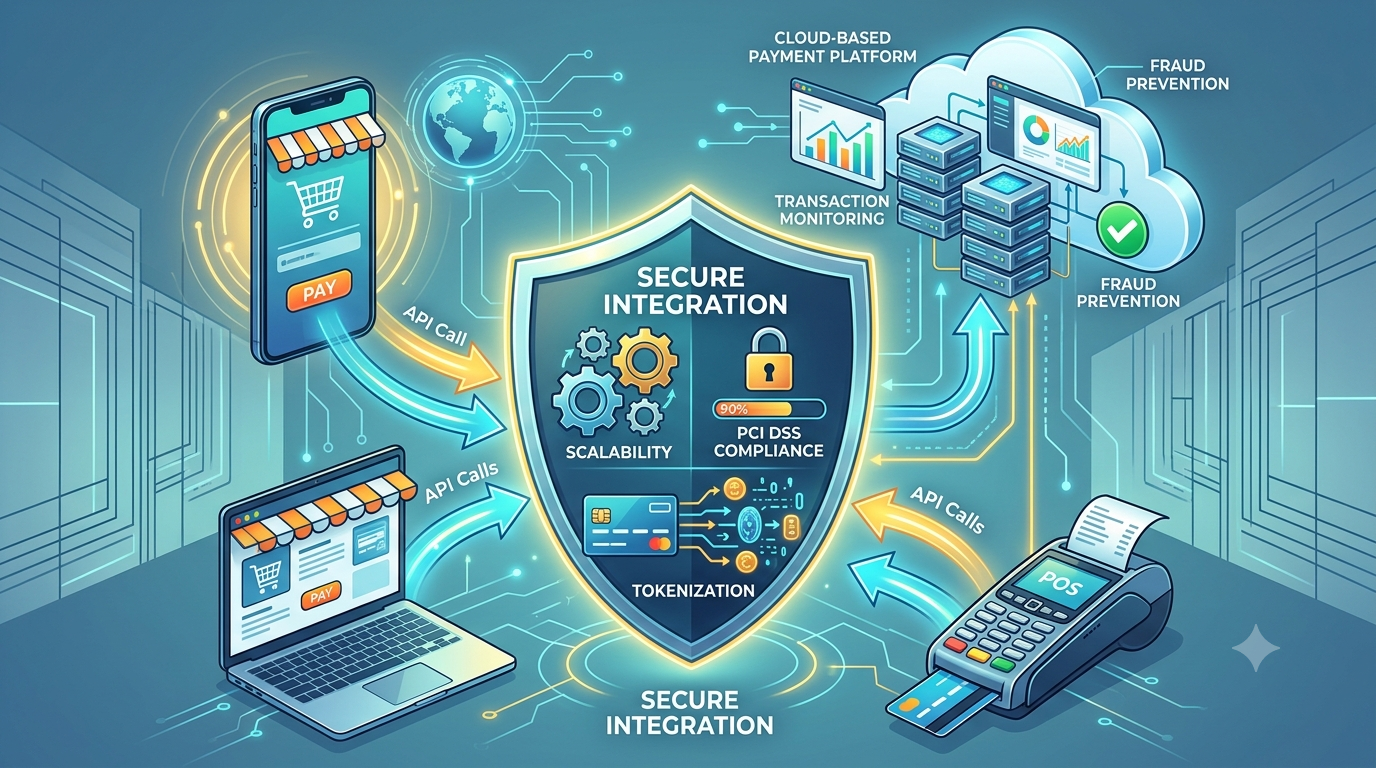
Digital payments have become a core part of modern commerce. Businesses across eCommerce, retail, hospitality, healthcare, SaaS, marketplaces, and fintech increasingly depend on payment gateways to accept transactions securely and provide customers with convenient payment experiences.
But payment gateway integration is much more than connecting an API and adding a checkout button.
A modern payment system needs to consider security, PCI DSS requirements, encryption, tokenization, authentication, fraud prevention, API security, transaction monitoring, scalability, and reliable payment processing.
For businesses planning a new payment application in 2026, choosing the right architecture can make a significant difference to the security and maintainability of the platform.
What Is Payment Gateway Integration?
A payment gateway acts as a technology layer between a business, its customers, and the payment-processing ecosystem.
A simplified payment flow can look like:
Customer → Payment Application → Payment Gateway → Payment Processor → Bank/Card Network
Depending on the business model, the system may also connect with:
- Mobile applications
- eCommerce websites
- POS systems
- Digital wallets
- Subscription platforms
- CRM systems
- Accounting software
- Fraud detection platforms
- Business dashboards
The gateway can help securely transmit payment information and communicate transaction results back to the application.
Why Payment Gateway Integration Matters in 2026
Customers expect payment experiences to be fast and reliable across mobile and web platforms.
Businesses may need to support:
- Credit and debit cards
- Digital wallets
- Contactless payments
- Recurring payments
- Subscription billing
- Mobile payments
- Online checkout
- Payment links
- Refunds
- Partial refunds
- Multi-currency transactions
A well-designed payment architecture allows businesses to support these capabilities while keeping security and operational requirements in mind.
How a Secure Payment Gateway Works
A typical transaction may follow these steps:
Step 1: Customer Starts Payment
The customer selects a product or service and proceeds to checkout.
Step 2: Payment Information Is Collected
The payment interface collects the information required to initiate the transaction.
The architecture should minimize unnecessary handling of sensitive payment data.
Step 3: Secure Request Is Sent
The application communicates with the payment gateway through secure APIs.
Step 4: Payment Is Authorized
The gateway and relevant payment-processing systems communicate with the appropriate financial networks.
Step 5: Transaction Result Is Returned
The application receives a success, failure, or other transaction status.
Step 6: Application Updates the Order
The business system updates the customer’s order, subscription, invoice, or account status.
This process needs to be designed carefully so that applications do not blindly trust payment responses or expose sensitive information.
PCI DSS and Payment Gateway Integration
PCI DSS is an important consideration for organizations involved in payment-card environments.
PCI DSS provides technical and operational requirements intended to protect payment account data.
The applicable responsibilities depend on how a business’s payment architecture handles cardholder data.
This means a business should determine:
- What payment information enters its systems?
- Is card data stored?
- Which systems transmit payment information?
- Which third-party services are involved?
- What data is logged?
- Which applications can access payment information?
- What security controls are required?
PCI DSS 4.0.1 is the current revision of the standard, following the retirement of PCI DSS 4.0 at the end of 2024.
Tokenization for Payment Applications
Payment tokenization is commonly used to reduce the amount of sensitive card information handled by an application.
Instead of repeatedly using the original payment credentials, a payment architecture can use a token representing the payment information for supported operations.
A simplified flow is:
Payment Information → Payment Provider → Token → Business Application
Tokenization can help reduce direct exposure to sensitive payment information.
However, tokenization does not automatically make an application PCI compliant. The complete payment environment, implementation, integrations, and applicable responsibilities still need to be evaluated.
Secure Payment APIs
Modern payment systems rely heavily on APIs.
A payment application may communicate with:
- Payment gateways
- Payment processors
- Banking platforms
- Digital wallets
- Fraud detection services
- Accounting systems
- POS platforms
- Customer management systems
A secure payment API should consider:
Authentication
APIs should verify that requests originate from authorized users or services.
Authorization
Users and applications should only have access to the resources and operations they require.
Input Validation
Incoming information should be validated before it is processed.
Rate Limiting
Rate limits can help protect APIs from abuse and excessive automated requests.
Secure Error Handling
Error responses should avoid exposing credentials, sensitive payment information, database details, or internal infrastructure information.
Logging
Security-relevant activity should be monitored while avoiding unnecessary storage of sensitive payment data.
Payment Gateway Webhooks
Webhooks are frequently used to notify applications about payment events.
For example:
Payment Gateway → Webhook → Business Backend → Order System
Webhook events could relate to:
- Payment success
- Payment failure
- Refund
- Chargeback-related event
- Subscription payment
- Payment status update
Applications should validate webhook authenticity and avoid trusting incoming notifications without appropriate verification.
Mobile Payment App Development
Mobile applications have become an important part of digital payment ecosystems.
A mobile payment app may connect to:
- Payment gateways
- Secure backend APIs
- Digital wallets
- Banking services
- POS systems
- Cloud infrastructure
Security considerations can include:
- Secure API communication
- Authentication
- Session management
- Secure local storage
- Credential protection
- Application integrity
- Secure updates
- Device security
For businesses developing a mobile payment application, the payment architecture should be designed around the actual transaction flow rather than simply adding payment functionality to an existing app.
Payment Gateway Integration for eCommerce
eCommerce businesses need payment systems that integrate smoothly with their online stores.
A typical architecture might include:
Customer → eCommerce Website → Payment Gateway → Payment Processor → Order Management
Additional integrations can include:
- Inventory
- Shipping
- CRM
- Accounting
- Tax systems
- Customer notifications
- Analytics
A secure payment architecture should ensure that order status is updated only after the application has appropriately verified the payment result.
Payment Gateway Integration for POS Systems
Modern POS systems increasingly combine payment processing with broader business operations.
A POS ecosystem may include:
POS Application → Payment Terminal → Payment Gateway → Processor
It may also connect to:
- Inventory management
- Customer loyalty
- Online ordering
- Kitchen management
- Accounting
- Reporting
- Mobile applications
For businesses building a PCI-compliant POS application, security needs to be considered across the complete ecosystem rather than only within the payment terminal.
Recurring Payments and Subscription Billing
Subscription businesses have additional payment requirements.
Examples include:
- SaaS platforms
- Membership services
- Streaming services
- Online education
- Subscription commerce
A payment system may need to support:
- Recurring billing
- Payment retries
- Subscription upgrades
- Subscription cancellations
- Refunds
- Failed-payment notifications
- Customer billing history
The architecture should clearly separate payment status, subscription status, and customer account information.
Fraud Prevention in Payment Applications
Payment security also involves identifying potentially fraudulent activity.
Depending on the business and payment architecture, applications may integrate with fraud detection systems that analyze signals such as:
- Transaction patterns
- Device information
- Account behavior
- Location-related signals
- Payment history
- Unusual transaction activity
Fraud prevention should be designed alongside payment processing rather than added only after the system is operational.
Cloud-Based Payment Architecture
Cloud platforms allow businesses to build scalable payment infrastructures.
A cloud payment platform may include:
- API services
- Application servers
- Databases
- Authentication
- Payment integrations
- Monitoring
- Logging
- Notification services
- Analytics
Cloud infrastructure can help businesses scale, but cloud deployment does not remove security responsibilities.
Organizations still need to determine which security controls are their responsibility and which are provided by their cloud or payment-service providers.
Payment Security Testing
Security testing should be integrated into the payment application’s development lifecycle.
Testing can include:
- API security testing
- Vulnerability scanning
- Authentication testing
- Authorization testing
- Dependency analysis
- Code review
- Penetration testing
- Configuration review
- Infrastructure testing
The exact testing requirements depend on the application’s architecture and applicable security obligations.
Common Payment Integration Mistakes
1. Hard-Coding API Credentials
Payment credentials should not be embedded directly into mobile applications or publicly accessible source code.
2. Trusting Webhooks Without Verification
Applications should appropriately validate payment notifications.
3. Storing Unnecessary Payment Data
Businesses should carefully evaluate whether sensitive payment information actually needs to be stored.
4. Ignoring API Security
Payment gateway integration depends heavily on APIs, making API security an important architectural consideration.
5. Treating PCI Compliance as a Final Checklist
PCI considerations should be incorporated into planning, architecture, development, testing, deployment, and ongoing security.
6. Neglecting Monitoring
A payment system needs visibility into relevant security and transaction events after launch.
How to Build a Payment Gateway Integration
A practical development process can include:
- Define business and payment requirements
- Map the payment-data flow
- Select appropriate payment providers
- Design the payment architecture
- Determine PCI scope and responsibilities
- Design secure APIs
- Implement payment gateway integration
- Add tokenization where appropriate
- Implement authentication and authorization
- Configure transaction monitoring
- Implement webhook verification
- Perform security testing
- Test payment failures and edge cases
- Deploy securely
- Monitor and maintain the platform
Why Choose a Payment App Development Company?
Payment software requires knowledge across multiple technology areas.
A development partner may need experience with:
- Payment app development
- PCI-compliant app development
- Payment gateway integration
- Secure payment APIs
- Tokenization
- Mobile payment applications
- POS payment solutions
- eCommerce payment systems
- Digital wallets
- Recurring payments
- Cloud payment platforms
- Payment security testing
- Backend development
- API integration
PCI App Developers focuses on payment-focused software development, including custom payment applications, mobile payment apps, payment gateway integrations, secure payment APIs, POS payment solutions, eCommerce payment systems, and cloud payment platforms.
Frequently Asked Questions
What is payment gateway integration?
Payment gateway integration connects an application’s checkout or payment functionality with a payment gateway so transactions can be securely submitted and their status returned to the business system.
Is payment gateway integration PCI compliant automatically?
No. Using a payment gateway does not automatically make an entire application or organization PCI compliant. The applicable responsibilities depend on the complete payment environment and how payment information is handled.
What is tokenization in payment processing?
Tokenization replaces sensitive payment information with a token that can be used for supported payment operations. It can reduce the amount of sensitive payment data directly handled by an application.
Can payment gateways be integrated into mobile apps?
Yes. Payment gateways can be integrated into mobile applications through appropriate SDKs, APIs, hosted payment components, or other supported architectures.
Can payment gateway integration work with POS systems?
Yes. Payment gateways can be integrated into POS ecosystems, although the architecture needs to account for terminals, payment processors, POS software, APIs, security, and applicable compliance requirements.
How much does payment app development cost?
The cost depends on factors such as application complexity, payment methods, gateway integrations, mobile and web platforms, POS requirements, backend architecture, security controls, third-party integrations, and testing requirements.
Conclusion
A modern payment gateway integration should be designed around more than transaction processing.
Businesses need to consider PCI DSS, secure APIs, tokenization, authentication, authorization, webhook security, fraud prevention, monitoring, scalability, and payment-data protection throughout the application lifecycle.
Whether you are developing a mobile payment app, eCommerce payment system, POS application, fintech platform, subscription service, or enterprise payment solution, security should be part of the architecture from the beginning.
The objective is not simply to connect a payment gateway.
It is to build a secure, scalable, reliable, and maintainable payment ecosystem.
Comments