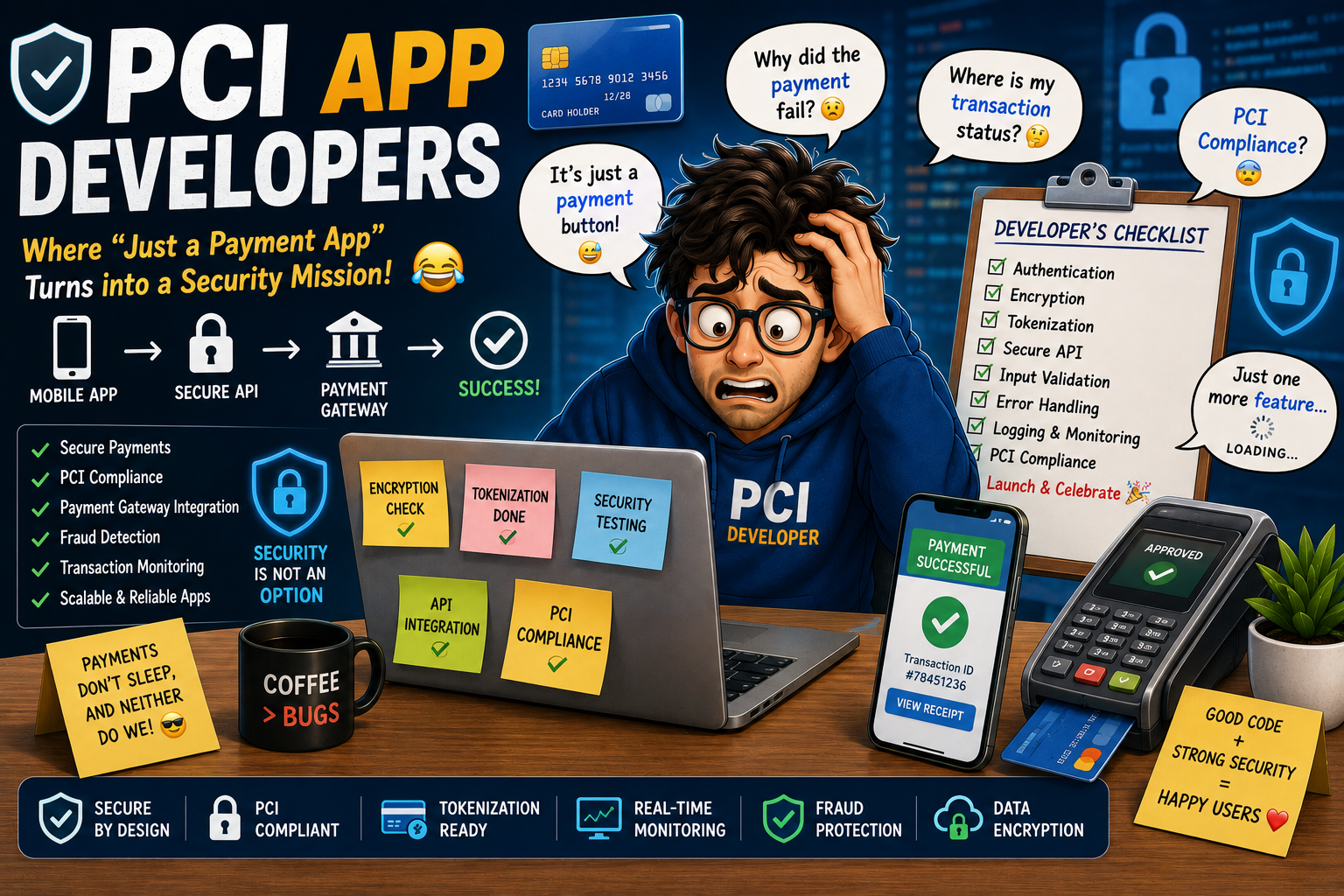
Every payment app project starts with one innocent sentence:
“We just need users to make payments.”
Developer:
“Sure. That’s straightforward.”
Then the requirements arrive.
User registration.
Login.
Payment processing.
Transaction history.
Notifications.
Admin dashboard.
Multiple payment methods.
Fraud detection.
Encryption.
Security testing.
PCI compliance.
And finally:
“Can we launch next Friday?”
Developer:
“Absolutely.” ☕😂
Welcome to the world of PCI app development.
What Is PCI App Development?
PCI app development involves building payment-related applications with security and payment-card requirements in mind.
A payment application can involve:
Mobile App 📱
↓
Secure API 🔐
↓
Payment Gateway 💳
↓
Payment Processor
↓
Banking / Financial Network
↓
Transaction Result ✅
The customer sees:
Payment Successful! 🎉
The development team sees:
Authentication → Encryption → Tokens → APIs → Logs → Security → Testing → Compliance
😂
The Famous “Just Add a Payment Button”
Client:
“We already have the app. Can we just add a payment button?”
Developer:
“Sure. What payment provider?”
Client:
“We haven’t decided.”
Developer:
“Okay…”
Client:
“Can users save their cards?”
Developer:
“Possibly, depending on the architecture.”
Client:
“Can we store the card numbers ourselves?”
Developer:
“Let’s talk about that.” 😐
Payment functionality isn’t simply:
Button → Money
There can be many security and compliance considerations behind that button.
When the Payment Button Becomes the Most Important Button in the App
A normal button:
LOGIN
If it breaks:
“Please try again.”
A payment button:
PAY NOW
If it breaks:
Everyone suddenly becomes very interested. 😂
Payment functionality requires careful handling because transactions involve:
- Authentication
- Payment processing
- API communication
- Transaction status
- Error handling
- Security
- Logging
- User notifications
A payment app needs to know not only:
“Did the user click Pay?”
but:
“Did the payment actually succeed?”
The Payment Flow Nobody Sees
The customer thinks:
Tap Pay → Done
The backend may be doing something more like:
User Request
↓
Authentication
↓
Secure API
↓
Payment Gateway
↓
Processor
↓
Authorization
↓
Response
↓
Transaction Verification
↓
Database Update
↓
Notification
↓
Receipt
The user sees:
Payment Successful ✅
The developer sees:
17 API requests and three logs. 😂
PCI Compliance: The Serious Part
Now we reach the part that makes payment developers sit up straight:
PCI compliance.
PCI-related requirements exist to help protect payment card data and payment environments.
For application developers, that means security can’t simply be added at the end.
It needs to be considered during:
- Architecture
- Development
- Authentication
- Data handling
- API design
- Testing
- Deployment
- Monitoring
In other words:
Security isn’t a checkbox you tick five minutes before launch.
“Can We Store the Card Number?”
This question has probably caused many developers to reach for their coffee.
Client:
“Can we save the customer’s card number in our database?”
Developer:
“Why?”
Client:
“So checkout is faster.”
Developer:
“We should discuss tokenization and the payment architecture first.”
😂
Modern payment architectures often use tokenization, where sensitive payment information is handled by appropriate payment infrastructure rather than unnecessarily storing raw card data in the application’s own systems.
The goal is simple:
Minimize sensitive payment-data exposure.
Tokens: The Developer’s Best Friend
Instead of repeatedly handling sensitive card information, payment systems can use tokens.
Conceptually:
Card Information
↓
Payment Provider
↓
Token
↓
Your Application
Your application can then work with the token rather than unnecessarily handling raw payment-card information.
The user thinks:
“My card is saved.”
The developer thinks:
“Thank goodness we’re using tokens.” 😂
Encryption: Because “123456” Is Not Security
Security conversations sometimes begin with:
“Don’t worry, the database has a password.”
Developer:
😐
Modern payment applications need a much stronger security approach.
Depending on the architecture, security considerations can include:
- Encryption in transit
- Encryption at rest
- Secure authentication
- Access controls
- API security
- Secrets management
- Secure logging
- Vulnerability management
- Secure development practices
Because:
Password ≠ Security Strategy
😂
The Login Screen Has a New Job
In an ordinary application:
Forgot password?
In a payment application:
Who are you?
Are you really you?
Should you be allowed to do this?
Does this transaction look normal?
Authentication and authorization become especially important when money and sensitive information are involved.
Depending on the application, this can involve:
- Strong authentication
- Multi-factor authentication
- Session management
- Role-based access
- Device verification
- Transaction controls
The “OTP Isn’t Arriving” Problem 📱
User:
“I didn’t receive the OTP.”
Support:
“Please wait.”
User:
“Still nothing.”
Support:
“Please check your network.”
User:
“Network is fine.”
Developer:
“Is the SMS provider working?”
😂
Authentication systems need reliable handling for:
- OTP generation
- OTP delivery
- Expiration
- Retry limits
- Verification
- Abuse prevention
- Failed attempts
Because users generally don’t enjoy waiting for a six-digit number while trying to pay for something.
Payment APIs: Where Things Get Interesting
Payment applications rarely operate alone.
They communicate with external systems through APIs.
For example:
Mobile App
↓
Backend API
↓
Payment API
↓
Payment Gateway
↓
Payment Processor
Every connection creates another place where developers need to think about:
- Authentication
- Encryption
- Request validation
- Error handling
- Timeouts
- Retries
- Webhooks
- Logging
And then comes the classic:
“The payment succeeded, but the app says it failed.”
😂
Now someone has to investigate.
Webhooks: The Message You Really Want to Receive
A payment may not always finish in the same instant the user clicks the button.
Payment platforms can send backend notifications, commonly through mechanisms such as webhooks, to communicate transaction events.
For example:
Payment Started
↓
Processing
↓
Payment Provider
↓
Webhook
↓
Backend
↓
Order Updated
This helps applications maintain accurate transaction states.
Because:
“The user closed the app”
doesn’t necessarily mean:
“The payment failed.”
The Double-Payment Nightmare 💳💳
Imagine:
User clicks:
PAY
Nothing happens.
User clicks again.
Still nothing.
User clicks again.
Then:
Payment Successful!
And suddenly:
Three transactions.
😳
This is why payment applications need careful handling of:
- Duplicate requests
- Idempotency
- Transaction states
- Retries
- Network failures
- Timeouts
A good payment architecture should be designed so that retrying a request doesn’t accidentally create duplicate transactions.
“The Internet Went Down During Payment”
This is one of the worst moments.
User:
“I clicked Pay.”
Internet:
Goodbye. 👋
App:
“Something went wrong.”
User:
“Did I get charged?”
Developer:
“Let’s check the transaction status.”
😂
Payment applications need reliable transaction-state management.
Possible states might include:
- Initiated
- Processing
- Successful
- Failed
- Cancelled
- Refunded
The application should not blindly assume:
Network Error = Payment Failed
PCI App Development and Testing
Testing a payment application isn’t just:
“Does the button work?”
Testing can include:
Functional Testing
Does the payment flow work?
API Testing
Do backend integrations behave correctly?
Security Testing
Are vulnerabilities identified and addressed?
Authentication Testing
Are unauthorized users blocked?
Transaction Testing
Are payment states handled correctly?
Error Testing
What happens when something fails?
Device Testing
Does the application work across supported devices?
Performance Testing
Can the system handle expected traffic?
Compliance-Focused Validation
Does the implementation align with applicable payment security requirements?
Because:
Payment testing isn’t the place for “probably works.”
The Admin Dashboard
Every payment platform eventually needs an admin dashboard.
It starts with:
“Just show transactions.”
Then:
“Add filters.”
Okay.
“Add refunds.”
Fine.
“Add reports.”
Sure.
“Add user management.”
Okay.
“Add fraud alerts.”
Yep.
“Can we export everything to Excel?”
😂
Suddenly the dashboard has become a financial control center.
A good payment dashboard may need to provide visibility into:
- Transactions
- Payment status
- Refunds
- Users
- Disputes
- Reports
- Alerts
- System activity
Fraud Detection Enters the Chat 🤖
Once a payment application starts processing meaningful transaction volume, fraud prevention can become an important consideration.
Systems may analyze signals such as:
- Transaction patterns
- Device information
- Account behavior
- Location signals
- Velocity
- Unusual activity
AI and machine learning can potentially help identify suspicious patterns.
For example:
Normal behavior
↓
Normal transaction
↓
No problem
But:
Sudden unusual activity
↓
Risk analysis
↓
Additional verification / review
This is where payment technology becomes much more intelligent.
AI + Payment Applications
AI isn’t just for chatbots.
In payment technology, AI can potentially support:
- Fraud detection
- Transaction monitoring
- Risk scoring
- Customer support
- Document processing
- Anomaly detection
- Financial analytics
But AI should complement a secure architecture.
Putting:
“AI-powered”
on the homepage doesn’t automatically make a payment application secure.
😂
Mobile Payment Apps: iOS vs Android
Building a payment application for mobile devices means dealing with different operating systems and device environments.
iOS
Developers may need to consider:
- Secure storage
- App permissions
- Authentication
- Network security
- App lifecycle
Android
Developers may need to consider:
- Device fragmentation
- OS versions
- Permissions
- Secure storage
- Background behavior
The payment experience should remain consistent even though the underlying devices aren’t.
The Security Checklist 😂
Before launch:
☑ Secure authentication?
☑ Authorization working?
☑ API secured?
☑ Sensitive data minimized?
☑ Encryption configured?
☑ Secrets protected?
☑ Logging reviewed?
☑ Error messages safe?
☑ Dependencies updated?
☑ Security testing completed?
☑ Payment flows tested?
☑ Transaction states handled?
☑ Duplicate transactions prevented?
☑ Monitoring ready?
☑ Coffee available?
☑ Coffee is always required. ☕
“Can We Launch Tomorrow?”
Client:
“The application is almost ready.”
Developer:
“We still need security testing.”
Client:
“How long?”
Developer:
“It depends.”
Client:
“Can we skip it?”
Developer:
“No.”
😂
When money and payment data are involved, rushing security work is a terrible shortcut.
A secure payment application is worth more than a fast but risky launch.
Where PCI-Compliant App Development Can Be Used
Payment-focused applications can support many industries.
🛒 E-Commerce
- Checkout
- Payments
- Refunds
- Order management
🍔 Restaurants
- Mobile ordering
- Digital payments
- POS integrations
- Customer accounts
🚕 Transportation
- Ride payments
- Wallets
- Driver payouts
🏨 Hospitality
- Reservations
- Deposits
- Guest payments
🏥 Healthcare
- Billing
- Payment processing
- Customer portals
💼 SaaS
- Subscriptions
- Recurring payments
- Billing portals
🎟️ Events
- Ticket purchases
- Digital payments
- Refund management
What Makes a Good Payment App?
A strong payment application should be:
🔐 Secure
Protect users, transactions, and sensitive information.
⚡ Fast
Payment flows should feel smooth.
📱 User-Friendly
Users shouldn’t need a tutorial to make a payment.
🧩 Reliable
Transactions should be handled consistently.
📈 Scalable
The platform should support business growth.
🔎 Observable
Developers need visibility into system and transaction health.
🔄 Maintainable
The application should be easy to improve and update.
Why PCI App Developers Matter
Payment applications aren’t ordinary mobile or web applications.
They combine:
Mobile/Web Development
Payment APIs
Security
Backend Systems
Authentication
Transaction Management
Compliance Considerations
Testing
Monitoring
A development team working on payment applications needs to understand not just how to build features, but how those features interact with a secure payment ecosystem.
The Future of Payment Apps 🚀
Payment technology is moving toward increasingly connected and intelligent experiences.
We can expect continued growth in areas such as:
- Digital wallets
- Contactless payments
- Embedded payments
- AI-powered fraud detection
- Biometric authentication
- Real-time payment experiences
- Automated financial workflows
- Cloud-based payment platforms
The future isn’t simply:
“Tap → Pay.”
It is increasingly:
Identity → Security → Intelligence → Payment → Automation
Why PCI App Developers?
Building a payment application requires careful planning from the beginning.
PCI App Developers focuses on payment-oriented application development, helping businesses build technology around:
- Payment applications
- Secure transaction flows
- Mobile payment apps
- Web payment applications
- Payment gateway integrations
- API integrations
- Tokenized payment architectures
- Authentication
- Security-focused development
- Payment dashboards
- Subscription systems
- Fintech applications
The goal isn’t simply to make a payment button work.
The goal is to create a secure, reliable, scalable payment experience.
Final Thoughts 😂
A payment app looks simple.
Open → Pay → Done.
Behind that experience?
Security + APIs + Authentication + Payment Gateway + Backend + Database + Testing + Monitoring + Compliance
And occasionally:
One developer + 14 cups of coffee + one mysterious payment failure. ☕😂
That’s why payment application development requires careful architecture and security-focused engineering.
So the next time someone says:
“It’s just a payment app.”
Smile.
Open your development environment.
Check the security requirements.
And prepare the coffee.
PCI App Developers — Building payment experiences where security isn’t an afterthought. 🔐💳
Comments