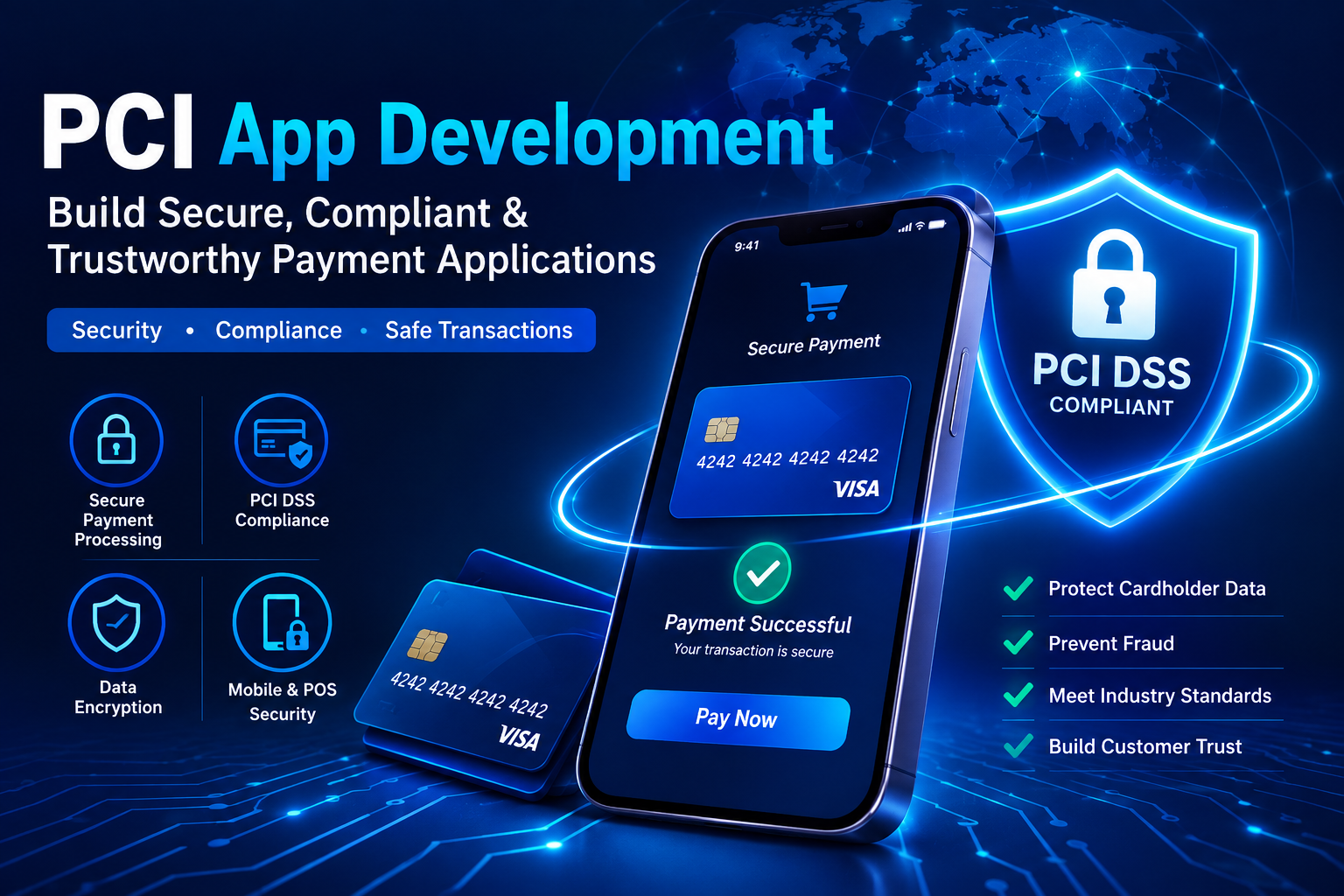
Payment applications are becoming an essential part of modern digital businesses. From mobile wallets and restaurant POS systems to e-commerce platforms and subscription services, businesses increasingly depend on applications that can process and manage payment information securely.
However, developing a payment application is not only about creating a smooth user interface. Security, data protection, compliance, encryption, and reliable payment processing are critical components of a successful payment solution.
In 2026, PCI-compliant app development is becoming increasingly important for businesses that handle payment card information.
What Is PCI App Development?
PCI app development refers to building applications that securely handle payment card data while following the requirements established by the Payment Card Industry Data Security Standard (PCI DSS).
A PCI-focused application may include:
- Mobile payment applications
- Payment gateways
- POS applications
- E-commerce applications
- Digital wallets
- Subscription payment platforms
- Payment management dashboards
- Financial applications
The objective is to protect sensitive payment information and reduce security risks throughout the payment lifecycle.
Why PCI Compliance Matters in 2026
Cybersecurity threats continue to evolve, and payment-related applications remain attractive targets for attackers.
Businesses that process, transmit, or store cardholder data need strong security controls to reduce the risk of data breaches and unauthorized access.
PCI-focused development helps businesses establish stronger practices around:
- Payment data protection
- Encryption
- Authentication
- Access control
- Secure application development
- Vulnerability management
- Security monitoring
Compliance should be considered during the application architecture and development process rather than added after the application is completed.
Key Features of a PCI-Compliant Payment Application
1. Secure Payment Processing
A payment application should use secure and trusted payment processing infrastructure instead of unnecessarily exposing sensitive card information.
Modern payment solutions can integrate with established payment gateways and tokenization services to reduce the amount of sensitive payment data handled directly by the application.
2. Data Encryption
Encryption is one of the most important components of payment application security.
Sensitive information should be protected while it is being transmitted and, where applicable, while it is stored.
Developers should implement appropriate encryption and secure communication protocols throughout the application architecture.
3. Tokenization
Tokenization replaces sensitive card information with a non-sensitive token.
Instead of repeatedly handling the actual card number, an application can use a token for future transactions or payment-related operations.
This can significantly reduce the exposure of sensitive card data within the application environment.
4. Strong Authentication
Payment applications should use appropriate authentication mechanisms to prevent unauthorized access.
Depending on the application, this may include:
- Multi-factor authentication
- Secure passwords
- Biometric authentication
- Session management
- Device verification
- Role-based access controls
5. Secure APIs
Modern payment applications depend heavily on APIs.
APIs may connect the application with:
- Payment gateways
- Banking platforms
- POS systems
- Cloud services
- Customer management platforms
- Accounting software
These APIs should be properly authenticated, authorized, monitored, and secured.
PCI App Development for Mobile Applications
Mobile payment applications require special attention because they operate across different devices, operating systems, networks, and environments.
A secure mobile payment application should consider:
- Secure local storage
- API security
- Certificate validation
- Authentication
- Session protection
- Application integrity
- Secure communication
- Protection against reverse engineering
Both Android and iOS applications should be designed with security requirements in mind from the beginning of development.
PCI Compliance and POS Applications
Point-of-sale applications are another major area where PCI security is important.
Modern POS systems may process transactions while also managing:
- Orders
- Products
- Customers
- Inventory
- Employees
- Discounts
- Receipts
- Reports
A secure POS architecture should separate sensitive payment operations from other business functionality whenever possible.
This approach can help reduce the scope of sensitive payment data within the broader business application.
The Role of Cloud Technology
Cloud platforms have transformed how payment applications are developed and deployed.
Cloud-based payment systems can provide:
- Scalable infrastructure
- Centralized monitoring
- Automated backups
- Access management
- Security monitoring
- High availability
- Application analytics
However, moving an application to the cloud does not automatically make it PCI compliant. The complete architecture, configuration, application code, access controls, and operational processes must be appropriately designed and managed.
Security Testing for Payment Applications
Security testing should be an ongoing part of PCI application development.
Important testing activities can include:
- Vulnerability assessments
- Penetration testing
- Code reviews
- API security testing
- Authentication testing
- Access-control testing
- Dependency scanning
- Configuration reviews
Regular testing can help identify vulnerabilities before they become serious security problems.
Common PCI App Development Challenges
Businesses often face several challenges when developing secure payment applications.
Managing Sensitive Data
Handling payment information requires careful architecture and strict controls.
Integrating Multiple Payment Providers
Businesses may need to support different payment gateways, currencies, regions, and payment methods.
Maintaining Compliance
Security requirements can change over time, requiring businesses to continuously review their systems and processes.
Protecting APIs
Poorly secured APIs can expose sensitive business and payment functionality.
Balancing Security and User Experience
Payment applications must be secure without creating unnecessary friction for customers.
Benefits of Professional PCI App Development
Working with an experienced development team can help businesses build payment applications with security integrated into the architecture.
Potential benefits include:
- Secure application architecture
- Payment gateway integration
- Mobile payment development
- POS application development
- API integration
- Cloud integration
- Security testing
- Ongoing maintenance
A professional development approach can also help businesses identify potential security issues earlier in the product lifecycle.
Future of PCI-Compliant Payment Applications
The payment technology ecosystem is continuing to evolve.
Future payment applications are expected to increasingly incorporate:
- Digital wallets
- Contactless payments
- Biometric authentication
- AI-powered fraud detection
- Tokenization
- Cloud-native payment infrastructure
- Real-time transaction monitoring
- Embedded payments
As payment experiences become more digital, security will remain one of the most important factors influencing customer trust.
Conclusion
PCI app development is becoming increasingly important for businesses building payment-related applications in 2026. Secure architecture, encryption, tokenization, authentication, API protection, and continuous security testing can help businesses create safer payment experiences.
Whether developing a mobile wallet, POS system, e-commerce application, or custom payment platform, security should be treated as a core product requirement rather than an afterthought.
Businesses planning to build payment applications should consider PCI requirements from the earliest stages of architecture and development to create secure, scalable, and trustworthy digital payment solutions.
Suggested SEO Keywords: PCI app development, PCI compliant app development, PCI DSS app development, payment app development, secure payment application, PCI compliance development, payment software development, secure POS development, payment gateway integration
Comments