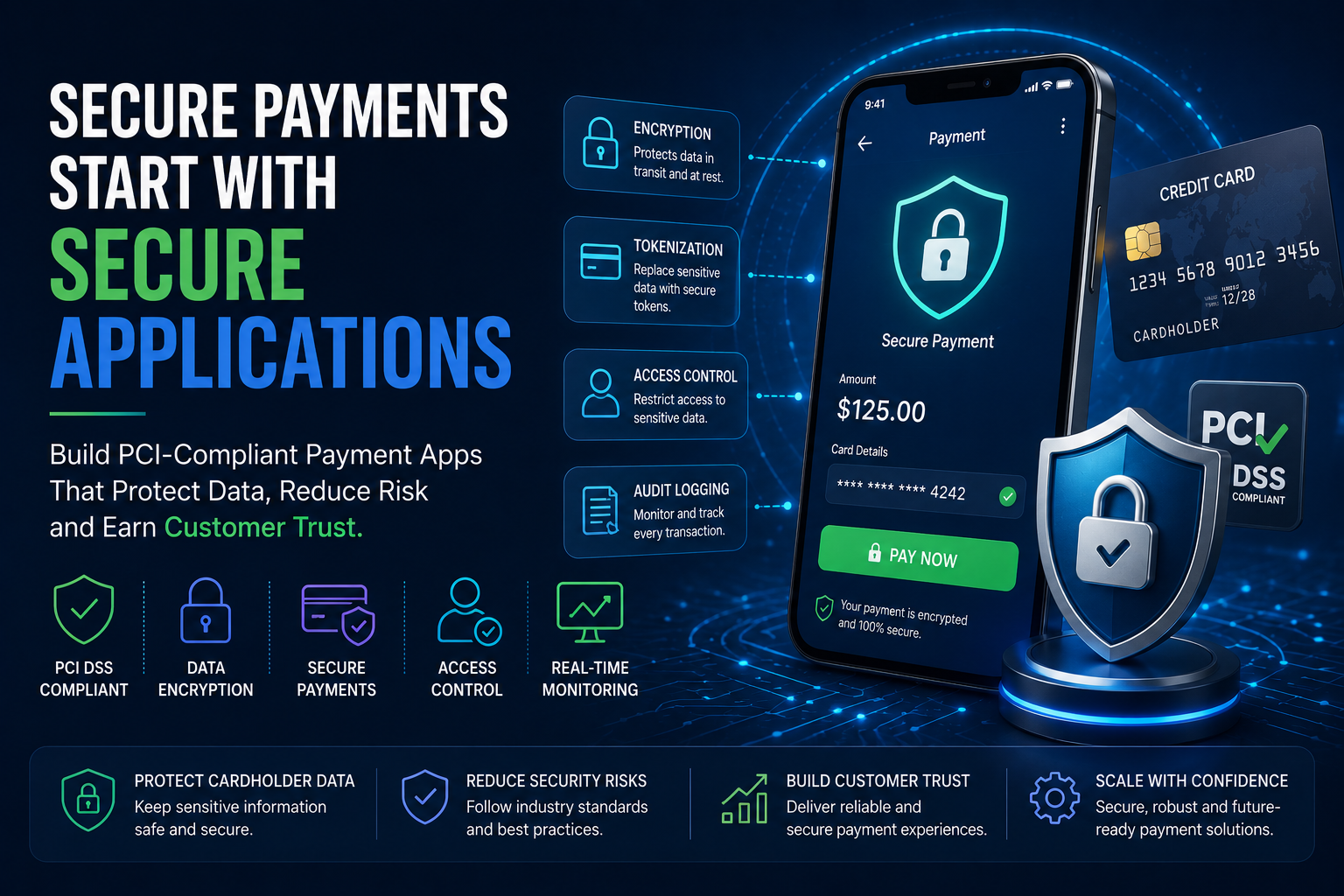
Every time a customer enters card details into a mobile app, website, or payment platform, they expect their information to remain protected.
For businesses, secure payment processing is no longer only a technical requirement. It is an important part of customer trust, business continuity, and long-term growth.
However, building a payment application involves more than adding a payment gateway. Businesses must consider secure data handling, access controls, encryption, application security, payment workflows, third-party integrations, and compliance requirements.
This is where PCI-focused application development becomes important.
At PCI App Developers, we help businesses build secure, scalable, and user-friendly payment applications with security considered throughout the development lifecycle.
What Is PCI Compliance?
PCI compliance refers to following the security requirements established by the Payment Card Industry Data Security Standard (PCI DSS).
PCI DSS provides a framework for protecting payment account data and improving the security of systems involved in payment processing.
The requirements may apply differently depending on how a business accepts, processes, stores, or transmits payment card information.
PCI compliance is not a one-time activity. Security must be reviewed and maintained as applications, payment systems, integrations, and business operations change.
Why Secure Payment App Development Matters
Customers want payment experiences that are:
- Fast
- Simple
- Reliable
- Secure
- Easy to understand
A poorly designed payment application can create risks such as:
- Unauthorized access
- Data exposure
- Payment fraud
- Security vulnerabilities
- Service interruptions
- Loss of customer confidence
Secure application development helps businesses reduce risk while creating smoother payment experiences.
PCI Compliance Is More Than Completing a Form
Some businesses view PCI compliance as a document or checklist completed before launching a payment product.
In reality, payment security should be part of the entire application lifecycle.
Security should be considered during:
- Business and technical planning
- Application architecture
- UI/UX design
- Software development
- Payment integration
- Security testing
- Deployment
- Ongoing maintenance
A secure payment application requires continuous attention because technology, threats, and business systems continue to change.
Key Components of a Secure Payment Application
1. Secure Payment Architecture
The application architecture should reduce unnecessary exposure to payment card information.
Businesses should clearly understand:
- Where payment information enters the system
- Which systems process payment data
- Whether card data is stored
- Which users can access payment-related systems
- How information moves between applications
A well-designed architecture can help reduce complexity and support stronger security controls.
2. Secure Payment Gateway Integration
Payment gateways allow applications to process transactions through trusted payment services.
A secure integration should consider:
- Tokenization
- Secure API communication
- Authentication
- Error handling
- Transaction validation
- Payment status updates
Whenever possible, businesses should avoid unnecessarily storing sensitive payment information.
3. Tokenization
Tokenization replaces sensitive payment information with a non-sensitive reference value called a token.
The application can use the token for approved payment-related operations without repeatedly handling the original card details.
This can reduce the exposure of sensitive information within the application.
4. Data Encryption
Encryption helps protect information while it is being transmitted or stored.
Payment applications may use encryption to protect:
- Data sent between applications
- API communication
- Sensitive business information
- Payment-related records
Encryption should be implemented using current, approved security practices and managed correctly.
5. Strong Authentication
Applications should verify the identity of users before providing access to sensitive features or information.
Security measures may include:
- Multi-factor authentication
- Secure password policies
- Session management
- Account monitoring
- Login alerts
6. Role-Based Access Control
Not every employee needs access to every system feature.
Role-based access controls can limit access according to job responsibilities.
For example:
- Customers may access their own payment information.
- Support teams may view limited transaction details.
- Finance teams may access reporting tools.
- Administrators may manage system settings.
This supports the principle of providing only the access required for a specific role.
7. Secure APIs
Modern payment applications often communicate through APIs.
API security may include:
- Authentication
- Authorization
- Input validation
- Rate limiting
- Secure communication
- Request monitoring
- Error management
A secure API strategy helps protect communication between applications and services.
8. Security Logging and Monitoring
Security events should be recorded and monitored.
Logs may help businesses identify:
- Unusual login activity
- Failed authentication attempts
- Unauthorized access
- Unexpected application behavior
- Important system changes
Monitoring can support faster detection and investigation of potential security issues.
Common Payment Application Security Mistakes
Storing Card Information Unnecessarily
Businesses should avoid storing sensitive payment information unless there is a clear business requirement and the required security controls are in place.
Using trusted payment providers and tokenization can reduce unnecessary exposure.
Adding Security Only at the End
Security is more effective when included during planning and development rather than added after the application is complete.
Using Weak Access Controls
Shared accounts, excessive permissions, and weak authentication can increase security risks.
Ignoring Third-Party Integrations
Payment applications may connect with:
- Payment gateways
- Banking services
- Accounting platforms
- CRM systems
- E-commerce platforms
- Fraud-detection tools
Third-party integrations should be reviewed for security and access requirements.
Delaying Security Updates
Software dependencies, operating systems, APIs, and application components should be maintained and updated according to a structured security process.
How PCI App Developers Build Secure Payment Applications
At PCI App Developers, we use a security-focused development approach.
Business and Compliance Discovery
We begin by understanding:
- Payment workflows
- Application requirements
- User roles
- Data movement
- Third-party services
- Business objectives
Secure Architecture Planning
Our team designs an application architecture that supports secure payment processing and scalable growth.
Custom Payment App Development
We develop custom:
- Payment applications
- Mobile payment apps
- Payment dashboards
- Transaction management platforms
- Subscription billing systems
- Payment portals
- Financial technology solutions
Payment Gateway Integration
We integrate payment services while focusing on secure communication, reliable transaction handling, and user-friendly payment experiences.
Security Testing
Testing may include:
- Application security reviews
- Authentication testing
- Access-control testing
- Input validation
- API security testing
- Vulnerability assessment
Deployment and Ongoing Support
Security does not end when an application launches.
We support application maintenance, updates, monitoring, and future improvements.
Benefits of Working With PCI-Focused Developers
Better Security Planning
Security requirements are considered from the beginning of the project.
Reduced Development Risk
A structured approach can help identify security concerns earlier.
Improved Customer Confidence
Secure and reliable payment experiences can strengthen customer trust.
Scalable Technology
Applications can be designed to support growing transaction volumes, users, and business requirements.
Custom Business Workflows
The application can be built around your payment processes rather than forcing your business to adapt to generic software.
Stronger Long-Term Value
Security-focused architecture can make future maintenance and improvements more manageable.
Industries That Benefit From Secure Payment Applications
PCI-focused payment development can support:
- E-commerce businesses
- Retail companies
- Restaurants
- Subscription platforms
- Marketplaces
- Healthcare payment systems
- Financial technology companies
- Travel and hospitality businesses
- SaaS platforms
- Online service providers
Any business that accepts payment cards through digital systems should consider security and PCI requirements during application planning.
The Future of Secure Digital Payments
Payment technology continues to evolve.
Future payment applications may include:
- AI-assisted fraud detection
- Biometric authentication
- Real-time transaction monitoring
- Digital wallets
- Contactless payment experiences
- Intelligent risk analysis
- Automated security monitoring
As payment experiences become faster and more connected, businesses will need to balance convenience with strong security.
The most successful payment applications will not treat security as an extra feature. Security will be part of the product’s foundation.
Final Thoughts
PCI compliance is not simply a checkbox completed before launching a payment application.
It is an ongoing approach to protecting payment information, reducing security risks, and building customer confidence.
A secure payment application should combine:
- Strong architecture
- Secure payment integrations
- Tokenization
- Encryption
- Access controls
- Authentication
- Security testing
- Continuous monitoring
At PCI App Developers, we help businesses build secure, scalable, and user-friendly payment applications designed for modern digital experiences.
Ready to build a secure payment application?
Connect with PCI App Developers to develop payment technology with security and business growth in mind.
Comments