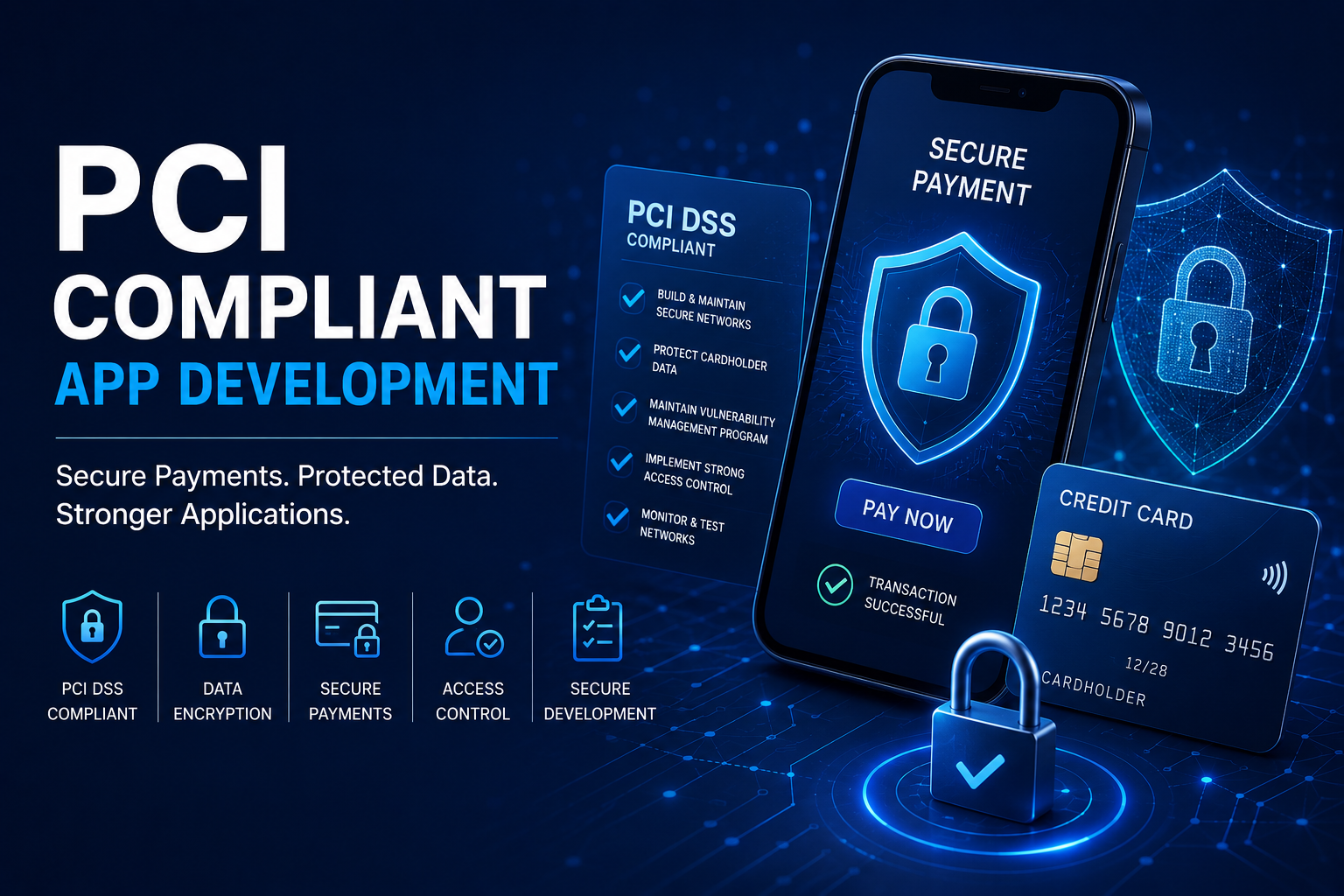
As digital payments continue to grow, businesses are increasingly relying on mobile and web applications to process transactions, manage customer information, and deliver seamless payment experiences.
With this growth comes a major responsibility: protecting payment card data.
PCI compliance has become an important consideration for businesses developing applications that interact with payment card information. In 2026, secure app development requires more than simply adding a payment gateway. Businesses need to consider security throughout the application architecture, development lifecycle, infrastructure, and payment-processing environment.
What Is PCI Compliant App Development?
PCI compliant app development refers to designing and developing applications in a way that supports the security requirements associated with the Payment Card Industry Data Security Standard (PCI DSS).
PCI DSS is designed to help organizations protect payment card data and reduce the risk of payment-related security breaches.
A PCI-focused application development strategy may involve:
- Secure payment processing
- Encryption
- Tokenization
- Secure APIs
- Access controls
- Authentication
- Vulnerability management
- Secure software development
- Logging and monitoring
- Secure payment integrations
The exact compliance responsibilities depend on how an application handles payment information and how the overall payment environment is designed.
Why PCI Compliance Matters for App Developers
Mobile and web applications can become an important part of the payment ecosystem.
An application may interact with:
- Payment gateways
- Payment processors
- Customer accounts
- Payment APIs
- POS systems
- E-commerce platforms
- Subscription systems
- Cloud services
If payment information is not handled securely, businesses may face security incidents, financial losses, reputational damage, and compliance problems.
For this reason, security should be considered during the initial architecture and development stages rather than added after the application is completed.
Key Elements of PCI Secure App Development
1. Minimize Payment Data Exposure
One of the most effective approaches to reducing payment security risk is to minimize the amount of sensitive card data that an application directly handles.
Developers should carefully evaluate whether payment card information needs to pass through their own application infrastructure.
Using secure payment providers and tokenization can help reduce the application’s exposure to sensitive payment information.
2. Use Tokenization
Tokenization replaces sensitive payment information with a non-sensitive token.
Instead of repeatedly storing or transmitting actual card information, an application can use a token when communicating with an authorized payment service.
This can help reduce the amount of sensitive payment data handled by the application.
3. Encrypt Sensitive Data
Sensitive information should be protected during transmission and, where applicable, while stored.
Developers should use modern security protocols and properly configured encryption rather than implementing custom cryptographic solutions.
Secure communication between:
Mobile App → API → Payment Service → Backend
is essential for protecting payment-related information.
4. Implement Strong Authentication
Applications that provide access to payment information or financial functionality should use strong authentication mechanisms.
Depending on the application, this may include:
- Strong passwords
- Multi-factor authentication
- Secure session management
- Biometric authentication
- Device verification
- Role-based access controls
Authentication should be combined with authorization so users can access only the resources they are permitted to use.
PCI Compliance for Mobile Applications
Mobile applications require special attention because they operate across different devices, operating systems, networks, and environments.
A secure payment application should consider:
- Secure local storage
- API authentication
- Certificate validation
- Session management
- Secure communication
- Application integrity
- Device security
- Secure logging
- Protection against reverse engineering
Developers should avoid storing sensitive payment information unnecessarily on mobile devices.
PCI Compliance for Web Applications
Web-based payment applications also require strong security controls.
Developers should consider:
- HTTPS
- Secure cookies
- Session protection
- Input validation
- Authentication
- Authorization
- API security
- Cross-site scripting protection
- Injection prevention
- Secure payment integrations
Third-party JavaScript and external services should also be carefully evaluated because compromised external resources can create additional security risks.
Secure Payment Gateway Integration
A payment gateway can simplify payment processing, but integrating one securely still requires careful development.
A secure integration should consider:
- Payment-provider requirements
- API authentication
- Secure communication
- Webhook validation
- Transaction verification
- Error handling
- Logging
- Fraud monitoring
- Sensitive-data handling
Developers should also ensure that payment status is verified securely rather than trusting unvalidated information received from the client application.
PCI DSS and APIs
APIs are a critical part of modern payment applications.
Mobile and web applications commonly communicate with backend services through APIs, making API security an important part of the overall architecture.
Important API security practices include:
- Strong authentication
- Authorization
- Input validation
- Rate limiting
- Secure tokens
- HTTPS
- API monitoring
- Proper error handling
- Secure secrets management
API keys, passwords, tokens, and other credentials should never be hard-coded into publicly distributed applications.
Secure Coding Practices
Security begins with the development process.
Developers should follow secure coding practices throughout the application lifecycle.
Important areas include:
Input Validation
Applications should validate user and system input before processing it.
Error Handling
Applications should avoid exposing sensitive technical information through error messages.
Dependency Management
Third-party libraries and frameworks should be monitored and updated when security vulnerabilities are discovered.
Secrets Management
Credentials, API keys, encryption keys, and other secrets should be stored securely rather than directly inside application source code.
Code Review
Security-focused code reviews can help identify vulnerabilities before an application reaches production.
PCI Compliance and Cloud Applications
Many modern payment applications use cloud infrastructure.
Cloud platforms can provide scalable infrastructure, monitoring, security services, and other capabilities, but moving an application to the cloud does not automatically make the application PCI compliant.
Businesses need to understand their responsibilities within the chosen cloud architecture.
Important considerations include:
- Identity and access management
- Network security
- Encryption
- Logging
- Monitoring
- Vulnerability management
- Secure configuration
- Data protection
The responsibilities of the application owner and cloud service provider should be clearly understood.
PCI Compliance for POS Applications
Point-of-sale applications often process payment transactions and therefore require careful security planning.
Modern POS applications may include:
- Mobile POS
- Restaurant POS
- Retail POS
- Cloud POS
- Tablet POS
- Self-service kiosks
A secure POS architecture should limit unnecessary exposure to cardholder data and use appropriate payment technologies and integrations.
For example, payment processing can be separated from the primary business application so that the POS application does not unnecessarily handle sensitive card information.
Testing a PCI-Focused Application
Security testing should be performed throughout development rather than only before launch.
Testing may include:
- Vulnerability assessments
- Code reviews
- Dependency scanning
- API security testing
- Penetration testing
- Configuration reviews
- Authentication testing
- Authorization testing
- Security monitoring
The specific testing and assessment requirements depend on the organization’s PCI DSS scope and responsibilities.
Common PCI App Development Mistakes
Businesses can increase their security risks by making avoidable development decisions.
Storing Card Data Unnecessarily
Applications should avoid storing sensitive card information unless there is a clear business and compliance requirement.
Hard-Coding Credentials
API keys and secrets should never be embedded directly into publicly distributed applications.
Ignoring Third-Party Dependencies
A secure application can still become vulnerable through outdated or compromised dependencies.
Weak Authentication
Simple passwords and poorly protected sessions can expose sensitive application functionality.
Insecure APIs
Poorly secured APIs can expose customer, transaction, and account information.
Treating Compliance as a One-Time Task
Security and compliance are ongoing processes. Applications, dependencies, infrastructure, and threats change continuously.
How AI Is Changing Secure Payment Applications
AI is increasingly being used in payment and cybersecurity environments.
AI-powered systems can help organizations analyze transaction patterns, detect unusual behavior, identify potential fraud, and prioritize security events.
Potential applications include:
- Fraud detection
- Transaction anomaly detection
- Behavioral analysis
- Automated security monitoring
- Risk scoring
- Threat detection
However, AI should complement—not replace—strong security architecture, secure development practices, and appropriate compliance processes.
Benefits of Working With a PCI-Focused App Development Team
Developing a payment-related application requires knowledge of both software engineering and security.
A specialized development team can help businesses with:
- Secure application architecture
- Payment gateway integration
- Mobile payment applications
- Web payment platforms
- POS application development
- API development
- Tokenization strategies
- Security testing
- Cloud integration
- Ongoing application maintenance
The development team should work closely with the organization’s compliance and security professionals to determine the appropriate PCI DSS scope and responsibilities.
Future of PCI Secure App Development
Payment applications will continue to evolve as businesses adopt mobile commerce, digital wallets, contactless payments, embedded finance, AI, and connected devices.
Future payment applications are likely to place greater emphasis on:
- Zero-trust security
- Tokenized payment architectures
- Passwordless authentication
- AI-powered fraud detection
- Secure APIs
- Cloud-native payment systems
- Continuous security monitoring
- Automated vulnerability management
Security will increasingly become a core product feature rather than an additional development task.
Conclusion
PCI-focused app development is essential for businesses building applications that interact with payment environments.
A secure payment application should minimize sensitive-data exposure, use secure payment integrations, protect APIs, implement strong authentication, follow secure coding practices, and continuously monitor the application environment.
In 2026, businesses should approach PCI security as an ongoing part of the software development lifecycle rather than a final checklist before launch.
By combining secure architecture, modern payment technologies, strong development practices, and continuous security monitoring, organizations can build payment applications that provide both stronger protection and better customer experiences.
Comments