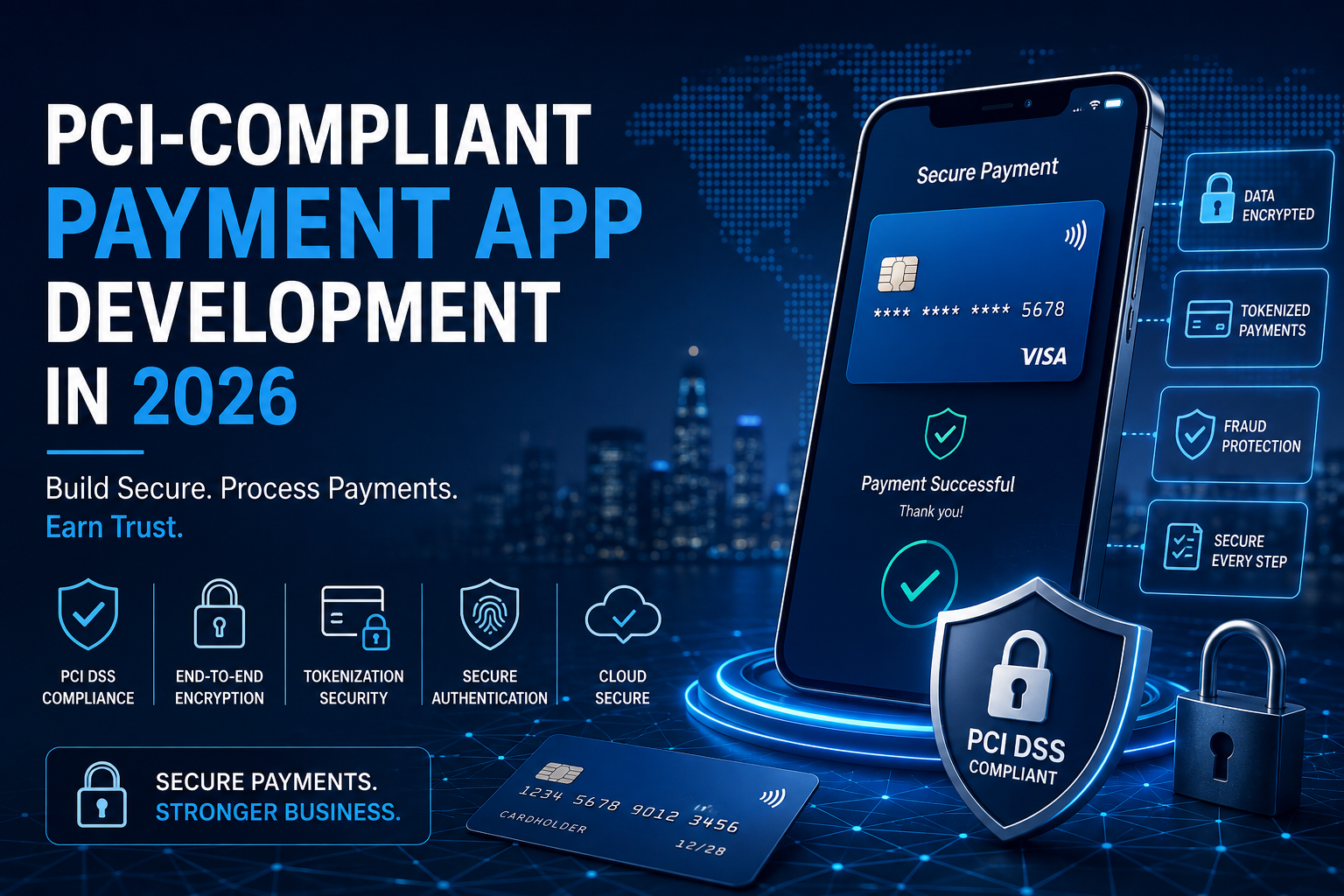
Introduction
Digital payments have become a core part of modern business.
Customers expect to pay through mobile apps, websites, digital wallets, subscriptions, QR codes, and connected devices. For businesses, this creates enormous opportunities—but it also creates significant security responsibilities.
A payment application cannot be developed like an ordinary mobile or web application.
It must be designed with security, privacy, payment processing, data protection, and compliance in mind from the beginning.
This is why PCI-compliant payment app development has become increasingly important in 2026.
Whether you are building a fintech platform, mobile payment application, marketplace, subscription platform, POS solution, or payment-enabled business application, security must be part of the product architecture—not something added after development.
What Is PCI DSS?
PCI DSS stands for Payment Card Industry Data Security Standard.
It is a security standard designed to help organizations protect payment card data and maintain secure payment environments.
For businesses developing payment applications, PCI DSS considerations can influence:
- Application architecture
- Data storage
- Payment processing
- Authentication
- Network security
- Access control
- Logging and monitoring
- Vulnerability management
- Security testing
The exact compliance requirements depend on the organization’s role, payment environment, technologies, and applicable PCI DSS requirements.
Why PCI Compliance Matters for Payment Apps
A payment application can potentially interact with highly sensitive information.
If payment data is exposed, businesses may face:
- Financial losses
- Customer trust issues
- Security incidents
- Operational disruption
- Regulatory or contractual consequences
- Significant remediation costs
Security therefore needs to be considered at every stage of development.
A secure payment application should protect data from the moment it enters the system through processing, transmission, and any permitted storage.
1. Start With a Secure Payment Architecture
The first step toward building a secure payment application is designing the architecture correctly.
A typical payment ecosystem may include:
Mobile/Web App → Secure API → Payment Gateway → Payment Processor → Banking Network
The application should avoid unnecessary exposure to sensitive cardholder data.
Whenever possible, businesses should use established payment providers and secure integrations rather than creating their own payment-processing infrastructure.
A well-designed architecture can reduce the application’s compliance scope while improving security and maintainability.
2. Use Tokenization Instead of Storing Card Data
One of the most important concepts in modern payment application development is tokenization.
Instead of storing sensitive card information directly, a payment provider can replace the sensitive information with a token.
The application can then work with the token rather than repeatedly handling raw card data.
Benefits can include:
- Reduced exposure to sensitive payment information
- Improved security
- Reduced storage requirements
- Better integration with payment providers
- Potentially reduced compliance scope
The exact implementation should be determined based on the payment provider and applicable PCI requirements.
3. Encrypt Data in Transit and at Rest
Encryption is a fundamental component of secure payment systems.
Data transmitted between applications, APIs, servers, and third-party services should use strong transport security.
Sensitive information that must be stored should also be protected using appropriate encryption and key-management practices.
Security should cover:
- Mobile applications
- Web applications
- APIs
- Databases
- Cloud infrastructure
- Administrative systems
- Third-party integrations
Encryption alone does not guarantee PCI compliance, but it is an important part of a broader security strategy.
4. Build Strong Authentication and Authorization
Payment applications need strong controls around user and administrator access.
Depending on the application, security mechanisms may include:
- Multi-factor authentication
- Strong password policies
- Secure session management
- Role-based access control
- Device verification
- Login monitoring
- Rate limiting
- Account lockout mechanisms
Administrative users should receive particularly strong protection because compromised administrative accounts can provide attackers with extensive access.
5. Secure Your APIs
Modern payment applications depend heavily on APIs.
The mobile or web application may communicate with backend services for:
- Customer accounts
- Payment status
- Orders
- Transactions
- Refunds
- Subscriptions
- Notifications
- Reporting
An insecure API can become a major attack surface.
Developers should implement appropriate controls such as:
- Authentication
- Authorization
- Input validation
- Rate limiting
- Secure error handling
- API monitoring
- Logging
- Protection against common web vulnerabilities
Every API endpoint should expose only the information and functionality required for its intended purpose.
6. Choose Payment Gateways Carefully
Building a payment application does not necessarily mean building the entire payment infrastructure yourself.
Established payment gateways and processors can provide important capabilities such as:
- Payment processing
- Tokenization
- Fraud detection
- 3-D Secure support
- Payment authentication
- Transaction management
- Refund processing
- Recurring payments
The correct provider depends on your business model, target market, currencies, payment methods, and technical requirements.
A development team should also understand exactly how the chosen provider affects the application’s PCI DSS responsibilities.
7. Secure Mobile Payment Applications
Mobile payment applications introduce additional security considerations.
Developers should consider:
- Secure local storage
- Certificate validation
- Application integrity
- Secure authentication
- Protection against reverse engineering
- Session security
- Jailbreak/root detection where appropriate
- Secure API communication
- Minimal collection of sensitive data
Sensitive payment information should not be unnecessarily stored on the user’s device.
The goal is to minimize the amount of valuable information available if a device is compromised.
8. Don’t Ignore Third-Party Integrations
Payment applications often connect with multiple external systems.
For example:
Payment Gateway + CRM + ERP + Accounting + Fraud Detection + Analytics
Every integration introduces another potential attack surface.
Businesses should evaluate:
- API authentication
- Data sharing
- Vendor security
- Permissions
- Encryption
- Logging
- Data retention
- Failure handling
Third-party services should receive only the data they actually need.
9. Security Testing Should Be Continuous
Security testing should not happen only immediately before launch.
A mature development lifecycle incorporates security throughout development.
Important activities can include:
Vulnerability Scanning
Identify known vulnerabilities in applications and dependencies.
Penetration Testing
Simulate attacks to identify weaknesses in the application and infrastructure.
Code Review
Review source code for security vulnerabilities and poor implementation practices.
Dependency Monitoring
Identify vulnerable third-party libraries and packages.
API Testing
Test authentication, authorization, input validation, and abuse scenarios.
Infrastructure Testing
Review cloud and server configurations for potential weaknesses.
10. PCI Compliance Is Not a One-Time Project
One common misconception is that achieving compliance once means the application remains compliant forever.
Technology changes.
Applications receive updates.
Dependencies change.
Infrastructure evolves.
New integrations are introduced.
Security threats also change.
Therefore, organizations need ongoing security and compliance processes.
This may include:
- Regular vulnerability management
- Security monitoring
- Access reviews
- Security testing
- Documentation
- Policy updates
- Incident-response planning
- Compliance assessments
Security should become part of the organization’s development and operational culture.
PCI-Compliant Payment Apps Need Security by Design
The most effective approach is to consider security before development begins.
During planning, businesses should determine:
- What payment information will the application handle?
- Where will payment data flow?
- What information actually needs to be stored?
- Which payment provider will be used?
- Which systems will communicate with the application?
- What users and administrators need access?
- What security controls are required?
- How will the application be tested?
- What compliance responsibilities apply?
- How will security be maintained after launch?
Answering these questions early can prevent expensive architectural changes later.
The Future of Secure Payment Applications
Payment technology is continuing to evolve.
Modern payment platforms are increasingly incorporating:
- AI-powered fraud detection
- Biometric authentication
- Digital wallets
- Contactless payments
- Tokenized transactions
- Real-time payment processing
- Embedded payments
- Subscription billing
- Connected POS systems
- Mobile commerce
As payment experiences become more intelligent and convenient, security must evolve alongside them.
The future of payment applications will not simply be about faster transactions.
It will be about creating secure, frictionless, intelligent, and trustworthy payment experiences.
How PCI App Developer Can Help
Building a payment application requires more than standard mobile or web development.
It requires an understanding of payment workflows, secure architecture, API integrations, authentication, data protection, testing, and compliance requirements.
PCI App Developer focuses on helping businesses develop payment-oriented applications with security and compliance considerations built into the development process.
From payment-enabled mobile applications and web platforms to POS integrations and secure payment workflows, the objective is to build technology that supports both business growth and customer trust.
Conclusion
In 2026, customers expect digital payments to be fast and effortless.
Businesses, however, must ensure that convenience does not come at the expense of security.
A successful payment application combines secure architecture, tokenization, encryption, strong authentication, protected APIs, trusted payment integrations, continuous testing, and ongoing compliance management.
PCI compliance should not be treated as a checkbox at the end of development.
It should be considered from the first architecture discussion through development, testing, deployment, and continuous improvement.
Building a secure payment application? Start with security by design.
Comments