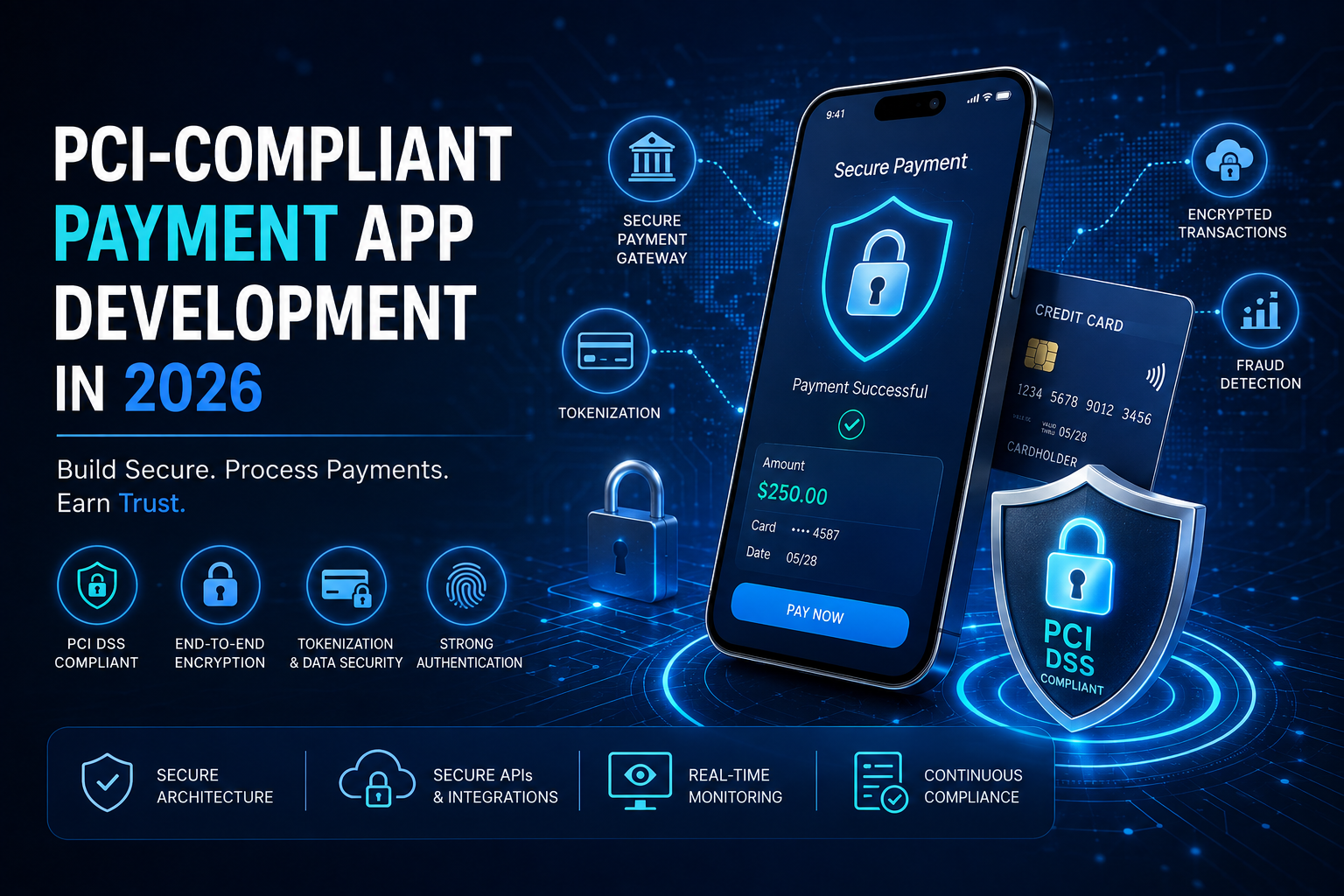
Digital payments have become a critical part of modern business. From mobile wallets and payment gateways to subscription platforms and POS systems, businesses increasingly depend on software that can process payments quickly and securely.
However, building a payment application is not simply about creating a convenient checkout experience. Businesses must also protect sensitive payment information and follow applicable security requirements.
This is where PCI-compliant payment app development becomes essential.
In 2026, companies developing payment applications need to consider security, compliance, encryption, authentication, tokenization, secure APIs, and continuous monitoring from the earliest stages of development.
What Is PCI Compliance?
PCI compliance refers to following the security requirements established by the Payment Card Industry Data Security Standard (PCI DSS).
PCI DSS is designed to protect payment card data and reduce the risk of unauthorized access, fraud, and data breaches.
For businesses developing payment applications, compliance should be treated as an ongoing security process rather than a one-time certification exercise.
Why PCI Compliance Matters for Payment Apps
Payment applications handle highly sensitive information. A security vulnerability can expose businesses and customers to financial losses, fraud, reputational damage, and regulatory problems.
A PCI-focused development approach helps businesses:
- Protect sensitive payment information
- Reduce security vulnerabilities
- Improve customer trust
- Minimize payment-related risks
- Strengthen application security
- Support secure payment processing
- Build scalable payment infrastructure
Security should be incorporated into the architecture instead of being added after development is complete.
Important Features of a PCI-Compliant Payment Application
1. Secure Data Encryption
Sensitive information should be protected during transmission and storage using appropriate encryption technologies.
Secure communication between mobile applications, servers, payment gateways, and other services is an important component of payment application security.
2. Tokenization
Tokenization can replace sensitive payment information with tokens that have limited value outside the intended payment environment.
This approach can help reduce the amount of sensitive card data directly handled by an application.
3. Secure Authentication
Payment applications should implement strong authentication and authorization mechanisms.
Depending on the application, businesses may use:
- Multi-factor authentication
- Secure session management
- Role-based access control
- Biometric authentication
- Device verification
- Secure password policies
4. Secure API Architecture
Modern payment applications often depend on APIs to communicate with payment gateways, banking systems, merchant platforms, and other services.
APIs should be designed with appropriate authentication, authorization, encryption, rate limiting, logging, and monitoring mechanisms.
5. Secure Payment Gateway Integration
Instead of unnecessarily storing sensitive payment information, businesses can integrate trusted payment gateways and use secure payment flows.
The architecture should clearly define how payment information moves between the customer, application, payment gateway, and backend systems.
6. Security Logging and Monitoring
Continuous monitoring can help identify suspicious activity and potential vulnerabilities.
Payment applications should have appropriate logging mechanisms for important security events while avoiding unnecessary exposure of sensitive information.
PCI Compliance Challenges in App Development
Developing a payment application can involve several challenges.
Handling Sensitive Information
Developers need to understand exactly what payment information the application collects, processes, transmits, or stores.
Reducing unnecessary handling of sensitive data can simplify the security architecture.
Third-Party Integrations
Payment applications frequently depend on external APIs, SDKs, gateways, analytics tools, and cloud services.
Every integration should be evaluated carefully because third-party components can introduce additional security risks.
Mobile Security
For iOS and Android payment applications, developers need to consider secure storage, application integrity, API security, authentication, and protection against common mobile security threats.
Continuous Compliance
Security requirements evolve, applications change, and infrastructure is updated regularly.
Therefore, PCI compliance should be incorporated into the application’s development, testing, deployment, and maintenance lifecycle.
PCI-Compliant Payment App Development Process
A structured development process can make compliance easier to manage.
Step 1: Define the Payment Architecture
First, identify how payment information will move through the system.
This includes the mobile application, backend, payment gateway, APIs, databases, cloud infrastructure, and third-party services.
Step 2: Minimize Sensitive Data Exposure
Determine which data the application actually needs to handle.
Reducing the application’s exposure to sensitive payment information can simplify security requirements.
Step 3: Implement Security Controls
Security controls should be incorporated into the application’s architecture and development process.
These may include encryption, authentication, access control, secure APIs, tokenization, and monitoring.
Step 4: Secure Development and Testing
Developers should conduct security-focused testing throughout development.
Testing may include:
- Vulnerability assessments
- API security testing
- Penetration testing
- Code reviews
- Authentication testing
- Infrastructure security testing
Step 5: Compliance Assessment
Before launching the application, businesses should evaluate their environment against the applicable PCI DSS requirements and work with qualified compliance professionals where appropriate.
Step 6: Continuous Monitoring
After launch, security monitoring, updates, vulnerability management, and periodic assessments should continue.
PCI Compliance for Mobile Payment Apps
Mobile payment applications require additional attention because they operate across different devices, operating systems, networks, and APIs.
A secure mobile payment application should consider:
- Secure local data storage
- Encrypted network communication
- Strong authentication
- Secure API communication
- Session protection
- Application integrity
- Secure SDK integrations
- Regular security updates
Developers should also avoid unnecessarily storing sensitive payment information on the user’s device.
How AI Is Changing Payment Security in 2026
Artificial intelligence is increasingly being used in payment ecosystems for fraud detection, transaction monitoring, anomaly detection, and risk analysis.
AI-powered systems can analyze transaction patterns and identify unusual activity that may require additional verification.
However, AI itself must also be implemented securely. Businesses should ensure that sensitive payment information is handled appropriately and that AI integrations do not introduce new privacy or security risks.
Why Choose PCIAppDeveloper?
Building a secure payment application requires expertise across mobile development, backend engineering, API integration, payment infrastructure, and security.
PCIAppDeveloper focuses on payment application development for businesses that need secure and scalable digital payment solutions.
Development capabilities can include:
- PCI-focused payment app development
- iOS payment applications
- Android payment applications
- Payment gateway integration
- Secure API development
- Mobile wallet development
- POS application development
- Payment platform development
- Backend and cloud development
- Security-focused application testing
The goal is to help businesses develop payment applications with security and compliance considerations integrated into the development lifecycle.
Choosing the Right Payment App Development Partner
Before selecting a development company, businesses should evaluate its technical experience and understanding of payment ecosystems.
Important questions include:
- Does the development team understand PCI DSS requirements?
- Does the company have payment application experience?
- How does it protect sensitive payment information?
- How are APIs and third-party integrations secured?
- What security testing is included?
- How is the application monitored after launch?
- Can the platform scale as transaction volumes increase?
The right development partner should understand both the technology and security requirements involved in payment applications.
Conclusion
PCI-compliant payment app development is becoming increasingly important as businesses move more payment experiences to mobile and digital platforms.
A successful payment application needs more than an attractive interface. It requires secure architecture, encrypted communication, appropriate authentication, secure APIs, careful data handling, payment gateway integration, continuous testing, and ongoing security management.
By integrating security and compliance considerations from the beginning, businesses can build payment applications that are more resilient, scalable, and trustworthy.
PCIAppDeveloper can help businesses develop secure payment applications tailored to their technical and business requirements.
Comments