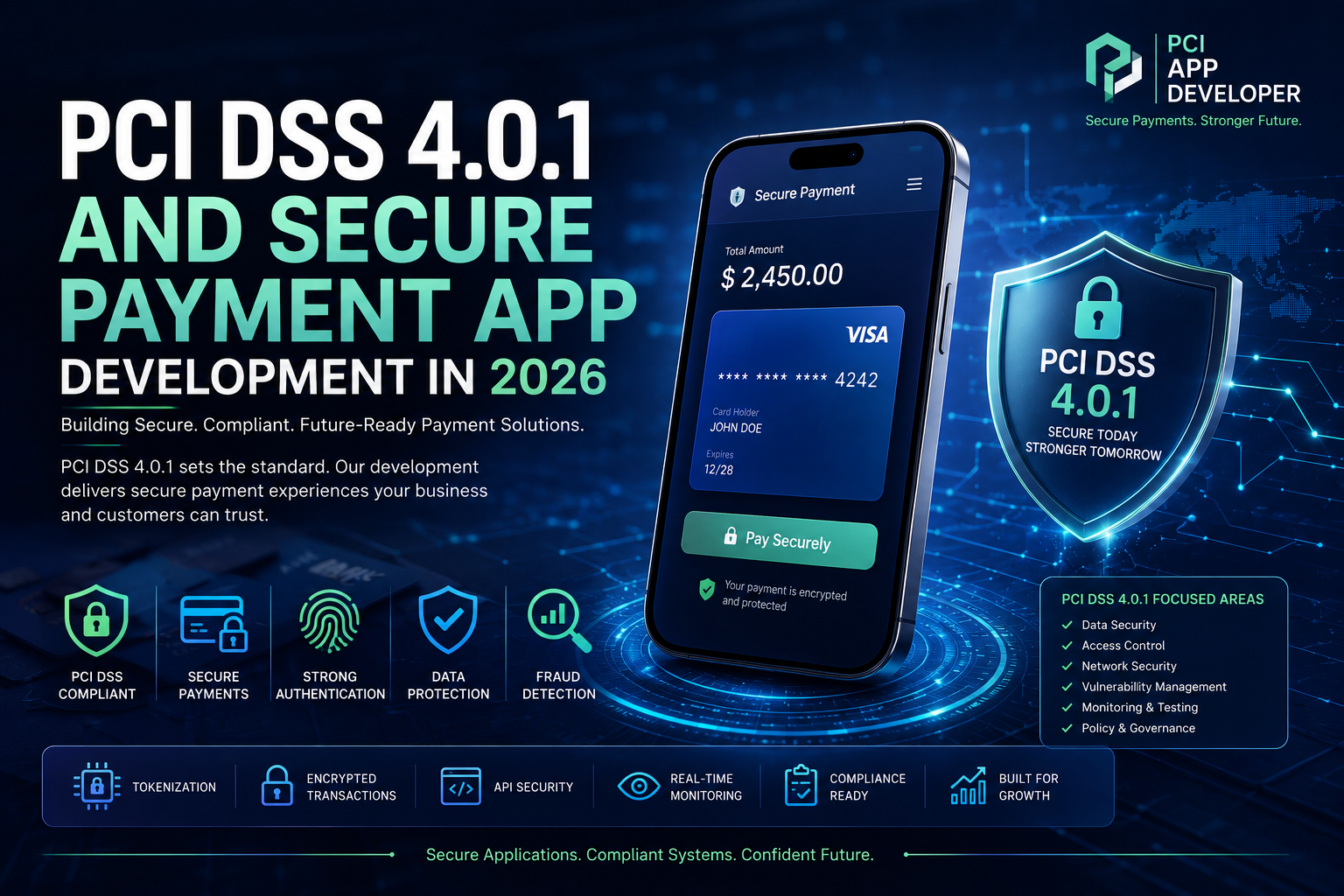
Digital payments have become an essential part of modern business. Customers expect fast, simple, and secure payment experiences across mobile apps, websites, eCommerce platforms, point-of-sale systems, and connected devices.
As payment technology evolves, cybersecurity risks continue to grow. Businesses that store, process, or transmit payment card information must take strong measures to protect sensitive data and reduce the risk of security incidents.
In 2026, secure payment app development is no longer only about adding encryption or integrating a payment gateway. Businesses need a complete security strategy that includes secure software architecture, strong access controls, continuous monitoring, secure development practices, and compliance with applicable payment security requirements.
PCI DSS 4.0.1 is an important part of this evolving payment security landscape.
What Is PCI DSS?
The Payment Card Industry Data Security Standard, commonly known as PCI DSS, is a set of security requirements designed to help protect payment account data.
PCI DSS applies to organizations that store, process, or transmit payment card information, as well as organizations that can affect the security of the cardholder data environment.
The standard covers important security areas such as:
- Network security
- Access control
- Data protection
- Secure system configuration
- Vulnerability management
- Security monitoring
- Security testing
- Information security policies
PCI DSS is not a one-time software feature. It requires an ongoing security and compliance approach.
What Is PCI DSS 4.0.1?
PCI DSS 4.0.1 is an update to PCI DSS 4.0 that provides clarification and corrections while maintaining the overall security objectives of the standard.
The update supports a more flexible and outcome-focused approach to payment security while continuing to emphasize strong protection for payment account data.
For businesses developing payment applications, PCI DSS 4.0.1 increases the importance of:
- Secure software development
- Strong authentication
- Access management
- Continuous security monitoring
- Regular testing
- Risk-based security practices
- Clear security documentation
Businesses should review the requirements that apply to their payment environment and work with qualified compliance and security professionals when needed.
Why Secure Payment App Development Matters
Payment applications often handle highly sensitive information.
A security weakness may lead to:
- Unauthorized access
- Payment fraud
- Data exposure
- Financial losses
- Business disruption
- Customer trust issues
- Compliance concerns
Secure payment app development helps reduce risk by building security into the application from the beginning.
Instead of treating security as a final testing step, development teams should consider security during:
- Business and compliance planning
- Software architecture
- UI and UX design
- Application development
- API integration
- Quality assurance
- Deployment
- Ongoing maintenance
This approach is often called security by design.
Key Security Features for Payment Applications
1. Payment Data Protection
Sensitive payment information should be protected during transmission and storage.
Security measures may include:
- Strong encryption
- Secure communication protocols
- Secure key management
- Tokenization
- Data minimization
Businesses should avoid storing sensitive payment data unless there is a clear business requirement and an appropriate security and compliance strategy.
2. Tokenization
Tokenization replaces sensitive payment information with a unique token.
The token can be used by the application or payment workflow without exposing the original payment information in every system.
Tokenization can help reduce the amount of sensitive payment data handled by an application, but it does not automatically remove all security or compliance responsibilities.
3. Strong Authentication
Payment applications should verify that users are authorized to access accounts and sensitive functions.
Authentication methods may include:
- Multi-factor authentication
- Biometric authentication
- Secure passwords
- One-time verification codes
- Device-based authentication
Authentication requirements should be designed according to the application’s risk level and user experience needs.
4. Role-Based Access Control
Not every employee or system should have access to all payment information.
Role-based access control helps limit access according to job responsibilities.
For example:
- Customers may access only their own payment information
- Support teams may view limited transaction details
- Finance teams may access approved reporting features
- Administrators may manage system settings
Limiting access can reduce the impact of compromised accounts.
5. Secure Payment APIs
Payment applications often connect with:
- Payment gateways
- Banking platforms
- POS systems
- Accounting software
- Fraud detection services
- Customer management systems
APIs should be designed and tested securely.
Important practices may include:
- Strong authentication
- Secure authorization
- Input validation
- Rate limiting
- Encrypted communication
- API activity monitoring
6. Secure Coding Practices
Application security begins with the code.
Development teams should follow secure coding practices to reduce common risks such as:
- Injection attacks
- Broken access controls
- Insecure data handling
- Authentication weaknesses
- Sensitive information exposure
Code reviews and automated security testing can help identify issues earlier in the development process.
Emerging Payment Security Trends in 2026
AI-Powered Fraud Detection
Artificial intelligence is helping payment systems identify unusual behavior and possible fraud.
AI-powered fraud detection may analyze:
- Transaction patterns
- Device activity
- User behavior
- Login activity
- Location signals
- Payment frequency
AI can help security teams identify suspicious activity more quickly. However, AI systems should be monitored to reduce false positives and support accurate decision-making.
Real-Time Security Monitoring
Businesses are moving from periodic security reviews toward continuous monitoring.
Real-time monitoring can help identify:
- Unusual login activity
- Unauthorized access attempts
- Suspicious transactions
- API abuse
- Unexpected system behavior
Continuous monitoring can improve visibility and support faster incident response.
Passwordless Authentication
Passwordless authentication is becoming more common in mobile and web applications.
Technologies such as biometrics, device-based authentication, and passkeys can improve security while reducing the need for users to remember complex passwords.
Zero-Trust Security
Zero-trust security is based on the principle that users, devices, and systems should be continuously verified.
Instead of automatically trusting a user because they are inside a company network, the system evaluates access based on identity, permissions, device security, and context.
Secure Mobile Payment Experiences
Mobile payment applications continue to grow.
Secure mobile payment development may include:
- Biometric authentication
- Secure device storage
- Encrypted communication
- App integrity checks
- Secure session management
- Protection against application tampering
Common Payment App Security Mistakes
Businesses should avoid treating payment security as an afterthought.
Common mistakes include:
- Storing unnecessary payment data
- Using weak authentication
- Providing excessive user permissions
- Exposing sensitive information in logs
- Using outdated software components
- Skipping security testing
- Failing to monitor payment systems
- Assuming that a payment gateway handles every compliance responsibility
A secure payment application requires shared responsibility across the business, development team, infrastructure providers, payment partners, and security professionals.
The Secure Payment App Development Process
A structured development process can help businesses create secure and scalable payment solutions.
Step 1: Payment and Compliance Discovery
The development team reviews:
- Payment workflows
- Business requirements
- User roles
- Data flows
- Required integrations
- Security risks
- Applicable compliance obligations
Step 2: Secure Architecture Planning
The application architecture is designed to protect sensitive data and reduce unnecessary exposure.
This may include:
- Tokenization
- Data segmentation
- Secure APIs
- Role-based access
- Secure cloud infrastructure
Step 3: UI and UX Design
Security should support a smooth user experience.
The application should make secure actions clear without creating unnecessary complexity for customers.
Step 4: Secure Application Development
Developers build the payment application using secure coding practices and approved development processes.
Step 5: Security Testing
Testing may include:
- Vulnerability assessments
- Application security testing
- API security testing
- Authentication testing
- Access control testing
- Penetration testing
Step 6: Secure Deployment
The application is deployed using secure infrastructure and appropriate monitoring.
Step 7: Ongoing Security and Maintenance
Payment security requires continuous attention.
Businesses should regularly:
- Apply security updates
- Monitor system activity
- Review user access
- Test security controls
- Update software dependencies
- Review compliance requirements
How to Choose a PCI App Development Company
When selecting a payment application development partner, consider:
- Experience with payment applications
- Knowledge of PCI DSS requirements
- Secure software development practices
- Payment gateway integration experience
- API security expertise
- Mobile and web development capabilities
- Security testing processes
- Post-launch support
A reliable development company should understand both the technical and business requirements of a payment solution.
Build Secure Payment Applications with PCI App Developer
At PCI App Developer, we help businesses create secure, scalable, and user-friendly payment applications.
Our services include:
- PCI-focused payment application development
- Secure mobile payment apps
- Payment gateway integration
- Custom POS application development
- Payment API development
- Tokenization integration
- Secure web application development
- Payment software modernization
- Application security testing
- Ongoing maintenance and support
We work with businesses to understand payment workflows, technical requirements, security needs, and long-term product goals.
Conclusion
Payment technology is becoming faster, more connected, and more intelligent. At the same time, businesses must take stronger steps to protect payment data and maintain secure systems.
PCI DSS 4.0.1 reinforces the importance of continuous security, strong access controls, secure development, and risk-based protection.
A secure payment application should be designed with security from the beginning and maintained throughout its lifecycle.
By combining secure architecture, strong authentication, tokenization, secure APIs, regular testing, and continuous monitoring, businesses can build payment solutions that support customer trust and long-term growth.
Ready to develop a secure payment application? Connect with PCI App Developer to discuss your payment software project.
Comments