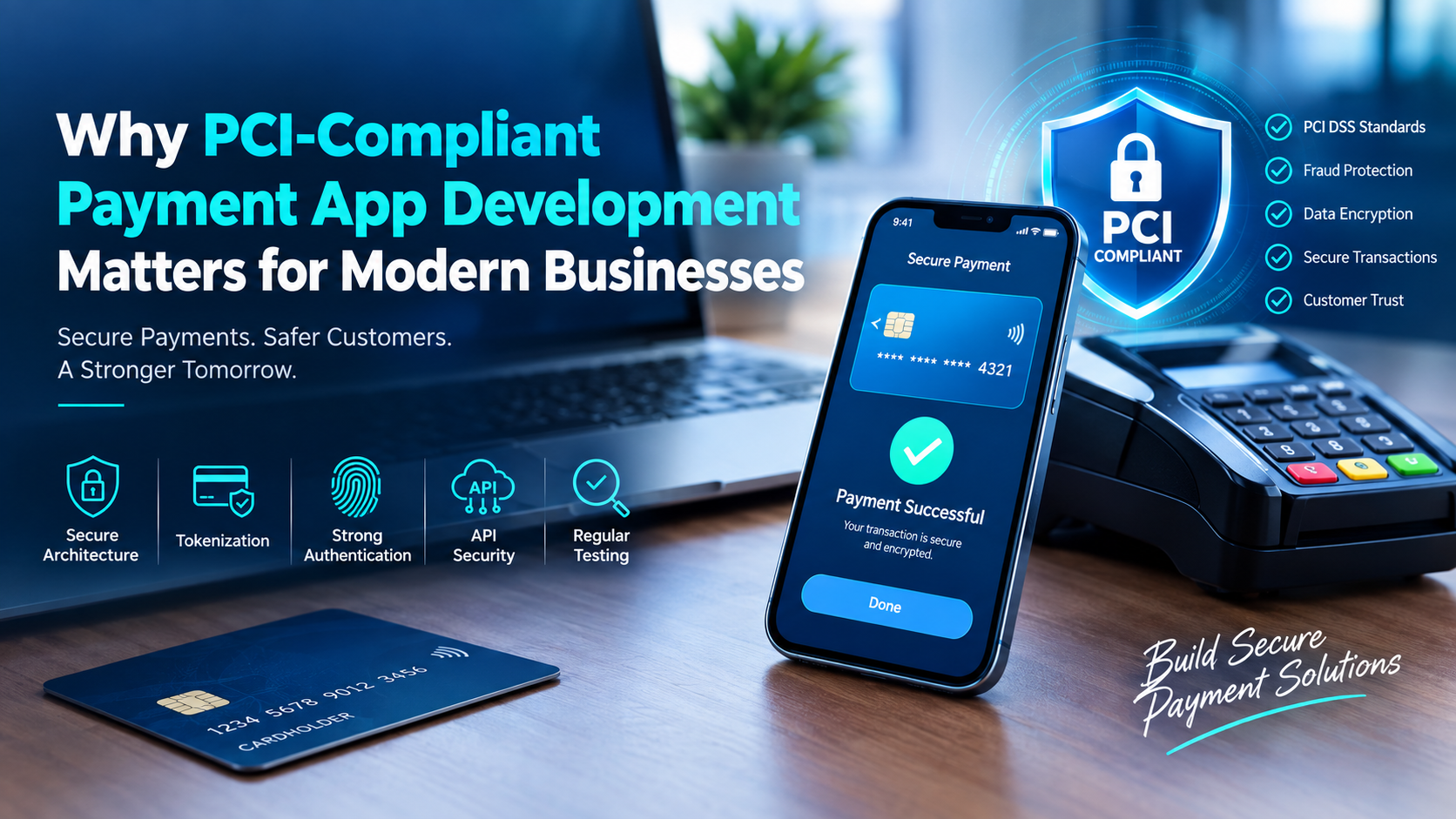
As digital payments continue to grow, businesses are relying more heavily on payment applications, mobile wallets, POS systems, online checkout platforms, and connected payment solutions.
But with greater convenience comes greater responsibility.
Businesses handling cardholder data need to prioritize payment security, data protection, and PCI compliance from the beginning of the application development process.
A payment application isn’t simply another mobile or web application. It requires a carefully designed security architecture capable of protecting sensitive payment information throughout the transaction lifecycle.
This is where PCI-compliant payment app development becomes essential.
What Is PCI Compliance?
PCI compliance refers to following the security requirements established by the Payment Card Industry Data Security Standard (PCI DSS).
The standard is designed to help organizations protect payment card data and reduce the risks associated with data breaches, unauthorized access, and payment fraud.
For businesses developing payment-related applications, compliance should be considered during architecture, development, testing, deployment, and ongoing maintenance.
Why Payment Application Security Matters
Payment applications can process highly sensitive information.
Depending on the application and payment architecture, this may include:
- Payment transaction information
- Cardholder data
- Customer information
- Authentication information
- Transaction history
- Payment tokens
- Merchant information
A security weakness anywhere in the application can potentially create significant business and customer risks.
For this reason, payment application development requires a security-first approach rather than adding security after the product has already been built.
Key Features of Secure Payment Applications
A modern payment application should combine usability with strong security controls.
1. Secure Data Transmission
Sensitive information should be protected while it moves between the application, payment gateway, APIs, and backend infrastructure.
Secure communication protocols and properly configured encryption help reduce the risk of unauthorized interception.
2. Strong Authentication
Authentication is an important part of protecting payment applications.
Depending on the product, developers can implement:
- Multi-factor authentication
- Secure password policies
- Biometric authentication
- Token-based authentication
- Role-based access controls
- Session management
The right approach depends on the application’s users, architecture, and security requirements.
3. Tokenization
Tokenization can reduce the need for applications to directly handle sensitive payment information.
Instead of repeatedly storing or transmitting actual payment card information, a payment system can use tokens that represent the underlying data.
This can help reduce the application’s exposure to sensitive cardholder information.
4. Secure API Development
Modern payment applications frequently communicate with multiple APIs.
These may connect the application with:
- Payment gateways
- Banking services
- POS systems
- Accounting platforms
- CRM systems
- Fraud detection services
- Cloud infrastructure
APIs therefore need appropriate authentication, authorization, validation, rate limiting, logging, and security controls.
PCI Compliance Should Start During Development
One of the biggest mistakes businesses can make is treating compliance as a final-stage checklist.
Security considerations should be incorporated throughout the software development lifecycle.
A strong development process can include:
Planning → Architecture → Secure Coding → Testing → Security Review → Deployment → Monitoring
Building security into the architecture from the beginning can be considerably more effective than attempting to fix fundamental security problems after launch.
PCI-Compliant Mobile Payment Apps
Mobile payment applications have become increasingly important for businesses.
A secure mobile payment application may support:
- Digital payments
- Mobile wallets
- In-app purchases
- POS connectivity
- Customer accounts
- Transaction history
- Push notifications
- Payment gateway integration
- Secure authentication
Developers also need to consider mobile-specific security risks, including insecure storage, reverse engineering, compromised devices, API vulnerabilities, and insecure communication.
PCI Compliance for POS Applications
Modern POS platforms are becoming much more than billing systems.
A sophisticated POS application can combine:
Payments + Inventory + Customer Management + Analytics + Orders + Loyalty
Because POS systems can be directly involved in payment processing, their architecture must be designed carefully.
Businesses developing restaurant, retail, hospitality, or enterprise POS solutions should consider payment security from the earliest design stages.
The Role of Security Testing
Secure development doesn’t end when the code is written.
Applications should go through appropriate testing and security reviews to identify potential weaknesses.
Depending on the application, security testing can include:
- Vulnerability assessment
- API security testing
- Authentication testing
- Authorization testing
- Penetration testing
- Secure code review
- Dependency analysis
- Configuration reviews
Regular testing is particularly important because applications, dependencies, APIs, and infrastructure change over time.
Why Choose a Specialized PCI App Development Partner?
Developing a payment application requires more than standard software development expertise.
Businesses need developers who understand the relationship between:
- Application architecture
- Payment processing
- API integrations
- Data security
- Mobile security
- Cloud infrastructure
- POS systems
- Compliance requirements
A specialized PCI app development company can help businesses plan their application architecture around security and compliance requirements from the beginning.
Building the Future of Secure Payments
The payment technology landscape is evolving rapidly.
Mobile payments, digital wallets, contactless transactions, cloud POS systems, embedded payments, and connected commerce are creating new opportunities for businesses.
At the same time, security expectations are becoming increasingly important.
Businesses that invest in secure payment application development can create products that are not only convenient but also designed to protect sensitive information.
Conclusion
Payment technology is becoming an essential part of modern digital businesses.
Whether you’re developing a mobile payment app, POS application, payment gateway integration, fintech platform, or enterprise payment solution, security should be part of the foundation.
PCI-focused development helps businesses approach payment applications with security, compliance, and scalability in mind.
The goal isn’t simply to build an application that processes payments.
The goal is to build a payment experience that customers and businesses can trust.
SEO Keywords
- PCI app development
- PCI compliant app development
- PCI DSS compliant application development
- payment app development
- secure payment app development
- PCI compliance developers
- payment application development company
- PCI compliant mobile app
- secure payment application
- PCI compliant POS development
Meta Title
PCI-Compliant Payment App Development: Security & Best Practices
Meta Description
Learn why PCI-compliant payment app development matters and how secure architecture, tokenization, authentication, APIs, and testing help protect payment applications.
Comments