PCI Developers Navbar

Tag: appdevelopement

  • 10 Things Payment App Developers Hear Every Week — And Why They’re Funny

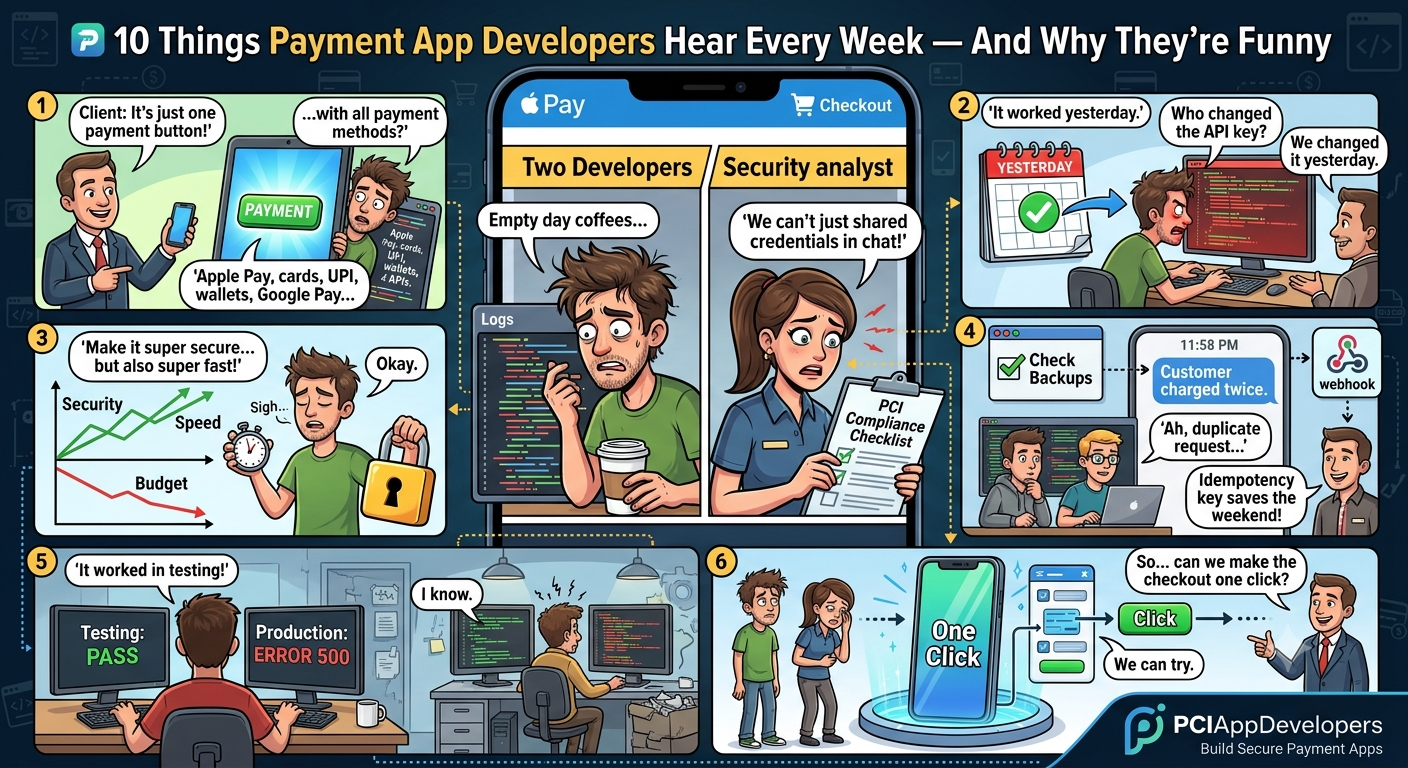
    10 Things Payment App Developers Hear Every Week — And Why They’re Funny

    Building a payment application sounds simple.

    A customer taps Pay.

    The payment goes through.

    Everyone goes home happy.

    Right?

    If only.

    Behind that little “Payment Successful” message are developers, APIs, security controls, databases, encryption, testing, compliance requirements, and at least one person asking:

    “Why did the payment fail only for this one customer?”

    Welcome to the funny side of payment app development.

    1. “It’s Just a Payment Button”

    Client:

    “We only need one payment button.”

    Developer:

    “Sure. Which payment methods?”

    Client:

    “Everything.”

    Developer:

    “Meaning?”

    Client:

    “Cards, Apple Pay, Google Pay, UPI, wallets, bank transfers, international cards…”

    Developer:

    “So… one button?”

    The button may be tiny.

    The architecture behind it definitely isn’t.

    2. “The Payment Worked Yesterday”

    Few sentences create more excitement for a payment developer than:

    “It was working yesterday.”

    Developer checks the code.

    Everything looks fine.

    Checks the database.

    Fine.

    Checks the payment gateway.

    Fine.

    Checks the logs.

    Nothing.

    Checks everything again.

    Still nothing.

    Then someone discovers that an API key was changed.

    Developer:

    “And when exactly did you change it?”

    Client:

    “Yesterday.”

    Developer:

    Deep breath.

    3. The Famous Test Payment

    Every payment developer has made hundreds of test transactions.

    Test card.

    Test payment.

    Test refund.

    Test failure.

    Test timeout.

    Test webhook.

    Test everything.

    At some point, the developer becomes so familiar with test payments that they almost feel emotionally attached to imaginary money.

    ₹10,000 paid successfully.

    Developer:

    “Excellent!”

    Bank account:

    ₹0.

    Developer:

    “Oh right.”

    4. “Can We Skip PCI Compliance?”

    This is one question payment developers definitely don’t want to hear.

    “Can we skip PCI compliance? It’s just an app.”

    Unfortunately, payment security doesn’t work that way.

    If a system handles payment card data, security and compliance requirements need to be considered from the beginning of the architecture.

    That means developers may need to think about:

    • Secure payment processing
    • Data protection
    • Encryption
    • Authentication
    • Access controls
    • Secure APIs
    • Logging and monitoring
    • Vulnerability management
    • Secure development practices
    • PCI DSS requirements

    So yes…

    That little payment button has homework.

    5. “The Customer Says They Were Charged Twice”

    This message arrives at 11:58 PM.

    “Customer says payment was deducted twice.”

    Everyone suddenly becomes very interested in logs.

    The development team starts checking:

    • Transaction IDs
    • Webhooks
    • Payment gateway responses
    • Retry logic
    • Database records
    • Network timeouts
    • Duplicate requests

    Eventually:

    “Ah. The customer clicked Pay twice.”

    Everyone looks at the screen silently.

    6. The Webhook Has Entered the Chat

    Webhooks are incredibly useful.

    They can also create interesting conversations.

    Developer:

    “We received the payment webhook.”

    Backend:

    “Great.”

    Webhook:

    “Here comes another one.”

    Backend:

    “Why?”

    Webhook:

    “Because I’m feeling generous.”

    Suddenly the system has to handle duplicate notifications without accidentally creating duplicate orders, invoices, or transactions.

    That’s why idempotency isn’t just a fancy technical word.

    It can save your weekend.

    7. “Make It Super Secure… But Also Super Fast”

    Client requirements:

    Maximum security.

    Maximum speed.

    Minimum development time.

    Minimum budget.

    Developer:

    “Anything else?”

    Client:

    “Make it beautiful.”

    Of course.

    Modern payment applications have to balance security, performance, usability, scalability, and business requirements.

    That’s why good payment app architecture matters.

    8. When Production Says Hello

    Everything works in development.

    Everything works in staging.

    The team celebrates.

    Then production says:

    “Hello.”

    Suddenly:

    • One API behaves differently.
    • One payment method fails.
    • One customer gets an error.
    • One webhook arrives late.
    • One database query takes 12 seconds.

    Developer:

    “But it worked in testing!”

    Production:

    “I know.”

    9. The Password Conversation

    Security team:

    “You cannot share credentials through chat.”

    Developer:

    “Absolutely.”

    Five minutes later:

    Someone sends:

    **“API key: ******”

    Developer:

    “Please delete that message.”

    Security:

    “I saw it.”

    Developer:

    “I know.”

    This is why secure credential management and proper access controls matter in payment software development.

    10. The Ultimate Payment App Question

    After weeks of development, testing, security reviews, integrations, and debugging, someone finally asks:

    “So… can we make the checkout one click?”

    Developer:

    “We can try.”

    And that’s how another payment technology project begins.

    Final Thoughts

    Payment app development isn’t only about making transactions work.

    It involves security, reliability, payment gateway integration, APIs, authentication, data protection, testing, monitoring, and compliance.

    And when card payments are involved, PCI DSS requirements need to be considered as part of the overall payment environment and security strategy.

    At PCIAppDevelopers, the goal is to help businesses build payment applications with security and compliance considerations from the beginning—not after the first production incident.

    Because a payment application should make customers think:

    “That was easy.”

    Not:

    “Where did my money go?”

    And developers should ideally finish the project saying:

    “It works.”

    Instead of:

    “It worked yesterday.”

  • Payment App Development in 2026: How to Build Secure and PCI-Aligned Payment Software

    Payment App Development in 2026: How to Build Secure and PCI-Aligned Payment Software

    Digital payments have become a core part of modern commerce. Businesses now expect payment applications to support cards, digital wallets, mobile payments, recurring transactions, online checkout, refunds, subscriptions, and multiple payment providers.

    But building a payment application requires more than creating a checkout screen and connecting a payment gateway.

    A modern payment app development project needs to consider application architecture, data protection, authentication, encryption, secure APIs, payment processing, third-party integrations, logging, vulnerability management, and applicable PCI requirements.

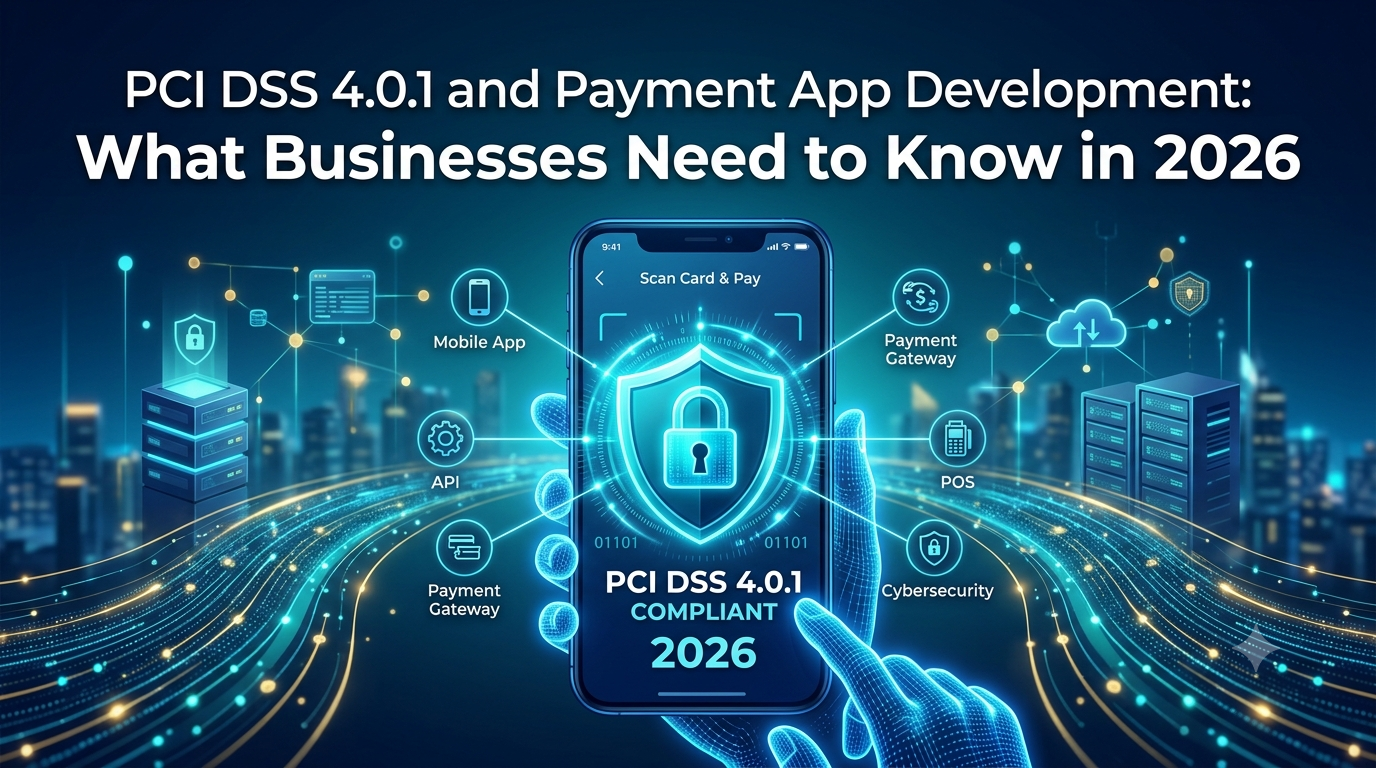
    In 2026, developers also need to understand the difference between PCI DSS and the PCI Security Standards Council’s software-security standards.

    PCI DSS v4.0.1 is the current revision of the PCI DSS, while the PCI Secure Software Standard focuses on security requirements for payment software. These are related but are not interchangeable compliance programs.

    What Is Payment App Development?

    Payment app development is the process of designing and building software that enables or supports payment-related activities.

    Depending on the business model, a payment application may provide:

    • Online payment acceptance
    • Mobile payments
    • Card payments
    • Digital wallet integration
    • Payment gateway integration
    • Subscription billing
    • Recurring payments
    • Refunds
    • Transaction management
    • Payment history
    • Customer accounts
    • Merchant dashboards
    • Fraud monitoring
    • Payment reporting
    • Notifications
    • Multi-currency support

    The architecture and security requirements depend on what the application actually does and how payment data moves through the environment.

    PCI DSS vs. PCI Secure Software Standard

    One of the most important considerations in payment software development is understanding that different PCI standards address different responsibilities.

    PCI DSS

    PCI DSS provides requirements for entities that store, process, or transmit cardholder data or can affect the security of the cardholder data environment.

    PCI DSS v4.0.1 became the active version after PCI DSS v4.0 was retired at the end of 2024. The future-dated requirements from PCI DSS v4.x became effective on March 31, 2025.

    PCI Secure Software Standard

    The PCI Secure Software Standard is intended for software vendors developing payment software that supports or facilitates payment transactions.

    It focuses on secure design, development, and maintenance of payment software and protection of payment-related functionality and sensitive data.

    PCI SSC also released version 2.0 of the PCI Secure Software Standard in January 2026, introducing changes including a new companion document for identifying and documenting sensitive assets and eligibility for certain SDK assessments.

    Secure Software Lifecycle

    The PCI Secure Software Lifecycle (Secure SLC) Standard focuses on integrating security throughout the software lifecycle, including design, development, deployment, and maintenance.

    These standards should therefore be considered according to the role of the organization, the software being developed, and the payment environment involved.

    How to Build a Secure Payment Application

    A secure payment application should be designed with security from the beginning rather than adding security controls immediately before launch.

    A typical development process includes the following stages.

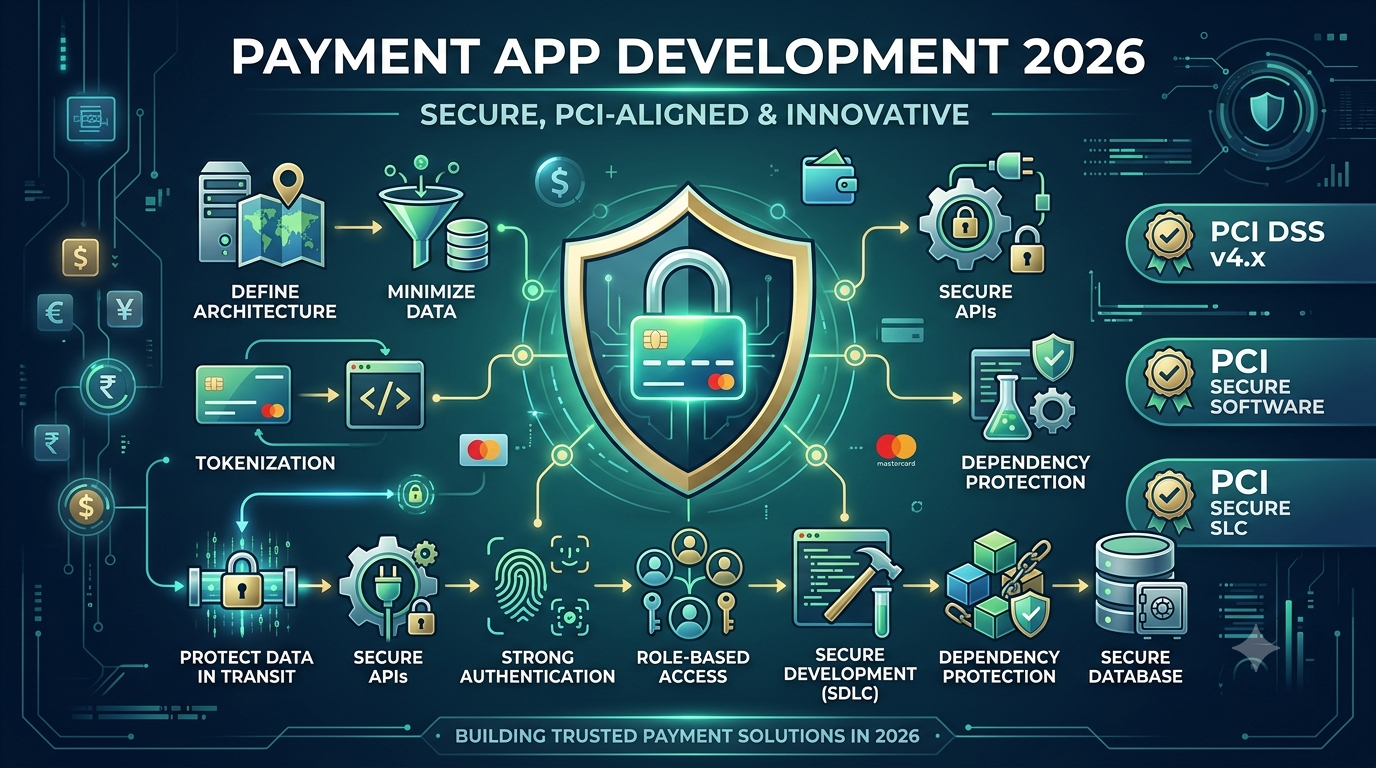
    1. Define the Payment Architecture

    Before development begins, identify exactly how payment information will flow through the system.

    For example:

    Customer → Payment UI → Payment Service → Gateway/Processor → Authorization → Transaction Result

    The architecture should identify:

    • Where payment information enters the system
    • Which systems process it
    • Which systems store information
    • Which third parties receive information
    • Where authentication occurs
    • Where transaction records are maintained

    Understanding this data flow helps define the application’s security boundaries and compliance scope.

    2. Minimize Sensitive Data

    One of the fundamental principles of secure payment application development is reducing unnecessary exposure to sensitive information.

    If the application does not need to store certain payment information, avoiding storage can reduce security responsibilities and potential exposure.

    Developers should evaluate:

    • What data is collected
    • Why it is collected
    • Where it is processed
    • Whether it needs to be stored
    • How long it is retained
    • Which systems can access it

    Data minimization should be part of the architecture rather than an afterthought.

    3. Use Tokenization Where Appropriate

    Tokenization can help reduce the exposure of payment account data within application environments.

    Instead of repeatedly handling sensitive payment information, an application can use a token generated by an appropriate payment service or tokenization system.

    A simplified workflow can look like:

    Payment Details → Secure Payment Service → Token → Application

    The application can then use the token for supported transactions without unnecessarily handling the original payment information.

    The exact implementation and compliance implications depend on the payment provider, integration model, and environment.

    4. Protect Data in Transit

    Payment applications communicate with multiple systems.

    These can include:

    • Mobile applications
    • Web applications
    • Payment gateways
    • Banking or processor APIs
    • Internal services
    • Cloud platforms
    • Third-party services

    Communication between these systems should use appropriate secure transport mechanisms.

    Developers should also ensure that sensitive information is not accidentally exposed through:

    • URLs
    • Application logs
    • Debug messages
    • Analytics systems
    • Error messages
    • Client-side storage

    5. Secure APIs

    APIs are often the connection point between a payment application and external systems.

    A payment application may have APIs for:

    • Authentication
    • Payment creation
    • Payment status
    • Refunds
    • Customer management
    • Subscription management
    • Transaction history
    • Merchant reporting

    API security should include appropriate controls such as authentication, authorization, input validation, rate limiting, monitoring, and secure error handling.

    PCI SSC has also highlighted the importance of controlling access to payment software web APIs and protecting communications between web-based payment software components.

    6. Implement Strong Authentication

    Payment applications should carefully protect administrative and user accounts.

    Depending on the application, security controls can include:

    • Strong passwords
    • Multi-factor authentication
    • Role-based access control
    • Session management
    • Login monitoring
    • Account lockout controls
    • Device management
    • Privileged-access controls

    Administrative access should receive particular attention because compromised administrator accounts can provide access to sensitive application functionality.

    7. Apply Role-Based Access Control

    Not every user should have access to every payment function.

    For example:

    User RoleExample Access
    CustomerView own transactions
    Support AgentView permitted customer information
    Finance UserAccess transaction reports
    Merchant AdminManage payment settings
    DeveloperAccess development environments
    Security AdminManage security controls

    Permissions should follow the principle of providing users only the access they need for their responsibilities.

    8. Secure Payment Application Development

    Security should be incorporated throughout the software development lifecycle.

    A secure development process can include:

    • Threat modeling
    • Secure coding standards
    • Code review
    • Dependency management
    • Vulnerability scanning
    • Security testing
    • Penetration testing where appropriate
    • Secure configuration
    • Change management
    • Release controls
    • Incident response planning

    The PCI Secure SLC Standard specifically addresses secure software lifecycle management so that security remains part of the development and maintenance process.

    9. Protect Third-Party Dependencies

    Payment applications often depend on external libraries, SDKs, APIs, cloud services, and payment providers.

    Developers should maintain visibility into these dependencies.

    Important areas include:

    • Dependency versions
    • Known vulnerabilities
    • Security updates
    • API permissions
    • Third-party access
    • Software components
    • Open-source packages

    PCI SSC’s Secure Software Standard has evolved to address modern software development practices and security management.

    10. Secure the Payment Database

    If an application legitimately needs to store payment-related information, database security becomes critical.

    Controls can include:

    • Encryption
    • Access control
    • Database monitoring
    • Secure credentials
    • Backup protection
    • Data retention policies
    • Audit logging
    • Network segmentation

    Developers should avoid storing sensitive authentication data when it is prohibited or unnecessary and should follow the applicable PCI requirements for any cardholder data that is retained.

    Payment App Architecture

    A modern payment application can be structured into several layers.

    Presentation Layer

    This includes:

    • Web application
    • Mobile application
    • Checkout interface
    • Merchant dashboard

    Application Layer

    This handles:

    • Business logic
    • Authentication
    • Payment workflows
    • Customer management
    • Transaction processing

    Integration Layer

    This connects the application with:

    • Payment gateways
    • Payment processors
    • Banks
    • Fraud services
    • CRM systems
    • Accounting platforms

    Data Layer

    This manages:

    • Transaction records
    • Customer information
    • Application data
    • Audit records
    • Reporting information

    Security Layer

    Security controls can operate across all layers through:

    • Encryption
    • Authentication
    • Authorization
    • Monitoring
    • Logging
    • Vulnerability management

    This layered approach can make the application easier to maintain and secure.

    Payment Gateway Integration

    Most businesses do not need to build their own payment-processing infrastructure from the ground up.

    Instead, a payment application can integrate with established payment providers through APIs or SDKs.

    A typical integration may support:

    1. Customer initiates payment.
    2. Application creates a payment request.
    3. Payment service processes the transaction.
    4. Gateway or processor communicates with the payment network.
    5. Application receives the transaction result.
    6. Order or subscription status is updated.
    7. Customer receives confirmation.

    The exact flow depends on the payment provider and integration architecture.

    Mobile Payment App Development

    Mobile payment applications require additional considerations because smartphones operate in environments that developers do not completely control.

    A mobile payment application should consider:

    • Secure API communication
    • Authentication
    • Session management
    • Secure local storage
    • Application integrity
    • Device security
    • Secure SDK integration
    • Push notification security
    • Protection against reverse engineering
    • Secure logging

    The application should also avoid unnecessarily storing sensitive payment information on the device.

    Web Payment Application Security

    E-commerce applications face another important challenge: protecting payment pages and the browser environment.

    PCI DSS v4.0.1 includes requirements addressing payment-page scripts and e-commerce security. PCI SSC has highlighted concerns around attacks that target scripts running in customers’ browsers, including e-skimming techniques.

    Developers should therefore carefully manage:

    • Third-party JavaScript
    • Payment-page scripts
    • Content Security Policy
    • Script authorization
    • Browser security
    • API endpoints
    • Web application vulnerabilities

    The exact PCI controls applicable to an environment depend on its architecture and validation method.

    Testing a Payment Application

    Testing should take place throughout development rather than only before production release.

    A payment application may require:

    Functional Testing

    Verify that payment flows work correctly.

    API Testing

    Test authentication, authorization, validation, error handling, and transaction workflows.

    Security Testing

    Identify vulnerabilities in application components and integrations.

    Penetration Testing

    Where applicable, conduct authorized security testing to identify exploitable weaknesses.

    Performance Testing

    Evaluate how the application behaves during high transaction volumes.

    Integration Testing

    Verify communication with payment gateways, processors, banks, and other external systems.

    Regression Testing

    Ensure security and functionality remain intact after updates.

    Monitoring and Logging

    Security does not end after deployment.

    Production payment systems should have appropriate monitoring and logging to help identify:

    • Failed login attempts
    • Suspicious transaction activity
    • API abuse
    • Configuration changes
    • Privilege changes
    • Application errors
    • Security events

    Logs should themselves be protected and should not unnecessarily contain sensitive payment information.

    PCI DSS v4.0.1 Considerations for Payment Applications

    PCI DSS v4.0.1 includes updated and clarified requirements compared with PCI DSS v4.0.

    PCI SSC describes v4.0.1 as a limited revision containing corrections and clarifications rather than additional or deleted requirements. The Council also confirmed that the March 31, 2025 effective date for the future-dated requirements was unchanged.

    For payment applications, development teams should pay particular attention to areas involving:

    • Secure development
    • Vulnerability management
    • Access control
    • Authentication
    • Encryption
    • Logging and monitoring
    • Payment-page security
    • Third-party software
    • API security
    • Security testing

    Organizations should work from the specific PCI DSS requirements applicable to their environment rather than assuming that a generic checklist establishes compliance.

    Common Payment App Development Mistakes

    Storing Unnecessary Payment Data

    Keeping sensitive information without a business requirement can increase exposure.

    Treating PCI Compliance as a Final-Stage Task

    Security and compliance considerations should influence architecture and development from the beginning.

    Ignoring Third-Party Components

    Payment applications often depend heavily on external SDKs, APIs, libraries, and services.

    Weak API Security

    Poor authentication, authorization, input validation, and rate limiting can create significant vulnerabilities.

    Excessive Logging

    Application logs can accidentally expose sensitive information.

    Inadequate Testing

    A successful functional test does not necessarily demonstrate that an application is secure.

    Confusing PCI Standards

    PCI DSS, the PCI Secure Software Standard, Secure SLC, P2PE, PTS, and other PCI standards address different areas. Selecting the applicable requirements requires understanding the specific payment environment.

    How PCIAppDeveloper Can Help

    PCIAppDeveloper focuses on payment application development with security and PCI-related requirements considered throughout the software development process.

    A payment software project may involve:

    • Payment gateway integration
    • Mobile payment applications
    • Web payment applications
    • Merchant dashboards
    • Subscription payment systems
    • Payment APIs
    • Digital wallet integrations
    • Transaction management
    • Tokenization
    • Security-focused architecture
    • Testing and maintenance

    The development approach should begin by understanding the payment flow, data environment, business requirements, and applicable standards.

    Conclusion

    Building a modern payment application requires more than integrating a payment gateway.

    A secure payment application should be designed around data minimization, secure APIs, strong authentication, encryption, controlled access, secure development practices, testing, monitoring, and appropriate payment-security requirements.

    PCI DSS v4.0.1 remains an important consideration for organizations within its scope, while the PCI Secure Software Standard and Secure SLC provide software-focused security frameworks for relevant payment software vendors and developers.

    For businesses developing a new payment application in 2026, starting with a clearly defined payment architecture and security model can help create a more maintainable and security-focused product.

    Frequently Asked Questions

    What is PCI-compliant payment app development?

    It refers to developing payment software while addressing the applicable PCI requirements and security controls relevant to the application’s payment environment. PCI compliance is not established simply by using secure coding practices; the applicable compliance scope and validation requirements must also be considered.

    Is PCI DSS the same as the PCI Secure Software Standard?

    No. PCI DSS and the PCI Secure Software Standard address different areas. PCI DSS applies to entities and environments within its scope, while the Secure Software Standard focuses on security requirements for applicable payment software.

    Is PA-DSS still used for new payment software?

    No. PA-DSS was retired in 2022 and superseded by the PCI Secure Software Standard and PCI Secure Software Lifecycle Standard within the PCI Software Security Framework.

    What is PCI Secure Software Standard v2.0?

    PCI SSC released version 2.0 of the PCI Secure Software Standard in January 2026. The revision includes changes to the standard and introduces a companion document for identifying and documenting sensitive assets; SDKs are also eligible for assessment under the revised framework.

    Can a payment app use a third-party payment gateway?

    Yes. Many payment applications integrate with third-party payment providers rather than processing card transactions directly. The resulting payment architecture and PCI scope depend on how the integration is implemented.

    Does using a PCI-validated payment application automatically make a business PCI DSS compliant?

    No. PCI SSC specifically states that use of validated payment software does not by itself make an entity PCI DSS compliant or imply validation against another PCI standard.

  • PCI-Compliant Payment App Development in 2026: Security, Architecture & Cost Guide

    PCI-Compliant Payment App Development in 2026: Security, Architecture & Cost Guide

    Digital payments have become a core part of modern commerce. Businesses across e-commerce, retail, hospitality, fintech, healthcare, transportation, and subscription services increasingly rely on mobile and web applications to accept and manage payments.

    However, developing a payment application requires much more than connecting a payment gateway.

    A modern payment application must be designed around security, data protection, secure APIs, authentication, encryption, tokenization, vulnerability management, and applicable PCI requirements.

    For businesses planning a new payment platform, choosing an experienced PCI compliant payment app development company can help address security and technical requirements from the beginning.

    In this guide, we explain how PCI compliant payment app development works in 2026, what technologies are involved, important security considerations, development costs, and how businesses can approach payment application development.

    What Is PCI-Compliant Payment App Development?

    PCI-compliant payment app development is the process of designing, developing, testing, deploying, and maintaining payment software with security controls appropriate to the payment environment and applicable PCI requirements.

    The PCI Security Standards Council (PCI SSC) describes PCI DSS as a standard for entities that store, process, or transmit payment card data or could affect the security of the cardholder data environment.

    A payment application may include:

    • Mobile payment applications
    • Web payment applications
    • Payment gateways
    • Digital wallets
    • Merchant payment platforms
    • Subscription billing systems
    • POS payment applications
    • Payment processing APIs
    • E-commerce payment systems
    • Financial transaction platforms

    The exact compliance obligations depend on the application’s architecture, payment flow, data handling, service providers, and overall environment.

    PCI DSS 4.0.1 and Payment Applications

    PCI DSS v4.0.1 is the current PCI DSS version listed by PCI SSC. It was published as a limited revision to PCI DSS v4.0 to clarify and correct aspects of the standard. PCI SSC states that PCI DSS v4.0 was retired on December 31, 2024, leaving v4.0.1 as the active version.

    The future-dated requirements in PCI DSS v4.x became effective on March 31, 2025.

    For payment application developers, this means security cannot simply be treated as a final-stage certification activity. Security needs to be incorporated into architecture, development, testing, deployment, and ongoing maintenance.

    Why Security Matters in Payment App Development

    Payment applications can process highly sensitive information and financial transactions.

    Security weaknesses can expose applications to risks such as:

    • Unauthorized transactions
    • Account takeover
    • Payment data exposure
    • API attacks
    • Credential theft
    • Malware
    • Injection attacks
    • Session attacks
    • E-commerce skimming
    • Data leakage

    PCI SSC has specifically highlighted the importance of securing e-commerce environments against attacks involving malicious scripts and payment-page security.

    A secure payment application therefore needs security controls throughout its technology stack.

    Key Features of a Secure Payment Application

    1. Secure Payment Gateway Integration

    A payment application should integrate with appropriate payment gateways or processors using secure APIs and supported integration methods.

    The architecture should clearly define:

    • Payment initiation
    • Authorization
    • Transaction confirmation
    • Refunds
    • Failed payments
    • Webhooks
    • Transaction reconciliation
    • Error handling

    2. Tokenization

    Tokenization can reduce the application’s direct exposure to sensitive payment information.

    Instead of repeatedly handling the original payment credential, an application can use a token supplied by an appropriate payment service.

    This can help simplify payment flows and reduce unnecessary handling of sensitive information.

    3. Encryption

    Encryption is an important component of payment application security.

    Depending on the architecture, developers may need to protect information:

    • During transmission
    • At rest
    • In databases
    • In backups
    • Between internal services
    • During API communication

    Encryption should be accompanied by appropriate key-management practices.

    4. Strong Authentication

    Payment applications should implement appropriate authentication and authorization controls.

    Depending on the use case, this may include:

    • Multi-factor authentication
    • Secure session management
    • OAuth
    • Short-lived access tokens
    • Role-based access control
    • Device verification
    • Biometric authentication

    5. API Security

    Modern payment applications depend heavily on APIs.

    Payment APIs should be designed with controls such as:

    • Authentication
    • Authorization
    • Input validation
    • Rate limiting
    • Secure communication
    • Request validation
    • Error handling
    • Logging
    • Monitoring

    An API should expose only the functionality and information required for its intended purpose.

    Secure Software Development for Payment Applications

    PCI SSC maintains a Secure Software Standard specifically for software vendors and developers. The standard addresses secure design and management of payment software and protection of payment transaction integrity and payment card data.

    PCI SSC also maintains a Secure Software Lifecycle Standard, which focuses on integrating security throughout the software lifecycle, including design, development, deployment, and maintenance.

    This makes a secure development lifecycle particularly important when building payment applications.

    A practical development lifecycle can include:

    Planning → Architecture → Secure Coding → Testing → Deployment → Monitoring → Maintenance

    Payment App Architecture

    A typical payment application architecture may contain several layers:

    Mobile/Web Application

    ↓

    API Gateway

    ↓

    Authentication & Authorization

    ↓

    Payment Service

    ↓

    Payment Gateway / Processor

    ↓

    Transaction & Business Systems

    Additional services may include:

    • Tokenization
    • Fraud detection
    • Notification services
    • Analytics
    • Audit logging
    • Merchant dashboard
    • Transaction reconciliation
    • Monitoring

    The architecture should be designed to minimize unnecessary exposure of sensitive payment information.

    Mobile Payment App Development

    Mobile payment applications require additional considerations because they operate on user devices and communicate over potentially untrusted networks.

    A secure mobile payment application may require:

    • Secure API communication
    • Certificate validation
    • Secure local storage
    • Session protection
    • Device security
    • Application integrity checks
    • Strong authentication
    • Secure authentication tokens
    • Secure payment SDK integration

    For mobile payment acceptance using commercial off-the-shelf devices, PCI SSC also maintains standards such as MPoC, CPoC, and SPoC, depending on the payment scenario.

    Web Payment Application Development

    Web-based payment systems require security across both the browser and server environment.

    Developers should consider:

    • HTTPS
    • Secure cookies
    • Content Security Policy
    • Input validation
    • Output encoding
    • Authentication
    • Session management
    • API security
    • Third-party scripts
    • Payment-page security
    • Vulnerability monitoring

    PCI DSS v4.x includes requirements addressing public-facing web applications and e-commerce payment-page security.

    Payment App Security Testing

    Security testing should be integrated throughout development.

    Important testing activities can include:

    Vulnerability Assessment

    Identify vulnerabilities in application components, infrastructure, dependencies, and APIs.

    Penetration Testing

    Security professionals attempt to identify weaknesses that could potentially be exploited.

    API Security Testing

    Test authentication, authorization, input validation, rate limiting, business logic, and session management.

    Code Review

    Review application code for security vulnerabilities and unsafe implementation patterns.

    Dependency Testing

    Third-party frameworks, packages, libraries, and SDKs should be monitored for known security vulnerabilities.

    Security Monitoring

    Production systems should generate appropriate logs and alerts to help detect suspicious activity.

    Avoid Storing Unnecessary Payment Data

    One of the important architectural decisions is determining what payment information the application actually needs to handle or store.

    Businesses should avoid collecting or retaining sensitive information unnecessarily.

    Depending on the payment architecture, developers may use:

    • Tokenization
    • Payment-provider vaults
    • Hosted payment pages
    • Secure payment SDKs
    • Encryption
    • Restricted database access

    Reducing unnecessary exposure can simplify security architecture and reduce the amount of sensitive information within the application’s environment.

    PA-DSS vs PCI Secure Software Standard

    Businesses sometimes still search for PA-DSS compliant payment app development.

    However, PA-DSS is retired.

    PCI SSC states that PA-DSS was retired in October 2022 and was superseded by the PCI Secure Software Standard and PCI Secure Software Lifecycle Standard.

    In January 2026, PCI SSC released version 2.0 of the PCI Secure Software Standard, representing a major revision of the standard.

    Therefore, businesses developing payment software in 2026 should understand the current PCI software-security framework rather than relying on outdated PA-DSS terminology.

    Payment App Development Process

    A structured PCI payment app development process can include the following stages.

    Step 1: Business & Payment Requirements

    Define:

    • Target users
    • Payment methods
    • Countries and currencies
    • Transaction types
    • Refunds
    • Subscriptions
    • Merchant requirements
    • Payment providers

    Step 2: Security & Compliance Analysis

    Determine:

    • What payment data is handled
    • Where data flows
    • What systems interact with payment data
    • Which third-party services are involved
    • Applicable PCI requirements
    • Security responsibilities

    Step 3: Architecture Design

    Create the architecture for:

    • Mobile/web applications
    • APIs
    • Databases
    • Authentication
    • Payment services
    • Cloud infrastructure
    • Monitoring
    • Logging

    Step 4: UI/UX Development

    Design a payment experience that is simple while minimizing unnecessary exposure of sensitive information.

    Step 5: Backend Development

    Develop:

    • APIs
    • Payment processing
    • User management
    • Transaction management
    • Refunds
    • Webhooks
    • Notifications
    • Administration

    Step 6: Payment Integration

    Integrate the selected payment gateway, processor, banking API, wallet provider, or payment infrastructure.

    Step 7: Security Testing

    Perform applicable:

    • Code reviews
    • Vulnerability assessments
    • API security testing
    • Penetration testing
    • Dependency analysis
    • Configuration reviews

    Step 8: Deployment

    Deploy the application using secured production infrastructure and appropriate access controls.

    Step 9: Continuous Monitoring

    Security continues after launch.

    Applications need ongoing:

    • Monitoring
    • Patching
    • Vulnerability management
    • Security testing
    • Log analysis
    • Incident response
    • Software maintenance

    How Much Does Payment App Development Cost?

    The cost of developing a payment application depends on its functionality and technical complexity.

    A basic payment application may include:

    • User registration
    • Authentication
    • Payment gateway integration
    • Transaction history
    • Notifications
    • Admin dashboard

    A larger payment platform may require:

    • Multiple payment gateways
    • Multi-currency transactions
    • Recurring billing
    • Digital wallets
    • Merchant accounts
    • Fraud detection
    • POS integration
    • Payment APIs
    • Advanced analytics
    • Multi-tenant architecture

    Therefore, the cost of PCI compliant payment app development should be estimated after defining the payment flow, integrations, security requirements, platform, and development scope.

    Common Payment App Development Mistakes

    Businesses should avoid common mistakes such as:

    • Storing unnecessary payment data
    • Hardcoding API credentials
    • Using insecure APIs
    • Weak authentication
    • Poor session management
    • Ignoring third-party dependencies
    • Using real payment data during development
    • Delaying security testing
    • Assuming a payment gateway automatically makes the entire application compliant
    • Treating PCI compliance as a one-time development task

    A payment gateway can change the scope and responsibilities associated with an application’s payment environment, but it does not automatically make every component of a business’s environment compliant.

    Why Choose a PCI Payment App Development Company?

    Developing payment software requires knowledge of both application development and payment security.

    A specialized development team can help businesses with:

    • Payment app architecture
    • Payment gateway integration
    • Secure API development
    • Mobile payment applications
    • Web payment applications
    • Tokenization
    • Authentication
    • Encryption
    • Payment system integration
    • Security testing
    • Cloud deployment
    • Ongoing application maintenance

    The development team should also understand that PCI requirements apply to the broader payment environment and not simply to the source code.

    Build a Secure Payment Application in 2026

    Modern payment applications need to balance user experience, performance, scalability, integration requirements, and security.

    Whether you are building a mobile payment app, payment gateway, digital wallet, merchant payment platform, POS payment system, subscription billing platform, or custom payment application, security should be considered from the architecture stage.

    PCIAppDeveloper provides payment application development services focused on secure architecture, payment integrations, API development, mobile and web applications, and PCI-related security considerations.

    If you are planning a new payment application, the first step is to map your payment flow and data environment. From there, you can determine the appropriate architecture, technology stack, integrations, security controls, and compliance requirements.

    Frequently Asked Questions

    What is PCI-compliant payment app development?

    PCI-compliant payment app development involves designing and developing pay

  • PCI-Compliant Payment App Development in 2026: Security, Architecture, and Best Practices

    PCI-Compliant Payment App Development in 2026: Security, Architecture, and Best Practices

    Digital payments continue to evolve rapidly. Businesses now expect payment applications to support mobile wallets, online checkout, recurring payments, digital banking integrations, payment gateways, and multiple transaction methods.

    But developing a payment application is very different from building a standard mobile or web application.

    A payment application may handle sensitive payment information and interact with systems that store, process, or transmit cardholder data. That makes security, compliance, authentication, encryption, and secure software development essential from the beginning.

    In 2026, businesses developing payment applications should consider PCI DSS v4.x requirements, PCI Secure Software standards, secure APIs, tokenization, encryption, fraud controls, and continuous security testing as part of the development lifecycle.

    PCI SSC describes PCI DSS as a baseline of technical and operational requirements designed to protect payment account data.

    What Is PCI-Compliant Payment App Development?

    PCI-compliant payment app development is the process of designing and developing payment software with security controls and development practices appropriate for protecting payment account data.

    A payment application may include:

    • Mobile payment applications
    • E-commerce payment systems
    • Payment gateway integrations
    • Digital wallet applications
    • POS applications
    • Subscription billing platforms
    • Payment processing APIs
    • Fintech applications
    • Online checkout systems
    • Merchant payment platforms

    The exact PCI requirements applicable to a project depend on how the application interacts with cardholder data and the overall payment environment.

    Importantly, PCI compliance is not simply a feature that can be added after development. Security needs to be considered throughout architecture, coding, testing, deployment, and maintenance.

    PCI SSC’s Secure Software Lifecycle standard specifically addresses integrating security throughout the software lifecycle, including design, development, deployment, and maintenance.

    PCI DSS and Payment Applications

    PCI DSS applies to entities that store, process, or transmit cardholder data or sensitive authentication data, as well as entities that can impact the security of the cardholder data environment.

    For payment software developers, this means the architecture and responsibilities of the application need to be carefully evaluated.

    A payment application might interact with:

    Customer → Mobile/Web App → Payment API → Payment Gateway → Processor → Issuer

    Each component can have different security responsibilities.

    Developers therefore need to understand:

    • Where payment data enters the system
    • Whether the application stores payment information
    • Where data is transmitted
    • Which third-party services are involved
    • Which systems are inside the relevant security scope
    • How authentication is implemented
    • How sensitive information is protected
    • How security events are monitored

    PCI DSS v4.0.1 Considerations in 2026

    PCI DSS v4.0.1 is the current limited revision of PCI DSS v4.x. PCI SSC states that v4.0.1 was published to address stakeholder feedback and questions received after PCI DSS v4.0.

    Developers should pay particular attention to requirements involving secure software, authentication, vulnerability management, logging, monitoring, access control, and protection of payment data.

    For example, PCI SSC notes that certain PCI DSS v4.x requirements became effective on March 31, 2025, including updated requirements relating to public-facing web applications, authentication, and critical security-control failures.

    This makes it important for development teams to work from the applicable current PCI documentation rather than relying on older PCI guidance.

    Secure Architecture for Payment Applications

    A secure architecture can help reduce unnecessary exposure of payment information.

    A simplified payment application architecture may look like:

    Customer App → Secure Backend → Payment Gateway → Payment Processor

    Additional services may include:

    • Authentication service
    • Tokenization service
    • Fraud detection
    • Transaction database
    • Audit logging
    • Notification service
    • Monitoring platform
    • Administrative dashboard

    The architecture should minimize the number of components that directly interact with sensitive payment information.

    Why Data Flow Matters

    Before development begins, teams should map how payment data moves through the system.

    For example:

    Card Entry → Secure Payment Component → Tokenization → Gateway → Transaction Response

    Understanding this data flow helps development and security teams determine where controls are required.

    Tokenization in Payment Applications

    Tokenization can help reduce the exposure of payment card information within an application architecture.

    Instead of repeatedly handling sensitive card information, a payment system may use a token representing the payment instrument.

    A simplified process can look like:

    Payment Details → Secure Payment Provider → Token → Application

    The application can then use the token for supported payment operations without unnecessarily handling the underlying card information.

    However, tokenization does not automatically make an application PCI compliant. The overall payment environment, integrations, implementation, and applicable requirements still need to be assessed.

    Encryption and Payment Data Protection

    Encryption is an important part of payment security.

    Payment applications should use appropriate cryptographic protections for sensitive information during transmission and, where permitted and necessary, while stored.

    PCI SSC identifies protection of stored account data and strong cryptography for cardholder data transmitted across open, public networks among the core PCI DSS requirements.

    Developers should consider:

    • TLS for network communication
    • Secure key management
    • Encryption at rest where appropriate
    • Secure secrets management
    • Certificate management
    • Database access controls
    • Secure API communication

    Sensitive credentials and cryptographic keys should never be hard-coded into application source code.

    Secure Payment APIs

    Modern payment applications frequently depend on APIs.

    APIs may connect the application to:

    • Payment gateways
    • Banks
    • Payment processors
    • Fraud detection services
    • Customer-management systems
    • Accounting platforms
    • Subscription platforms

    A secure payment API architecture should consider:

    Authentication

    APIs should verify the identity of clients and users before providing access to protected resources.

    Authorization

    Authentication alone is not enough. The application should determine what each authenticated user or service is allowed to access.

    Input Validation

    API requests should be validated to prevent unexpected or malicious input from reaching backend systems.

    Rate Limiting

    Rate limiting can help reduce abuse and automated attacks.

    Logging

    Security-relevant events should be appropriately logged and monitored.

    Secure Error Handling

    Payment APIs should avoid exposing sensitive implementation details through error messages.

    Mobile Payment App Security

    Mobile payment applications require additional security considerations.

    A secure mobile payment application may use:

    • Secure authentication
    • Biometric authentication where appropriate
    • Secure local storage
    • Certificate validation
    • Encrypted communication
    • Session management
    • Secure API authentication
    • Application integrity controls
    • Device security controls

    Developers should also carefully consider what payment information is stored locally on the device.

    PCI SSC notes that software developed for payment acceptance can be within the developer’s relevant security considerations even when the consumer’s own device environment is outside the organization’s PCI DSS assessment scope.

    Web Payment Application Security

    E-commerce payment applications have their own security challenges.

    A payment page can involve:

    Customer Browser → Merchant Website → Payment Interface → Payment Provider

    Developers need to carefully evaluate:

    • Third-party scripts
    • JavaScript security
    • API requests
    • Session management
    • Authentication
    • Content Security Policy
    • Payment-page integrity
    • Vulnerability management
    • Logging and monitoring

    PCI SSC’s guidance includes specific requirements concerning public-facing web applications and automated technical solutions for detecting and preventing web-based attacks.

    Authentication and Access Control

    Payment systems should use strong authentication and carefully controlled access.

    Administrative users, developers, support staff, and customers may have different permissions.

    A role-based access model can separate permissions such as:

    • Customer
    • Merchant
    • Finance administrator
    • Support employee
    • Security administrator
    • System administrator

    The principle of least privilege should be applied so users and services receive only the access required for their responsibilities.

    Logging and Monitoring

    Payment systems need visibility into important security and transaction events.

    Monitoring can include:

    • Login attempts
    • Authentication failures
    • API requests
    • Administrative activity
    • Payment events
    • Configuration changes
    • Security alerts
    • System failures

    PCI DSS includes requirements relating to logging, monitoring, and testing of systems and networks.

    Effective monitoring can also help development and security teams investigate suspicious activity.

    Secure Software Development Lifecycle

    Security should be incorporated throughout the development process rather than addressed immediately before launch.

    A payment application development lifecycle can include:

    1. Requirements

    Identify:

    • Payment methods
    • Users
    • Transaction flows
    • Data types
    • Third-party services
    • Compliance considerations

    2. Threat Modeling

    Identify potential attack paths and determine how they can be mitigated.

    3. Architecture

    Design secure application, API, database, authentication, and payment flows.

    4. Development

    Use secure coding practices and appropriate development controls.

    5. Security Testing

    Test the application for vulnerabilities and implementation weaknesses.

    6. Deployment

    Use controlled deployment procedures and secure infrastructure configurations.

    7. Monitoring

    Monitor applications, infrastructure, APIs, and security events.

    8. Maintenance

    Continue patching, testing, monitoring, and improving the application after launch.

    PCI SSC’s Secure Software Lifecycle standard specifically promotes security throughout the software lifecycle rather than treating security as a one-time activity.

    Security Testing for Payment Applications

    Security testing should be integrated into the development process.

    Testing may include:

    • Vulnerability assessments
    • Penetration testing
    • API security testing
    • Authentication testing
    • Authorization testing
    • Dependency analysis
    • Secure code review
    • Configuration testing
    • Infrastructure security testing

    Testing should be performed according to the application’s architecture, risk profile, and applicable compliance requirements.

    Common Payment Application Development Mistakes

    Several mistakes can increase security risk.

    Storing Unnecessary Card Data

    Applications should avoid storing sensitive payment information unless there is a legitimate requirement and appropriate controls.

    Hard-Coding Secrets

    API keys, passwords, private keys, and other secrets should not be embedded directly into application source code.

    Ignoring Third-Party Components

    Open-source libraries and third-party services can introduce security risks if they are not properly maintained and monitored.

    Treating PCI as a Final Audit

    Security and compliance should not be postponed until the application is ready for launch.

    Weak Access Controls

    Excessive administrative privileges can increase the impact of compromised accounts.

    Poor Logging

    Without appropriate monitoring, suspicious activity can be difficult to identify and investigate.

    What Is the Difference Between PCI DSS and PCI Secure Software Standards?

    PCI DSS focuses on protecting payment account data and the environments that store, process, or transmit it.

    The PCI Secure Software Standard focuses specifically on security requirements for payment software vendors and developers. PCI SSC describes it as a standard intended to help ensure the secure design and management of payment software and protect the integrity and confidentiality of payment transactions and associated payment data.

    The Secure Software Lifecycle Standard focuses on integrating security throughout the software lifecycle.

    It is also important to note that PA-DSS is retired. PCI SSC states that PA-DSS was retired on October 28, 2022, and was superseded by the Secure Software Standard and Secure Software Lifecycle Standard.

    How to Build a PCI-Focused Payment Application

    A practical development roadmap can look like this:

    Business Requirements

    ↓

    Payment & Data-Flow Analysis

    ↓

    Secure Architecture

    ↓

    API & Gateway Integration

    ↓

    Secure Application Development

    ↓

    Security Testing

    ↓

    Compliance Assessment

    ↓

    Production Deployment

    ↓

    Continuous Monitoring & Maintenance

    This approach helps teams address security requirements throughout development rather than attempting to retrofit security after the application has already been built.

    Choosing a Payment App Development Company

    Businesses evaluating a payment application development partner should consider several areas.

    Payment Technology Experience

    Look for experience with payment gateways, transaction processing, APIs, and financial technology.

    Security Knowledge

    The development team should understand secure coding, authentication, encryption, API security, and vulnerability management.

    PCI Knowledge

    Ask how the team approaches PCI DSS and applicable PCI Secure Software requirements.

    Mobile and Web Development

    The team should be capable of building the required customer-facing applications and dashboards.

    Backend and API Development

    Payment applications frequently depend on secure backend services and third-party integrations.

    Testing

    Ask about security testing, code review, vulnerability assessment, and ongoing monitoring.

    Post-Launch Support

    Payment applications require ongoing updates, security patches, monitoring, and maintenance.

    Future of Payment Application Development

    Payment applications are increasingly becoming connected platforms rather than simple transaction interfaces.

    Emerging technologies can influence payment development in areas such as:

    • Digital wallets
    • Contactless payments
    • Mobile payment acceptance
    • Tokenization
    • AI-powered fraud detection
    • Real-time transaction monitoring
    • Biometric authentication
    • Cloud-native payment infrastructure
    • API-based financial services
    • Embedded payments

    As payment ecosystems become more connected, security needs to remain part of the architecture rather than an afterthought.

    Conclusion

    Developing a secure payment application requires much more than integrating a payment gateway.

    Businesses need to consider application architecture, payment data flows, authentication, encryption, API security, tokenization, secure development, testing, monitoring, and applicable PCI requirements.

    PCI DSS provides a baseline of technical and operational requirements for protecting payment account data, while PCI SSC’s Secure Software and Secure Software Lifecycle standards provide security-focused frameworks for payment software developers and vendors.

    A well-designed payment application should therefore be built with security throughout its entire lifecycle—from initial architecture and development through deployment, monitoring, updates, and maintenance.

    Build Your Payment Application With PCIAppDeveloper

    PCIAppDeveloper focuses on payment application development, payment gateway integration, secure APIs, mobile and web payment solutions, and security-focused payment software architecture.

    Whether you are planning a new payment platform, upgrading an existing application, or integrating payment functionality into a mobile or web product, a security-first development approach can provide a stronger foundation for your payment ecosystem.
  • PCI-Compliant Payment App Development in 2026: Security, Features, and Development Guide

    PCI-Compliant Payment App Development in 2026: Security, Features, and Development Guide

    Digital payments have become a core part of modern commerce. Consumers expect fast, convenient, and secure payment experiences across mobile apps, websites, connected devices, and digital platforms.

    For businesses developing a payment application, however, creating a smooth checkout experience is only one part of the challenge. Payment applications must also be designed with strong security controls, appropriate compliance requirements, secure integrations, and reliable transaction processing.

    This is where PCI-compliant payment app development becomes important.

    In this guide, we explore the key features, architecture, security considerations, technologies, and development process involved in building secure payment applications in 2026.

    What Is a PCI-Compliant Payment App?

    A PCI-compliant payment application is designed and operated in a way that addresses applicable requirements of the Payment Card Industry Data Security Standard (PCI DSS) when the application is involved with cardholder data or the card-payment environment.

    PCI DSS is focused on protecting payment card data through security controls covering areas such as access control, encryption, vulnerability management, monitoring, and secure development.

    The exact compliance responsibilities depend on how a payment application is designed and how card data flows through the system.

    For this reason, PCI considerations should be included during architecture and development rather than treated as a final-stage checklist.

    Why Payment App Security Matters in 2026

    Payment applications can process highly sensitive financial information.

    A security weakness can potentially expose businesses and customers to:

    • Unauthorized transactions
    • Data breaches
    • Account takeover
    • Payment fraud
    • Credential theft
    • Financial losses
    • Regulatory and contractual consequences
    • Loss of customer trust

    Modern payment applications therefore need security at multiple layers, including the application, API, infrastructure, authentication system, database, and payment integration.

    Key Features of a Modern Payment Application

    1. Secure Payment Processing

    The core function of a payment application is processing transactions reliably.

    Depending on the business model, the application may support:

    • Credit and debit cards
    • Digital wallets
    • Bank transfers
    • Mobile payments
    • Recurring payments
    • Contactless payments
    • QR-based payments
    • International payments

    The application should use secure payment infrastructure and avoid unnecessarily handling sensitive card data.

    2. Tokenization

    Tokenization can replace sensitive payment information with a token that has limited usefulness outside the intended payment environment.

    For example:

    Card Data → Secure Payment Provider → Token → Application

    Using tokenization can reduce the amount of sensitive card data handled directly by an application.

    3. Strong Customer Authentication

    Authentication is an important part of payment security.

    Depending on the use case and applicable requirements, payment applications may implement:

    • Multi-factor authentication
    • One-time passwords
    • Biometric authentication
    • Device verification
    • Risk-based authentication
    • Secure session management

    The objective is to reduce unauthorized access while maintaining a convenient user experience.

    4. Payment History

    Customers should be able to securely view transaction information from within the application.

    A payment history module may include:

    • Transaction amount
    • Date and time
    • Payment status
    • Merchant information
    • Refund status
    • Transaction reference

    Clear transaction records can also simplify customer support and reconciliation.

    5. Refund Management

    Businesses often require automated refund workflows.

    A payment application can support:

    • Full refunds
    • Partial refunds
    • Refund status tracking
    • Refund notifications
    • Administrative approval workflows

    The exact implementation depends on the payment provider and business requirements.

    6. Recurring Payments

    Subscription businesses may require recurring billing.

    Examples include:

    • SaaS subscriptions
    • Memberships
    • Streaming services
    • Online education
    • Service subscriptions

    A secure payment architecture can manage recurring billing through payment-provider APIs while minimizing direct exposure to sensitive payment credentials.

    7. Fraud Detection

    Fraud prevention is increasingly important for digital payment applications.

    Modern systems can use rules and machine-learning models to analyze signals such as:

    • Transaction amount
    • Transaction frequency
    • Device information
    • Geographic signals
    • Account behavior
    • Previous transaction patterns

    Suspicious activity can trigger additional verification or transaction review.

    AI in Payment Applications

    Artificial intelligence can play an increasingly important role in payment security and analytics.

    AI-Based Fraud Detection

    Machine-learning models can identify unusual transaction patterns and assign risk indicators to transactions.

    For example:

    Transaction → Risk Analysis → Risk Score → Approve / Review / Decline

    The model can continuously improve as additional transaction data becomes available, subject to appropriate governance and monitoring.

    Automated Payment Insights

    AI assistants can help businesses analyze transaction information by answering questions such as:

    “Which payment method generated the most transactions this month?”

    or:

    “Show transactions with unusual activity.”

    This can make payment analytics easier for business teams.

    Customer Support Automation

    AI-powered support systems can assist customers with common questions regarding:

    • Payment status
    • Refunds
    • Failed transactions
    • Subscription billing
    • Transact

  • How to Build a PCI-Compliant Payment App in 2026: Security, Architecture, and Development Guide

    How to Build a PCI-Compliant Payment App in 2026: Security, Architecture, and Development Guide

    Digital payments have become an essential part of modern commerce.

    Businesses now expect customers to pay through mobile applications, websites, digital wallets, contactless interfaces, and integrated payment platforms. As payment experiences become more convenient, the security requirements behind them also become increasingly important.

    For companies developing payment applications, security cannot be treated as a final-stage feature.

    It needs to be considered throughout the software development lifecycle.

    The PCI Data Security Standard (PCI DSS) provides a baseline of technical and operational requirements designed to protect payment account data. The current PCI DSS documentation is based on PCI DSS v4.0.1.

    For developers building payment applications, this means architecture, authentication, data protection, logging, vulnerability management, testing, and secure development practices all need to be considered from the beginning.

    What Is a PCI-Compliant Payment Application?

    A PCI-compliant payment application is software designed and operated in a way that supports applicable payment security requirements.

    Depending on the application’s architecture and role in the payment process, the security scope can vary significantly.

    A payment application might:

    • Connect customers with a payment gateway
    • Process payment transactions
    • Integrate with payment terminals
    • Support card-not-present transactions
    • Connect with digital wallets
    • Provide merchant payment management
    • Integrate with POS systems
    • Process payment-related information
    • Communicate with third-party payment providers

    The exact PCI responsibilities depend on how payment data flows through the environment.

    This is why payment application development should begin with scope and data-flow analysis, rather than simply adding security controls after development is complete.

    Why PCI Compliance Matters for Payment App Development

    Payment applications operate in an environment where security failures can have serious consequences.

    A vulnerable application can potentially expose sensitive payment information, create unauthorized access opportunities, or become a target for attackers.

    PCI DSS establishes requirements intended to protect payment account data across the payment environment.

    For software developers, PCI considerations can affect:

    • Application architecture
    • Database design
    • API development
    • Authentication
    • Authorization
    • Encryption
    • Logging
    • Vulnerability management
    • Software development practices
    • Security testing
    • Deployment processes

    Security therefore needs to be incorporated into the development lifecycle rather than treated as a final audit checklist.

    PCI DSS v4.0.1 and Modern Payment Software

    PCI DSS v4.0.1 is the current revision listed by the PCI Security Standards Council.

    The revision was created to address stakeholder feedback, correct errors, and clarify requirements and guidance. PCI SSC states that it did not add or remove requirements in the revision.

    PCI DSS v4.x also places greater emphasis on security as an ongoing process and provides organizations with greater flexibility in how security objectives can be achieved.

    For developers, this reinforces an important principle:

    Payment security should be continuous—not something performed only before an application launch.

    Start With Payment Data Flow

    One of the first steps in developing a secure payment application is understanding exactly where payment information travels.

    Consider a simplified payment flow:

    Customer → Mobile/Web Application → Payment Gateway → Payment Processor → Bank

    The application may also communicate with:

    Database → Analytics → CRM → Notifications → Merchant Dashboard

    Each connection needs to be evaluated carefully.

    Developers should determine:

    • What payment data enters the application?
    • Is payment data stored?
    • Where is it transmitted?
    • Which systems receive it?
    • Which third-party providers are involved?
    • Which components can access it?
    • What data is logged?
    • Which systems are inside the relevant security scope?

    A clear data-flow diagram can help identify unnecessary exposure and security boundaries.

    Minimize Payment Data Storage

    One of the most important architectural decisions is determining whether the application actually needs to store payment card data.

    If payment data does not need to be stored, processing architecture can often be designed to reduce the application’s exposure.

    Depending on the payment architecture, developers may use payment gateways, tokenization, hosted payment components, or other approaches that reduce direct handling of sensitive payment information.

    The appropriate approach depends on the specific payment flow and compliance requirements.

    The objective is simple:

    Only handle the payment information that the application genuinely needs.

    Tokenization in Payment Applications

    Tokenization is commonly used in payment environments to replace sensitive payment information with a token.

    Instead of repeatedly using sensitive card information throughout an application, the system can work with a token representing that payment credential.

    A simplified architecture might look like:

    Card Information

    ↓

    Secure Payment Provider

    ↓

    Token

    ↓

    Merchant Application

    ↓

    Future Payment Request

    Tokenization architecture can help reduce the amount of sensitive payment information handled directly by an application.

    However, developers should not assume that tokenization automatically makes an environment PCI-compliant.

    The complete payment architecture, third-party relationships, implementation, and applicable requirements still need to be evaluated.

    Secure API Development for Payment Applications

    Modern payment applications depend heavily on APIs.

    Mobile apps, websites, merchant dashboards, payment gateways, fraud detection systems, and backend services may all communicate through APIs.

    Payment APIs should be designed with strong security controls.

    Important areas include:

    Authentication

    Only authorized users and services should be able to access protected resources.

    Authorization

    Authentication confirms who a user or service is.

    Authorization determines what that identity is allowed to do.

    These should be implemented separately and carefully.

    Input Validation

    Applications should validate incoming data before processing it.

    This helps reduce the risk of common application vulnerabilities.

    Rate Limiting

    APIs should consider appropriate rate limits to reduce abuse and automated attacks.

    Secure Error Handling

    API responses should not expose sensitive information, credentials, internal infrastructure details, or unnecessary technical information.

    Logging

    Security-relevant events should be logged appropriately while avoiding unnecessary exposure of sensitive payment information.

    Protect Payment Data in Transit

    Payment-related information should be protected while moving between systems.

    Secure communication protocols such as HTTPS using current TLS configurations are fundamental components of modern web and mobile payment architectures.

    Developers should carefully evaluate:

    • TLS configuration
    • Certificate management
    • API endpoints
    • Mobile-to-server communication
    • Server-to-server communication
    • Third-party integrations

    Security should cover the entire communication path rather than only the main payment API.

    Protect Payment Data at Rest

    If payment-related data must be stored, developers should carefully determine:

    • What information is being stored
    • Why it is required
    • How long it needs to be retained
    • Where it is stored
    • Who can access it
    • How it is protected
    • How it is securely deleted

    Data minimization should be considered before implementing database storage.

    A secure payment application should avoid collecting or retaining sensitive information simply because the database technically allows it.

    Secure Authentication and Access Control

    Payment applications require strong controls around user access.

    A merchant administrator should not necessarily have the same permissions as:

    • A cashier
    • Customer-support staff
    • Finance staff
    • Developers
    • System administrators
    • API services

    Role-based access control can help limit users and services to the functions they actually require.

    Additional security controls may include:

    • Multi-factor authentication
    • Strong password policies
    • Session management
    • Account lockout or protection mechanisms
    • Privilege management
    • Access monitoring

    The principle of least privilege is particularly important in payment environments.

    Secure Software Development

    PCI SSC’s requirements include secure development considerations for bespoke and custom software.

    PCI DSS Requirement 6 addresses developing and maintaining secure systems and software, including secure development practices for bespoke and custom software.

    A secure software development lifecycle can include:

    Planning

    ↓

    Threat Modeling

    ↓

    Secure Design

    ↓

    Secure Coding

    ↓

    Code Review

    ↓

    Security Testing

    ↓

    Deployment

    ↓

    Monitoring

    ↓

    Continuous Improvement

    Security should be incorporated into each stage.

    Threat Modeling for Payment Apps

    Threat modeling can help development teams identify potential security problems before they become expensive to fix.

    For example, developers can ask:

    • What happens if a user’s account is compromised?
    • What happens if an API credential is stolen?
    • Can users access another customer’s payment information?
    • What happens if a payment request is modified?
    • Can an attacker replay a transaction?
    • Can a malicious user manipulate transaction amounts?
    • What happens if a third-party API becomes unavailable?

    Thinking about these scenarios during design can strengthen the overall application architecture.

    Security Testing Before Launch

    Payment applications should undergo appropriate security testing before production deployment.

    Testing can include:

    • Vulnerability scanning
    • Code review
    • Dependency analysis
    • API security testing
    • Authentication testing
    • Authorization testing
    • Penetration testing
    • Configuration reviews
    • Infrastructure security testing

    The appropriate testing methodology depends on the application and its environment.

    External vulnerability scanning requirements can also apply in specific PCI DSS scenarios, with PCI SSC providing guidance around Approved Scanning Vendors and related requirements.

    Third-Party Payment Integrations

    Most modern payment applications rely on third-party services.

    These may include:

    • Payment gateways
    • Payment processors
    • Fraud detection platforms
    • Banking APIs
    • Digital wallets
    • Tax systems
    • Accounting platforms
    • POS platforms

    Third-party integrations introduce additional dependencies.

    Before integrating a payment service, developers should understand:

    • What information is sent
    • What information is returned
    • Where information is stored
    • How authentication works
    • How credentials are protected
    • What security responsibilities belong to each party

    A third-party provider can reduce development complexity, but it does not eliminate the need for secure application design.

    Mobile Payment App Security

    Mobile payment applications have additional security considerations.

    Developers should consider:

    Secure Local Storage

    Sensitive information should not be unnecessarily stored on the device.

    Secure API Communication

    The mobile application should communicate with backend services through secure channels.

    Authentication

    Mobile sessions should be protected against unauthorized access.

    Application Integrity

    Developers should consider threats involving tampering, reverse engineering, and compromised devices.

    Secure Updates

    Applications should have a controlled and secure update process.

    PCI SSC specifically notes that software developed to facilitate merchant payment acceptance remains relevant to secure development considerations even when it runs on a consumer’s device.

    Payment Application Logging and Monitoring

    Security does not end when the application goes live.

    Payment environments should have appropriate monitoring and logging.

    Security teams may need visibility into:

    • Failed authentication attempts
    • Privilege changes
    • Suspicious API activity
    • Administrative actions
    • Configuration changes
    • Security events
    • Unusual transaction behavior

    However, developers must ensure that logs themselves do not unnecessarily expose sensitive payment information.

    Build Security Into CI/CD

    Modern development teams frequently use continuous integration and continuous deployment pipelines.

    Security checks can be integrated directly into these workflows.

    For example:

    Developer Commit

    ↓

    Automated Build

    ↓

    Static Analysis

    ↓

    Dependency Scan

    ↓

    Automated Tests

    ↓

    Security Testing

    ↓

    Deployment

    ↓

    Monitoring

    This approach helps identify vulnerabilities earlier in the development lifecycle.

    Why Secure Software Standards Matter

    PCI SSC also maintains a Secure Software Standard specifically for software vendors and developers creating payment software.

    The standard provides security requirements for the design and management of payment software and aims to protect the integrity of payment transactions and the confidentiality of payment data.

    For payment software companies, this provides an additional framework to consider alongside applicable PCI DSS requirements.

    Common Mistakes in Payment App Development

    Treating Security as a Final Audit

    Security should not begin immediately before an assessment.

    It should begin during architecture and design.

    Storing Too Much Data

    If sensitive information is not required, avoid collecting or retaining it.

    Hardcoding Credentials

    API keys, passwords, tokens, and other secrets should not be embedded directly into application source code.

    Ignoring Third-Party Dependencies

    Libraries and APIs can introduce security risks if they are outdated or improperly configured.

    Weak Access Controls

    Users should receive only the permissions required for their roles.

    Inadequate Testing

    A payment application should not rely solely on functional testing.

    Security testing needs to be part of the development process.

    How PCIAppDeveloper Helps Build Secure Payment Applications

    At PCIAppDeveloper, we focus on developing payment software with security considerations built into the architecture and development lifecycle.

    Our payment application development services can include:

    • PCI-focused payment application development
    • Payment gateway integration
    • Secure API development
    • Mobile payment applications
    • Web payment applications
    • Digital wallet integration
    • POS payment integration
    • Tokenization-based architectures
    • Payment dashboard development
    • Secure backend development
    • Payment system modernization
    • Security-focused application testing

    Every payment application is different.

    The appropriate architecture depends on the payment flow, business model, integrations, data handling requirements, and compliance scope.

    PCI Compliance Is More Than a Checklist

    Building a secure payment application requires more than adding encryption or completing a compliance questionnaire.

    It requires an architecture that considers:

    Data → Applications → APIs → Infrastructure → Users → Integrations → Monitoring

    Security needs to be maintained throughout the software lifecycle.

    PCI DSS provides a baseline for protecting payment account data, while secure software practices help development teams build applications with security integrated into their design and development processes.

    Final Thoughts

    Payment applications are becoming more sophisticated, but the fundamental requirement remains the same:

    Protect payment information and build security into the technology from the beginning.

    For businesses developing a new payment application in 2026, the development strategy should consider data minimization, secure architecture, API protection, authentication, encryption, access control, testing, monitoring, third-party integrations, and applicable PCI requirements.

    A secure payment application is not simply a product that passes a test at launch.

    It is a system designed to maintain security throughout its lifecycle.

    Planning a secure payment application?

    PCIAppDeveloper can help businesses design and develop payment applications around their business requirements, integrations, security objectives, and applicable payment technology standards.

  • PCI DSS 4.0.1 and Payment App Development: What Businesses Need to Know in 2026

    PCI DSS 4.0.1 and Payment App Development: What Businesses Need to Know in 2026

    Digital payments have become an essential part of modern business.

    From eCommerce websites and mobile applications to restaurant POS platforms, subscription services, marketplaces, and fintech products, businesses increasingly depend on software to accept and manage payments.

    But developing a payment application is not simply about connecting a payment gateway and adding a checkout button.

    Security must be designed into the entire payment environment.

    In 2026, businesses developing payment applications need to understand the current PCI DSS requirements, minimize exposure to cardholder data, secure integrations, protect payment pages, and build strong security practices into the software development lifecycle.

    PCI DSS v4.0.1 is the active version of the PCI DSS standard, following the retirement of PCI DSS v4.0 at the end of 2024. The PCI Security Standards Council describes PCI DSS as a baseline of technical and operational requirements designed to protect payment account data.

    What Is PCI DSS 4.0.1?

    PCI DSS stands for the Payment Card Industry Data Security Standard.

    It provides security requirements for organizations that store, process, or transmit payment card data, as well as organizations that can affect the security of the cardholder data environment.

    PCI DSS 4.0.1 was published as a limited revision to PCI DSS 4.0.

    According to the PCI Security Standards Council, the revision primarily introduced corrections and clarifications rather than adding or deleting requirements. PCI DSS 4.0.1 became the only active version after PCI DSS 4.0 was retired on December 31, 2024.

    For businesses developing payment software, this means compliance and security considerations need to be incorporated into the development strategy from the beginning.

    Why PCI DSS Matters for Payment App Development

    A payment application can interact with highly sensitive information and multiple external systems.

    A typical payment environment may include:

    Mobile App → API → Payment Gateway → Payment Processor → Bank

    An eCommerce environment may also involve:

    Customer Browser → Payment Page → Website → Third-Party Scripts → Payment Provider

    Every component and integration needs to be considered as part of the overall security architecture.

    A vulnerability in an application, API, payment page, authentication mechanism, or third-party integration can potentially create security risks.

    That is why secure payment application development should not be treated as a final testing phase.

    PCI Compliance Starts With Application Architecture

    One of the biggest mistakes businesses can make is thinking about PCI compliance after the application has already been developed.

    A better approach is:

    Requirements → Architecture → Development → Security Testing → Deployment → Monitoring

    Security decisions made during architecture can significantly influence the application’s payment-data exposure and overall security model.

    Development teams should determine:

    • What payment data the application actually needs
    • Where payment information enters the system
    • Where it travels
    • Which systems can access it
    • Whether sensitive information can be eliminated or reduced
    • Which payment provider should handle payment data
    • How APIs will be secured
    • How users and administrators will be authenticated
    • How security events will be monitored

    This creates a security-first foundation for the application.

    Reduce Cardholder Data Exposure

    One of the most important principles in secure payment application development is minimizing unnecessary exposure to sensitive payment data.

    If an application does not need to collect or store certain payment information, businesses should consider architectures that avoid unnecessary handling of that information.

    This can reduce the systems and components that need to be considered within the payment security environment.

    For example, instead of building a system that directly collects and stores sensitive card information, a business may integrate a suitable payment provider and use tokens or hosted payment mechanisms where appropriate.

    However, businesses should not assume that using a third-party provider automatically makes the entire application PCI compliant.

    The complete payment architecture and responsibilities still need to be understood.

    Tokenization in Payment Applications

    Tokenization is widely used in modern payment environments.

    Instead of repeatedly handling sensitive card information, a payment infrastructure can provide a token that represents the payment credential.

    The application can then use the token for supported payment operations.

    This can help reduce the amount of sensitive payment information flowing through application components.

    However, tokenization is not a substitute for PCI compliance.

    Businesses still need to understand their payment architecture, applicable requirements, service-provider responsibilities, and security controls.

    Secure Payment Gateway Integration

    Payment gateway integration is a core component of most modern payment applications.

    A secure integration should consider:

    • API authentication
    • Secure credentials management
    • Encryption
    • Webhook security
    • Input validation
    • Error handling
    • Rate limiting
    • Access control
    • Transaction verification
    • Logging and monitoring

    API keys and other credentials should never be hard-coded into mobile applications or publicly accessible source code.

    Payment callbacks and webhooks should also be validated so that applications do not blindly trust incoming transaction notifications.

    Protect E-Commerce Payment Pages

    E-commerce payment pages require particular attention.

    Modern websites frequently depend on JavaScript libraries and third-party scripts for analytics, marketing, personalization, chat, payment functionality, and other features.

    These scripts can introduce additional security considerations.

    PCI DSS v4.0.1 includes requirements related to payment-page scripts, and the PCI Security Standards Council has specifically highlighted e-commerce security requirements designed to address threats such as e-skimming.

    For businesses building eCommerce payment systems, development teams should therefore consider:

    • Script authorization
    • Script integrity
    • Payment-page monitoring
    • Third-party JavaScript
    • Content security controls
    • Change detection
    • Secure deployment practices

    The objective is to reduce opportunities for malicious code to capture payment information from customers.

    Strong Authentication and Access Control

    Payment applications should not provide unlimited access to every employee or administrator.

    A secure architecture should implement appropriate:

    • Authentication
    • Authorization
    • Role-based access
    • Multi-factor authentication
    • Session management
    • Privileged-access controls

    Different users may require different permissions.

    For example:

    Customer → View own transactions

    Employee → Process transactions

    Manager → Access operational reports

    Administrator → Manage system configuration

    Separating these permissions can help reduce the impact of compromised credentials.

    Secure Software Development Lifecycle

    Security should be integrated throughout the software development lifecycle.

    A practical secure development process can include:

    1. Security Requirements

    Identify security and compliance requirements before development begins.

    2. Threat Modeling

    Identify potential attack paths and high-risk components.

    3. Secure Coding

    Develop applications using secure coding practices.

    4. Dependency Management

    Monitor third-party libraries and frameworks for known vulnerabilities.

    5. Code Review

    Review sensitive payment-related code before deployment.

    6. Security Testing

    Perform appropriate vulnerability assessments and application security testing.

    7. Secure Deployment

    Protect production environments, credentials, infrastructure, and deployment pipelines.

    8. Continuous Monitoring

    Continue monitoring the application after launch.

    The PCI Security Standards Council’s Secure Software Standard is specifically designed around the secure design and management of payment software, while the Secure Software Lifecycle Standard addresses integrating security throughout the software lifecycle.

    PCI Compliance for Mobile Payment Apps

    Mobile payment applications introduce additional considerations.

    An iOS or Android payment application may communicate with:

    • Payment gateways
    • APIs
    • Cloud services
    • Authentication platforms
    • POS systems
    • Banking services
    • Digital wallets

    Developers should consider:

    • Secure API communication
    • Certificate validation
    • Secure authentication
    • Session protection
    • Secure local storage
    • Application hardening
    • Protection of sensitive credentials
    • Secure logging
    • Device-level security considerations

    The exact compliance responsibilities depend on the payment architecture and how the application handles payment account data.

    PCI SSC notes that software developed to facilitate merchant payment acceptance can be within the scope of applicable PCI DSS requirements, depending on how it handles payment account data.

    PCI-Compliant POS Applications

    Point-of-sale applications are another important area of payment software development.

    A modern POS ecosystem may include:

    POS Application → Payment Terminal → Gateway → Processor

    Additional systems may include:

    • Inventory
    • CRM
    • Loyalty
    • Accounting
    • Online ordering
    • Mobile applications
    • Kitchen systems
    • Analytics

    As more components become connected, secure APIs, authentication, access controls, encryption, monitoring, and vulnerability management become increasingly important.

    Businesses developing custom POS applications should therefore consider payment security during the architecture phase rather than treating it as an add-on.

    Cloud-Based Payment Applications

    Cloud technology has made it easier for businesses to build scalable payment platforms.

    A cloud payment environment may include:

    • Application servers
    • APIs
    • Databases
    • Authentication services
    • Storage
    • Monitoring
    • Payment integrations
    • Third-party services

    Cloud deployment does not eliminate security responsibilities.

    Businesses still need to understand which controls are handled by the cloud provider and which controls remain their responsibility.

    A secure cloud payment architecture should consider:

    • Identity and access management
    • Encryption
    • Network security
    • Secrets management
    • Logging
    • Monitoring
    • Backup security
    • Vulnerability management
    • Configuration management

    Why Payment Software Security Is an Ongoing Process

    Launching a secure payment application is not the end of the security process.

    Applications change.

    New APIs are introduced.

    Dependencies are updated.

    New payment methods are added.

    Employees change.

    Cloud infrastructure evolves.

    Attack techniques change.

    For this reason, payment application security needs ongoing attention.

    Businesses should establish processes for:

    • Security monitoring
    • Vulnerability management
    • Access reviews
    • Software updates
    • Dependency management
    • Incident response
    • Security testing
    • Documentation
    • Compliance validation

    Security should evolve alongside the application.

    Common Mistakes in Payment App Development

    Businesses can create unnecessary security risks by making mistakes such as:

    Storing Unnecessary Payment Data

    If the application does not need certain sensitive information, avoid collecting it unnecessarily.

    Hard-Coding Credentials

    API keys and secrets should not be embedded in publicly accessible application code.

    Ignoring Third-Party Scripts

    Third-party JavaScript can introduce additional security considerations for eCommerce payment pages.

    Treating Compliance as a Checklist

    PCI compliance should not be treated as simply completing documentation.

    Securing Only the Backend

    Payment security must consider the entire ecosystem, including applications, APIs, payment pages, infrastructure, users, and integrations.

    Skipping Continuous Testing

    Security testing should not happen only before launch.

    How to Choose a PCI App Development Company

    Choosing the right development partner can significantly influence the security and scalability of a payment application.

    Before selecting a PCI app development company, businesses should evaluate experience with:

    • Payment application development
    • PCI DSS requirements
    • Secure software development
    • Payment gateway integration
    • Tokenization
    • Payment APIs
    • Mobile payment applications
    • POS systems
    • eCommerce payment systems
    • Cloud architecture
    • API security
    • Vulnerability testing

    A development partner should also be able to explain the payment architecture clearly and identify where sensitive payment information enters, moves through, and leaves the system.

    Why Work With PCI App Developers?

    PCI App Developers focuses on payment-focused software development with security and compliance considerations built into the development approach.

    Businesses can work with experienced developers to create:

    • Custom payment applications
    • Mobile payment apps
    • Payment gateway integrations
    • Secure payment APIs
    • POS payment solutions
    • eCommerce payment systems
    • Cloud payment platforms
    • Payment management dashboards

    The goal is to build payment technology that balances:

    Security + User Experience + Scalability + Business Requirements

    For businesses developing a new payment product, security should be part of the architecture from the first planning stage.

    Final Thoughts

    Payment technology is evolving rapidly.

    Businesses are adopting mobile payments, embedded payments, digital wallets, cloud platforms, subscription billing, connected POS systems, and new digital checkout experiences.

    But innovation cannot come at the expense of payment security.

    PCI DSS 4.0.1 reinforces the importance of a structured security approach, while the PCI Security Standards Council’s secure software standards emphasize secure design and security throughout the software lifecycle.

    For companies building payment applications in 2026, the strongest strategy is simple:

    Minimize sensitive-data exposure.

    Secure every integration.

    Build security into the development lifecycle.

    Monitor continuously.

    Design for compliance from the beginning.

    When payment security is treated as a fundamental part of product development—not an afterthought—businesses can build payment applications that are better prepared for customers, growth, and an evolving security landscape.

  • PCI-Compliant Payment App Development in 2026: How Businesses Can Build Secure Payment Solutions

    PCI-Compliant Payment App Development in 2026: How Businesses Can Build Secure Payment Solutions

    Digital payments have become an essential part of modern business.

    Customers expect fast, convenient, and secure ways to pay through mobile applications, websites, payment terminals, digital wallets, and other connected platforms.

    For businesses building their own payment applications, however, convenience is only one part of the challenge.

    Security and compliance are equally important.

    This is where PCI-compliant payment app development becomes critical.

    A payment application must be designed to protect sensitive payment information while integrating securely with payment processors, gateways, banking systems, and other financial technologies.

    For businesses looking for a PCI-compliant payment app development company, understanding the development process, security requirements, integrations, and compliance considerations is an important first step.

    What Is PCI-Compliant Payment App Development?

    PCI-compliant payment app development involves designing and developing payment software according to applicable Payment Card Industry security requirements.

    The objective is to reduce the risk of unauthorized access, payment-data exposure, fraud, and security vulnerabilities.

    A secure payment application may include:

    • Payment processing
    • Card payment integration
    • Digital wallet integration
    • Payment gateway integration
    • Customer authentication
    • Tokenization
    • Encryption
    • Transaction monitoring
    • Fraud detection
    • Payment history
    • Refund management
    • Recurring payments
    • Administrative dashboards
    • Reporting and analytics

    The exact requirements depend on how the application handles payment-card data and how its payment environment is structured.

    Why Payment Security Matters in 2026

    Payment applications process highly sensitive transactions.

    A security vulnerability can result in financial losses, customer distrust, operational disruption, and regulatory or contractual consequences.

    Businesses therefore need to consider security throughout the software development lifecycle.

    Security should not be added as an afterthought.

    It should be considered during:

    Planning → Architecture → Development → Testing → Deployment → Monitoring

    This approach helps create a stronger foundation for secure payment processing.

    1. Build Security Into the Application Architecture

    The architecture of a payment application can have a major impact on its security.

    Developers should carefully determine:

  • The Complete Guide to PCI DSS Compliant Application Development

    The Complete Guide to PCI DSS Compliant Application Development

    In today’s digital economy, processing payments seamlessly is essential for mobile and web applications. However, with digital transactions comes the immense responsibility of protecting cardholder data. Financial losses, severe regulatory penalties, and reputational damage from data breaches make payment security a top priority for businesses and developers alike.

    This guide explores what PCI DSS compliance means for software development, the core pillars of building a compliant application, and a step-by-step framework to secure your payment ecosystem.

    What Is PCI DSS Compliance in App Development?

    The Payment Card Industry Data Security Standard (PCI DSS) is a set of security requirements established by major card brands (Visa, Mastercard, American Express, Discover, and JCB).

    In application development, PCI compliance means designing, writing, testing, and deploying software such that credit card numbers, expiration dates, and sensitive authentication codes are kept safe from unauthorized access or interception.

    Core Pillars of PCI App Security

    To build a secure payment architecture, developers must implement key technical and operational controls:

    1. Scope Reduction via Tokenization & Hosted Fields

    The best way to comply with PCI DSS is to reduce your Cardholder Data Environment (CDE) scope:

    • Use hosted payment fields or client-side SDKs (e.g., Stripe Elements, Braintree, PayPal) where payment data is captured directly by the payment processor.
    • Implement tokenization, replacing raw Primary Account Numbers (PANs) with secure tokens. Your app servers only store tokens, meaning raw card numbers never touch your database.

    2. End-to-End Encryption

    • In Transit: Enforce strong cryptographic protocols (TLS 1.2 or higher, ideally TLS 1.3) for all web and API traffic carrying payment information.
    • At Rest: If your system must store allowed payment metadata (such as the cardholder’s name or the last 4 digits of the card), ensure it is encrypted using robust algorithms like AES-256 with strict key management practices.

    3. Strict Access Control & Authentication

    • Implement Multi-Factor Authentication (MFA) for administrative access to payment systems and backend infrastructure.
    • Enforce Role-Based Access Control (RBAC) following the Principle of Least Privilege—grant access only to systems and personnel that strictly require it.

    4. Secure Coding Practices

    Follow the OWASP Top 10 guidelines to guard against prevalent vulnerabilities:

    • Prevent SQL Injection (SQLi) by using parameterized queries and ORMs.
    • Mitigate Cross-Site Scripting (XSS) with input validation and output encoding.
    • Use secure session handling and avoid storing sensitive data in client-side local storage or cookies without proper encryption.

    5. Continuous Logging and Monitoring

    Maintain detailed, audit-ready logs for all user access to cardholder data, administrative privileges, and payment-related API calls. Automated alerting systems should flag suspicious activities, repeated failed login attempts, or anomalous transaction rates in real time.

    Step-by-Step PCI-Compliant Development Lifecycle

     [1. Map Data Flows] ➔ [2. Secure Architecture] ➔ [3. Vulnerability Testing] ➔ [4. Compliance Validation]
    

    Step 1: Map Data Flows & Define Scope

    Before writing code, map out every data pathway:

    • Where does card data enter the app?
    • Where is it processed or routed?
    • Which third-party services interact with the transaction?

    Minimizing data exposure early saves significantly on audit costs later.

    2. Implement Secure Gateway Integrations

    Integrate trusted, PCI-certified payment processors using modern APIs and client SDKs. Ensure API keys, client secrets, and environment passwords are statefully managed using secure secret managers (e.g., AWS Secrets Manager, HashiCorp Vault) and never hardcoded in source code.

    3. Perform Regular Vulnerability Assessments

    • Conduct automated Static Application Security Testing (SAST) and Dynamic Application Security Testing (DAST) within your CI/CD pipeline.
    • Perform regular dependency scans to detect vulnerable third-party packages or SDKs.
    • Conduct annual penetration testing and quarterly vulnerability scans using certified ASVs (Approved Scanning Vendors).

    4. Complete Compliance Certification

    Depending on your transaction volume and architecture, complete the appropriate PCI DSS Self-Assessment Questionnaire (SAQ)—such as SAQ A for fully outsourced payment fields—or work with a certified Qualified Security Assessor (QSA).

    3 Critical PCI Mistakes to Avoid

    1. Storing Sensitive Authentication Data (SAD): Never store CVV/CVC verification codes, PIN blocks, or full magnetic stripe data after transaction authorization, under any circumstances.
    2. Hardcoding Secret Keys: Exposing payment provider secret keys inside front-end client code or repository history is a major security flaw.
    3. Ignoring Dependency Updates: A PCI-compliant app can easily become vulnerable if third-party libraries or SDKs remain unpatched and outdated.

    Final Thoughts

    PCI DSS compliance should not be an afterthought retrofitted at launch; it should be built into the architectural DNA of your application. By leveraging tokenization, hosted payment fields, and secure coding standards, you can minimize compliance overhead, prevent costly data breaches, and foster long-term customer trust.

  • Engineering Secure Payment Systems: The Developer’s Guide to PCI DSS Compliance

    Engineering Secure Payment Systems: The Developer’s Guide to PCI DSS Compliance

    In modern fintech, application security is not an afterthought—it is the foundation of digital payment infrastructure. Whether you are building an enterprise checkout gateway, a custom point-of-sale (POS) platform, or a mobile payment wallet, adhering to the Payment Card Industry Data Security Standard (PCI DSS) is mandatory.

    For payment application developers (PCI app developers), compliance is not just about passing annual audits; it is about writing resilient software that protects cardholder data against evolving cybersecurity threats.

    Core Principles of PCI-Compliant Application Engineering

    Engineering PrincipleImplementation ApproachCompliance Benefit
    Scope ReductionHosted payment fields, iframe injection, and direct tokenization APIs.Minimizes audit footprint down to SAQ A or SAQ A-EP levels.
    Cryptographic StandardsEnforce TLS 1.3 for transit; AES-256 for data at rest with key rotation.Protects sensitive authentication data (SAD) against exposure.
    Secure SDLCAutomated SAST/DAST pipeline checks, dependency scanning, and input validation.Satisfies PCI DSS Requirement 6 for application security.
    Zero Trust AccessRole-Based Access Control (RBAC), API key rotation, and mandatory MFA.Limits internal system exposure and prevents lateral movement.

    Key Technical Mandates for PCI App Developers

    1. Scope Reduction via Tokenization

    The safest way to secure cardholder data is to ensure your application server never processes, transmits, or stores raw Primary Account Numbers (PAN) or Card Verification Values (CVV). By utilizing client-side tokenization SDKs or hosted fields:

    • Sensitive card numbers are exchanged directly with a secure vault before reaching your backend.
    • Your server receives a non-sensitive token used for processing transactions and recurring billing.
    • You drastically reduce the complexity and cost of compliance audits.

    2. Adhering to PCI DSS Requirement 6 (Secure Coding)

    Requirement 6 explicitly dictates how developers must handle code production and deployment. Key development requirements include:

    • PAN Masking: Displaying only the first 6 and last 4 digits of a card number on user interfaces or digital receipts.
    • Input Sanitization: Enforcing strict schema validation to eliminate SQL Injection (SQLi), Cross-Site Scripting (XSS), and Remote Code Execution risks.
    • Credential Hygiene: Eliminating hardcoded secret keys, default administrative passwords, and exposed API tokens from source code repositories.

    3. Continuous Vulnerability Management

    Security is an ongoing operational workflow rather than a one-time checklist. Development pipelines should integrate:

    • Automated Static & Dynamic Scanning: Identifying security flaws in application code before merging into production.
    • Dependency Auditing: Regularly patching third-party libraries and open-source frameworks to remediate known vulnerabilities.
    • Penetration Testing: Performing regular third-party security assessments on all public-facing API endpoints.

    Building for Security and Scale

    Integrating PCI DSS compliance directly into your development lifecycle reduces security risks, prevents costly data breaches, and protects user trust. By architecting applications around tokenized workflows, robust encryption, and continuous automated testing, developers can build scalable payment platforms that stand up to modern security threats.